🔤 Character texture analysis
Character n-gram analyzer
Paste any passage to rank repeated 2, 3, 4, or 5 character sequences, toggle spaces and punctuation, calculate entropy, and compare a compact language fingerprint.
These presets show how character-level patterns change across prose, catalog text, dialogue, code-like notes, OCR, and multilingual samples.
DISCLOSURE: This post may contain affiliate links, meaning when you click the links and make a purchase, I receive a commission. As an Amazon Associate I earn from qualifying purchases.
The top table is calculated from the current controls. The fingerprint table compares compact character-level features, not word pairs or phrase bigrams.
| Rank | N-gram | Count | Density | First slot | Signal |
|---|---|---|---|---|---|
| Load a preset or paste text to see top character n-grams. | |||||
| Fingerprint baseline | Distance | Space share | Entropy fit | Interpretation |
|---|---|---|---|---|
| Fingerprint comparison will appear after analysis. | ||||
| N value | Character window | Best lens | What it reveals |
|---|---|---|---|
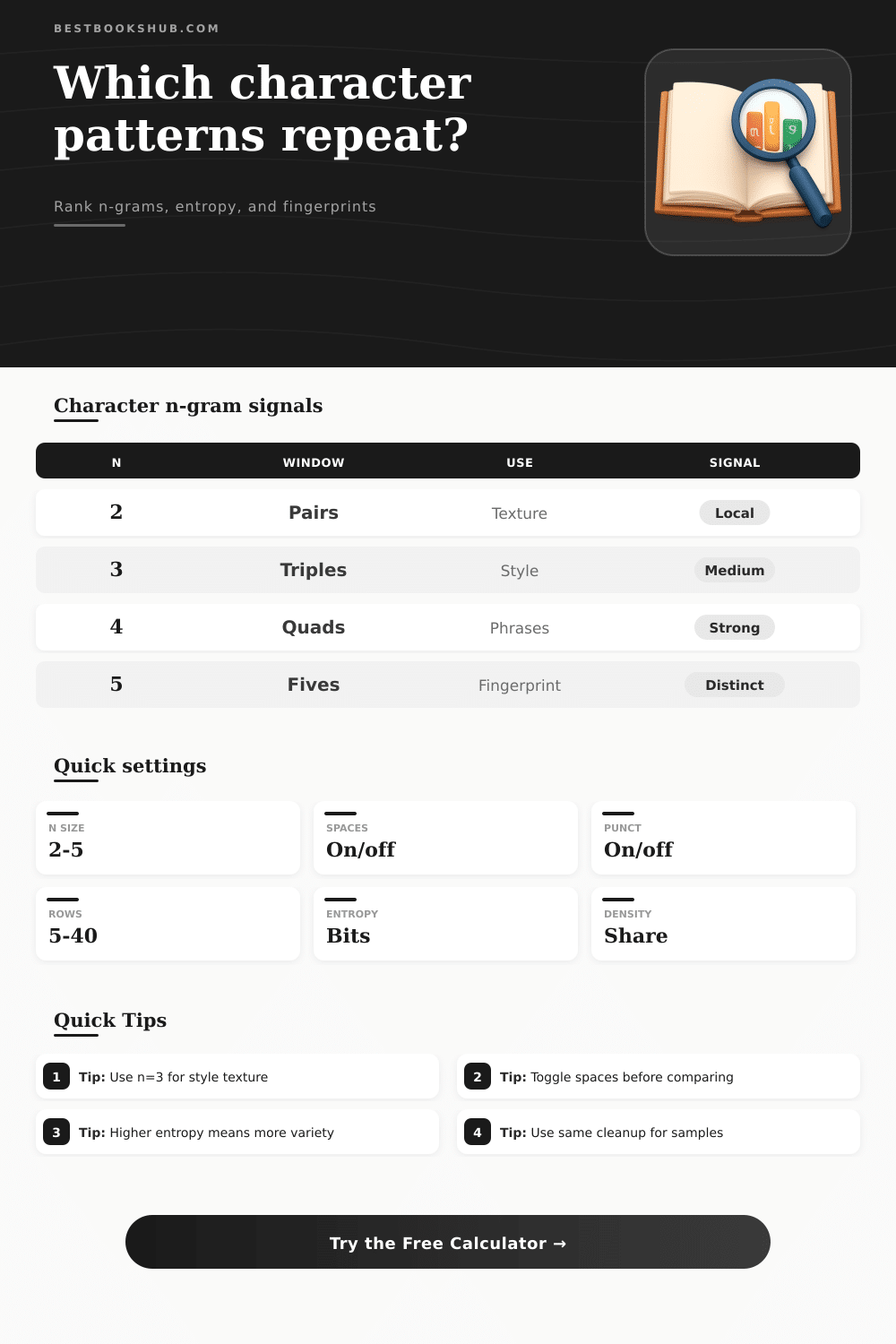
| 2 | Two characters | Texture check | Spacing, letter joins, punctuation habits |
| 3 | Three characters | Style scan | Common endings, prefixes, and rhythm |
| 4 | Four characters | Phrase hints | Fragments such as tion, ing plus space |
| 5 | Five characters | Fingerprint | Recurring stems and sample-specific markers |
| Entropy band | Typical feel | Density pattern | Review note |
|---|---|---|---|
| Low | Repetitive | Few patterns dominate | Check echoes, lists, or templates |
| Medium | Balanced | Top patterns visible | Usually normal prose texture |
| High | Varied | Longer tail of patterns | Good for mixed or rich samples |
| Very high | Fragmented | Many rare patterns | May be short, noisy, or multilingual |
| Toggle | When on | When off | Use for comparison |
|---|---|---|---|
| Spaces | Shows word-boundary rhythm | Focuses on letters only | Keep the same choice across samples |
| Punctuation | Captures dialogue and OCR marks | Removes formatting noise | Use punctuation on technical exports |
| Digits | Tracks codes and years | Cleaner prose profile | Tag digits for catalog IDs |
| Boundaries | Avoids cross-line artifacts | Gives maximum continuous windows | Use line mode for title stacks |
Punctuation: Tune it. Spaces: Tune it. Use a character n-gram analyzer to rank the most used 2-5 character patterns. The idea is that you use this tool to compare densities, read entropy, and build something like a compact language fingerprint using character patterns.
Character patterns are out there in plain sight, in products catalogs, in email threads, or novels. On their own, you’ll never think the letter combination “ing ” or “the” is of any importance…yet those microscopic habits create voice and rhythm. Once you begin noticing those clusters, you want a tool that helps you count these sliding windows.
How Small Letter Patterns Show Writing Style
After writing thousands of sentences, a writer’s muscle memory will create automatic sequence of letters. More so than nonfiction, dialogue writers relies on question marks and contractions. Technical documentation repeat numeric tags and fixed prefixes until it reads like a template. They’re more than just stylistic flourishes; they’re structural: Punctuation shifts or changes the pattern in the landscape. Consistency from sample to sample are important since these little details form entire structure.
What this shows is text through a different window: longer or shorter. With two-character pairs, you learn simple texture, like which letters join together and which ones are frequently followed by a space, or a comma. With three characters, you’re seeing the beginnings of true style: the most frequent prefixes, and common letter endings. At four characters, you start getting the sense of phrases. At five characters, you know it’s a document even before you read words.
As you go up, each increment zooms tighter… Making signal clearer. The text structure quietly tells a story of its own: entropy. The calculator show that low entropy means repetition dominates sample. That’s often what comes from lists and highly templated writing, repetition after repetition. High entropy spreads the probability around lots of different patterns, typicaly meaning noisy text or richer prose. It’s an abstract number, but compare a few passages and you’ll get a sense of what it show.
The punctuation and spaces become unseen controls for the analysis. Leaving the spaces in data reveals word-boundary habits. For example, it shows how often ” th” starts words. Removing the spaces zeroes in on letter combinations alone; showing us stylized DNA that goes beyond word boundaries. Similarly, leaving commas and question marks in place gives dialogue-heavy text a different signature. Because technical exports tend to use specific placement of brackets and colons as markers, there presence also shows itself in this way. There’s no right or wrong, only whichever lens best matches what you’re trying to ask.
But then you play with it and you start seeing real world use cases. Editors find unconscious tics in their own writing. Forensic linguists does the same thing when comparing ransom notes. Catalog managers will export and run it through analyzer to identify field labels that is repetitive noise. Language learners also find these metrics tell them how native patterns bleed into their second language.
And data tells the truth. There is no way to trick the patterns. They just don’t lie. But that’s where the numbers only get you so far, it’s all about intent and context. When you interpret the results, human judgment remain firmly at the wheel. Redundancy may signal terrible writing in a memo, but could also be brilliant repetition in a poem. The tool is not taste, and it doesn’t replace it; instead, it gives you a microscope so you can stop guessing.
Each text has its own subtle signature: two to five characters long, and written in overlapping windows. Most of us don’t even see them, but once you do the page looks different.