📖 Paragraph readability lab
Reading ease by paragraph calculator
Paste a draft to split it into paragraphs, calculate Flesch Reading Ease for each paragraph, and find the easiest, hardest, most uneven, and off-target sections.
Load a realistic passage, then adjust paragraph splitting, sentence detection, syllable handling, target bands, and minimum paragraph size.
DISCLOSURE: This post may contain affiliate links, meaning when you click the links and make a purchase, I receive a commission. As an Amazon Associate I earn from qualifying purchases.
The first table ranks paragraphs by the selected order. The second table highlights easiest and hardest sections plus target-band distance.
| Paragraph | Flesch ease | Band | Words | Sentences | Syllables | W/S | Syl/W | Flag |
|---|---|---|---|---|---|---|---|---|
| Load a preset to calculate paragraph metrics. | ||||||||
| Signal | Paragraph | Score | Distance | Main driver | Preview |
|---|---|---|---|---|---|
| Hardest and easiest paragraph signals appear after analysis. | |||||
| Flesch Reading Ease | Band name | Typical reader signal | Paragraph action |
|---|---|---|---|
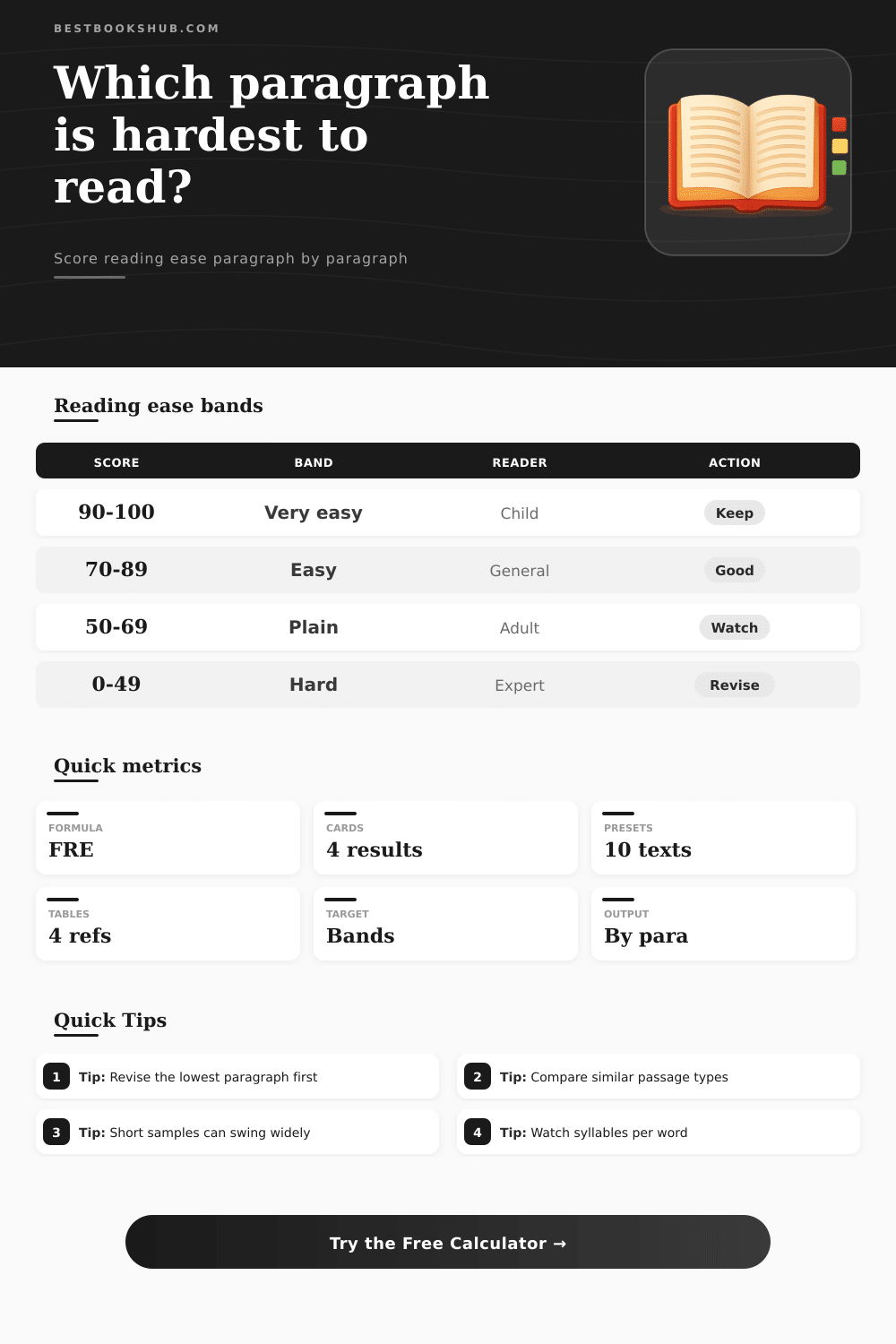
| 90 to 100 | Very easy | Simple words and short sentences | Good for early readers, notices, or quick help |
| 80 to 89 | Easy | Comfortable general reading | Usually keep unless tone is too simple |
| 70 to 79 | Fairly easy | Clear public-facing prose | Good web, newsletter, and book-club range |
| 60 to 69 | Plain | Standard adult readability | Watch long sentences and technical terms |
| 50 to 59 | Fairly hard | Dense adult prose | Revise if broad access matters |
| 30 to 49 | Difficult | College or specialist load | Split sentences or explain terms |
| 0 to 29 | Very hard | Academic, legal, or technical pressure | Rewrite first if it is not specialist text |
| Control | Default | What it changes | When to adjust |
|---|---|---|---|
| Paragraph split mode | Blank lines | Defines the paragraph units to score | Use line mode for pasted newsletter blocks |
| Sentence detection | Punctuation | Defines words per sentence | Use hybrid mode for bullets or fragments |
| Syllable style | Standard | Defines syllables per word | Use strict mode for sensitivity checks |
| Minimum words | 8 words | Filters headings and tiny fragments | Lower it when short paragraphs are intentional |
| Paragraph pattern | Common score driver | Metric to inspect | Revision cue |
|---|---|---|---|
| Long explanatory paragraph | High words per sentence | W/S above 24 | Split clauses before changing vocabulary |
| Technical paragraph | High syllables per word | Syl/W above 1.65 | Define terms or swap dense nouns |
| Dialogue paragraph | Short sentences | W/S below 10 | Usually easy; check rhythm, not score alone |
| Summary paragraph | Mixed sentence lengths | Variance from passage average | Use as a bridge between harder sections |
| Use case | Practical target | Variance goal | Paragraph review priority |
|---|---|---|---|
| Early reader passage | 90 to 100 | Low spread | Any paragraph below 85 |
| General web article | 70 to 89 | Moderate spread | Paragraphs below 60 |
| Book review | 60 to 79 | Moderate spread | Outlier paragraph first |
| Academic abstract | 30 to 59 | Controlled spread | Paragraphs under 30 if public-facing |
This reading ease by paragraph calculator lets you see sentence/syllable metrics, find difficult sections, check balance of your paragraphs, and edit your draft more quickley. Maybe you’ve read something before that flows nicely for several paragraphs. Then you hit a thick section of text where you lose track. Your eyes glaze over and you start reading fast and skipping around.
Usually, it’s not because of the whole thing; it’s usually because of some one stubborn paragraph that require much more work to get through than surrounding ones. So how does readability change things? Because now instead of a number that hides trouble areas, you can actualy see them on an exact paragraph by paragraph basis.
Why Checking Each Paragraph Is Important
While the Flesch Reading Ease is a formula dating back to the 1940s, few people use it on individual paragraphs; instead they treats entire pages at once. That’s missing the point. Sure, your average for a report may come in comfortabley at 68, but what happens if third paragraph scores 31, and the others are all in the seventies? You’ve just erected an invisible barrier. People don’t read averages. They read one paragraph at a time.
When we look at it this way, breaking up the text into its pieces, we see the difference that actualy affects our understanding. The levers that pull on each score is sentence length and word complexity. Heavier drag comes from long sentences loaded with many-syllable words. But context is important too. Fictional dialogue will likely produce more sentences and a higher score different than a legal notice with the same rhythm.
The calculator offers different ways to count syllables and split up sentences based off what you want out of the text in real life. Sometimes writers just find one number to aim at, and then they’re done. Wrong! What you want is for your text to be consistent within some kind of reasonable range. A children’s book should remains extremely accessible from almost every paragraph. A newsletter with some thought involved can vary moderately as long as no single paragraph fall into difficult waters.
What do you have to figure out: Which are the bridge paragraphs? And which are carrying the load? The latter tend to require most care. Be aware of syllables per word: Pay extra attention to this one. Writers consistently undervalue it. Words such as “methodology,” “facilitation” and “utilization” can piles on fast. Maybe you need one or two. If six pop up within a paragraph (even with relatively brief sentences), then you’re in trouble.
Conversely, if your marketing copy swings too high, readers may feel they’re being talked down to. Readers find themselves feeling talked-down-to when every paragraph rate high-ninety something. Keep things balanced. In reality, real documents don’t look like this… And they shouldn’t. You want a policy document with a warm welcome to the reader followed by hard-and-fast detail. With an academic abstract, you have the benefit of knowing your audience will be prepared for more complex wording. It’s about being deliberate: not having complexity pile up by chance.
When you’ve identified the one paragraph furthest off track from your desired range, you’re able to revise selectively, no longer blindly guessing at changes. When I edit, I start with bottom score. Almost every time, that’s where you’ll find the spot where something has gone wrong and needs fixing. And sometimes all it takes is dividing a long sentence into two shorter ones. Or you can substitute a series of academic-sounding nouns for some more straightforward versions.
You’re allowed to maintain those tricky words because you know from the context around them that they’ve got momentum on their side. Once you get to see the context, it’s your friend. The way the story changes tell a different story. Even though mean may be decent, scores will go up and down like a roller coaster. It’s a jarring effect that makes it feel like the piece doesn’t flow. Smooth that out and whole draft seems much more professional. Paragraphs goes together rather than competing with each other to get reader’s attention.
A high readability score doesn’t indicate that you’re dumbing down your ideas. It indicates that you’ve removed any unnecessary friction so that the ideas themselves can land with full force. If one of your paragraphs scores too low, don’t worry: That’s not a sign that your thinking is flawed. It simply indicates that the paragraph could of use some polishing. Identify the rough spots early, work on them thoughtfully, and entire piece will flow better. Nobody, least of all your readers, will ever recieve just how much effort you put into making it feel effortless. And that is exactly how it should be.