📖 Chapter length statistics
Chapter Length Consistency Analyzer
Paste a chapter word-count list to calculate mean, median, standard deviation, coefficient of variation, outlier chapters, pacing range, genre targets, and a consistency score.
Each preset uses word-count-only patterns. This analyzer does not score scenes, hooks, beats, or plot pace; it focuses on length consistency and genre-length fit.
DISCLOSURE: This post may contain affiliate links, meaning when you click the links and make a purchase, I receive a commission. As an Amazon Associate I earn from qualifying purchases.
The first two tables update from your draft. Reference tables below stay fixed so you can compare your statistics with common genre-length targets.
| Chapter | Words | Vs center | Z-score | Status | Range position |
|---|
| Flagged chapter | Words | Reason | Distance | Revision check |
|---|
| Genre target | Typical words/chapter | Preferred CV | Range style | Consistency note |
|---|---|---|---|---|
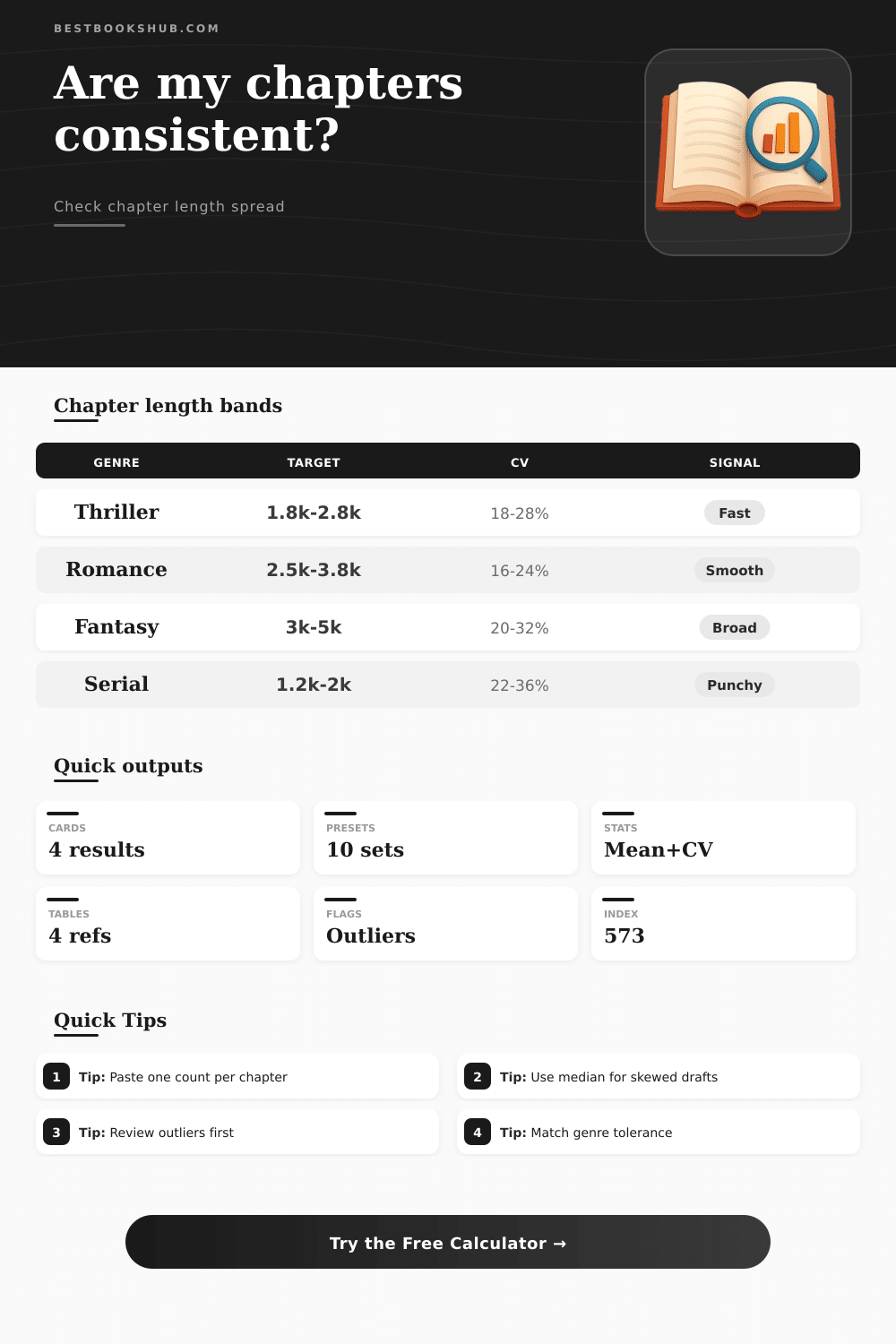
| Thriller, suspense, horror | 1,800-2,800 | 18-28% | Tight to brisk | Shorter chapters can vary, but spikes stand out fast. |
| Romance and commercial fiction | 2,500-3,800 | 16-24% | Smooth | Readers expect emotional beats without abrupt chapter bulk. |
| Fantasy or historical novel | 3,000-5,000 | 20-32% | Broad | Worldbuilding allows roomier chapters if variance feels patterned. |
| Literary or upmarket novel | 3,200-5,500 | 18-30% | Flexible | Length variety can work when structural intent is clear. |
| Young adult novel | 1,800-3,000 | 18-28% | Controlled | Keep length changes readable across school and commute sessions. |
| Middle grade fiction | 1,200-2,400 | 14-24% | Clear | Large outliers may feel more noticeable to younger readers. |
| Serial web novel | 1,200-2,000 | 22-36% | Episode-sized | Installments can flex, but reliable range supports habit reading. |
| Memoir or narrative nonfiction | 2,800-5,200 | 18-30% | Segmented | Scene and reflection chapters can differ if transitions are clean. |
| Practical nonfiction | 3,500-7,000 | 15-26% | Instructional | Readers benefit from predictable section load. |
| Statistic | Formula idea | Low value means | High value means |
|---|---|---|---|
| Mean | Total words divided by chapters | Short average chapter length | Long average chapter length |
| Median | Middle chapter after sorting | Typical chapter is short | Typical chapter is long |
| Standard deviation | Average distance from the mean | Chapters cluster tightly | Chapters spread widely |
| Coefficient of variation | Stdev divided by mean | Stable chapter sizing | Noticeable length swings |
| IQR fence | Quartile spread test | Few statistical extremes | Possible structural outliers |
This chapter length consistency analyzer will show you genre targets, center statistics, outlier, pacing range, word count for each chapter, as well as overall consistency (coefficient of variation). Use it to see where your manuscript is divided up in sections. The system will give you data on the rhythm and flow so that you can balance out any uneven chapters.
A consistent chapter length allow you to control the feeling of pace within the reader. Even if you have good writing, when the chapter lengths swing wildly with no real artistic cause than the momentum of the story suffers.
Why Chapter Length Matters
This is what they do. They show you what your numbers say. Drop them into analyzer and the calculator instantly spits out mean and median. Together, these two numbers simply tell a story about skew in the data. When the mean’s far above the median, that’s a sign there might be a couple of particularly long chapters pulling up the average. This can be a common sign that you’ve got some world-building or backstory that has grown into a couple of chapter that are overdoing it. It’s not judgmental; the calculator just surface it. For writers, though, it means: those chapters might benefit from being split or pruned to keep the breath of the narrative constant.
But here’s why Coefficient of Variation (CV) is better: It normalizes spread against your typical chapter size. If you’re writing a fast-paced thriller, you can’t afford as much variation in word count as if you were writing sprawling fantasy which gives reader time to breathe between chapters. Using the tool, you’ll define your genre-specific CV target. Hit a low number and you know you’ve got a manuscript whose skeleton is working with you instead of against you. Go over and length swings draw attention to themselves instead of the plot itself.
The author should pay particular attention to outliers. A single chapter that’s 30% longer or shorter than all those around it hardly escapes readers’ notice. Maybe it’s the climactic sequence you couldn’t bear to cut up into digestible beats; maybe it’s your prologue, disguised as chapter one. The analyzer identifies them through various ways of looking at statistics, and then lets you choose: Do these departures support the story, or just interrupt its flow?
In most successful novels, most chapters cluster within a recognizable band with purposeful exceptions at turning points. Another wrinkle is that genre has a role here too. In commercial romance, people expects chapters of similar size and want their emotional beats to hit at an expected rhythm. In fantasy, where world-building chapters can be longer than dialogue-heavy ones, people are willing to cut slack on wider spreads because they understand the naturaly lengthening involved.
These aren’t the rules of any book. Instead, they are patterns laid out on page as reference tables to help you see if your draft stays within the comfort zone of its audience or strays so far outside that it might look amateur. And they do tend to spot some common errors with alarming frequency.
One new writer was surprised her first chapter was far shorter than normal because she thought it would catch the reader quickly. She later found her whole manuscript felt front-loaded. Another saved his greatest chapter for last, and ended up writing an overlong climax that rushed all other part. With a quick glance, the analyzer will show such structural imbalances, so you can focus instead on whether they’re intentional craft choices or unintentional drifts from form.
But all of this gets to the heart of consistent chapter lengths: managing audience expectations. As readers make their way down the page they find a rhythm, a comfortabley stride, to their reading pace. Breaking that rhythm makes the reader lose trust. So run your draft through the numbers. See what comes out. Then determine which variations advance the story and which ones just need fixing. A steady hand on length doesn’t write the book for you, but it will keep those pages turning exactly as they should of.