📖 Draft rhythm analyzer
Scene Length Balance Calculator
Paste a scene word-count list to measure average, median, range, short and long scene flags, act and sequence balance, dialogue/action weighting, and an overall rhythm score.
Use these tables to see which scenes are flagged, how acts or sequences are loaded, and how common style bands interpret scene-length variation.
| Scene | Words | Difference vs avg | Flag | Use in revision |
|---|---|---|---|---|
| Run the calculator to list scene flags. | ||||
| Act / sequence | Scenes | Words | Share | Balance signal |
|---|---|---|---|---|
| Run the calculator to see act balance. | ||||
| Draft style | Usual scene band | Healthy variation | Common outlier use | Watch point |
|---|---|---|---|---|
| Thriller / suspense | 700-1,700 words | Short bursts | Chase, clue, reversal | Too many tiny fragments can blur stakes. |
| Romance / commercial | 1,000-2,600 words | Moderate pulses | Emotional turn, argument, reveal | Long talk scenes still need a clear shift. |
| Fantasy / sci-fi | 1,400-3,600 words | Wide but tracked | Travel, combat, world turn | Watch mid-act weight and exposition drag. |
| Literary / interior | 1,800-4,500 words | Roomier arcs | Memory, interior crisis, frame shift | Long scenes need visible internal movement. |
| Serial web fiction | 600-1,600 words | Hook driven | Installment cliff, reveal, tag | Uniform shortness can flatten texture. |
| Metric | Green signal | Review signal | Revision meaning |
|---|---|---|---|
| Average vs median gap | 0-12% | 20%+ | Large gap means a few scenes are pulling the draft off center. |
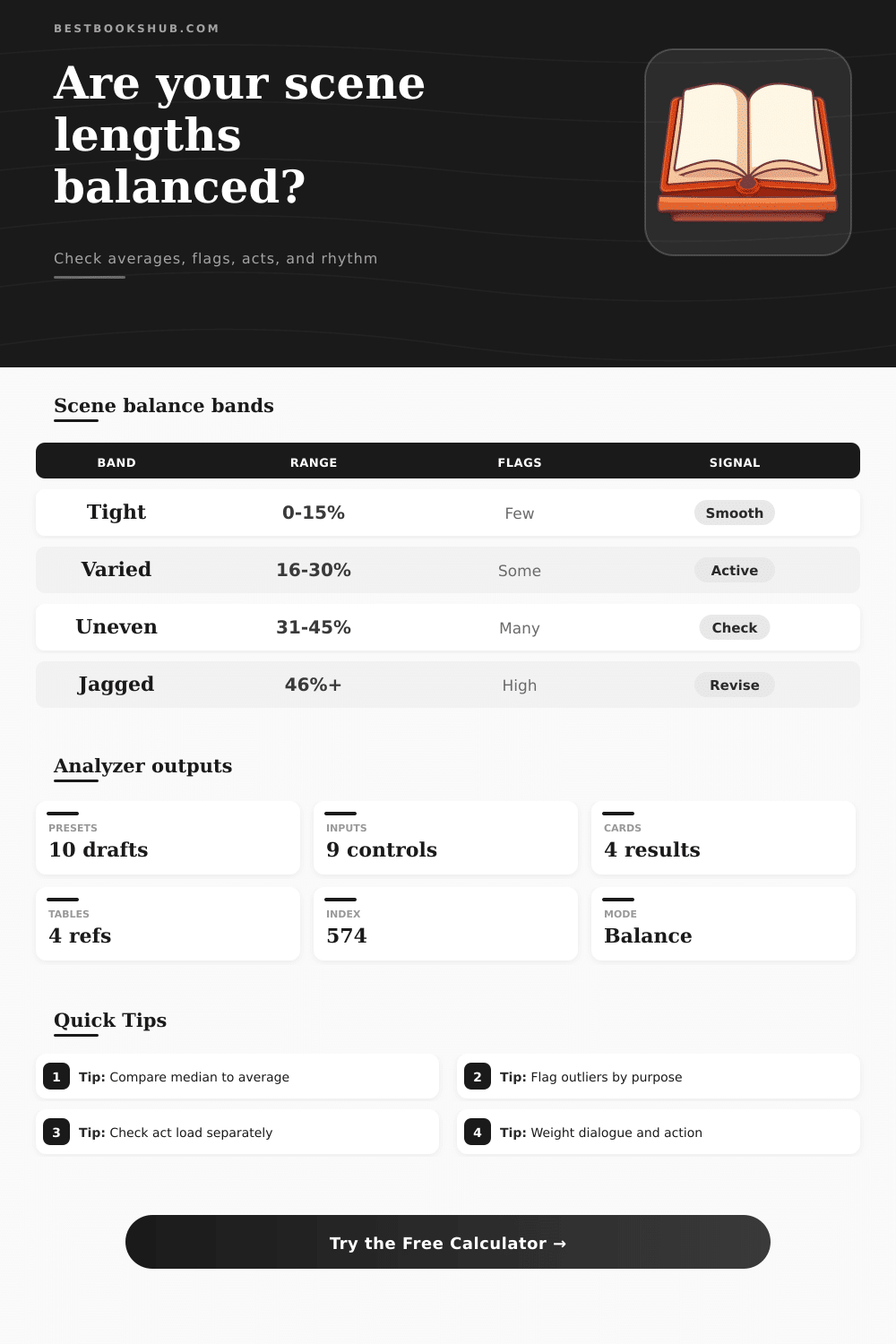
| Coefficient of variation | 0-30% | 45%+ | Higher values mean a jagged scene-length rhythm. |
| Short or long flags | Under 20% | Over 35% | Many flags are fine only when they match scene purpose. |
| Act word share gap | Under 12% | Over 20% | One act may be bloated or under-developed. |
| Texture fit | 0-10% off | 25%+ off | Dialogue and action choices may justify shorter targets. |
DISCLOSURE: This post may contain affiliate links, meaning when you click the links and make a purchase, I receive a commission. As an Amazon Associate I earn from qualifying purchases.
To audit your manuscript, try out this scene length balance calculator. It checks your scenes’ word count distribution by measuring weight of each act. The tool will then identify any long or short outliers, examine texture of action and dialogue, and help you find a revision rhythm that improves pacing.
But how do you know if your story’s off? It might be dragging in certain spots and snapping suddeny in others. The emotional beats aren’t hitting as hard as they should of. In most cases, there’s usually a tell in the numbers (not on the page). The scenes has an uneven rhythm because their lengths vary so much. The word counts goes from 800-word sprints to 4,000-word marathons. That’s uneven. And when you see the pattern clearly, than you fix it.
Fix Your Story Pacing with Scene Lengths
How do you manage reader energy and expectation? By managing scene length. If every scene have the same number of words, your story sounds like a machine. Too much variation makes for whiplash in the reader, who must wade through pages of thick description one minute, then skim breezy dialogue the next. The sweet spot is deliberate variation. Short scenes offers punch or breath, while long ones provide space to let tension grow or character unfold. These variations supports rather than fight the story.
What’s normal? That depends on your genre. Literary fiction spends thousands of words inside someone’s head; thrillers cut tight so our hearts race. Romance falls between: we’ll have some conversation and internal understanding sharing page space. YA reads faster different than adult fantasy (because fantasy is okay with sprawling world-building scenes). These are all jumping-off points for why the exact same list of scene lengths might feel chaotic on one manuscript but balanced on another.
And this brings us back to raw length vs. This refers to texture. Even if two scene are equal in terms of words, a dialogue-heavy scene will read faster than an interior-thought/action-packed scene. Quick dialogue provides white space that flies by the eyes, while quiet interior moments slows down and ask the reader to do the same. Adjusting for these textures can reveal whether you’ve got the right scene lengths for the experience you wish to create. And this is often where the true surprise happen.
Here’s another secret to reading your draft: check balance of your acts. Sixty percent of your words may have gone into Act Two, because many writers throw their energy there, leaving start and finish of the story feeling starved. The result: a sagging middle that can’t entirely be fixed through line editing. Compare each section with the overall draft. How much do they builds on what came before? Where were you attending in the work? The space between acts will tell a tale.
Cuts are not automatic. Pay special attention to outliers. There may be one 400-word scene that is precisely what’s needed because it follows a long build up and allows the reader to make a realization. A 5,000-word chapter may wrap several thread together nicely and therefore be worth it. The question of purpose always applies here. Is this scene necessary? Is it bloated with unneccesary detail or does the length serve the beat? Once you have flagged all your outliers and justified their existence, most manuscript will see dramatic improvement.
If you notice a sizable gap between your book’s median and average scene length, that can be another tell. If there’s a tight cluster around these figures, then the draft have a solid center of gravity. But if there’s a big spread between them, it means that a few monster scenes has thrown off the whole feel of the book. You find yourself rereading chapters and asking why story seems to stall out. More often than not, the numbers alert you to this first.
The less you guess, the more precise your revision will be. You’ll have solid locations to examine instead of an overall sense that something is off in pacing. Split some scenes. Tighten others. Merge some. Clarify purpose for a couple, and their length won’t feel arbitrary anymore. The story doesn’t want metronomic precision; it wants rhythm. It needs a rush of action after a moment of holding its breath.
A perfectly balanced book doesn’t necessarily mean it’s a great one. Voice and character matter more than any spreadsheet. There are also still stakes to consider. But when the overall beat gets it right, then those aspects stands out even more. It’s like the book is no longer fighting you, but instead pulling you along at just the right speed. And it’s worth every careful calculation to get there.