📖 Serial release planner
Serialized Chapter Split Calculator
Split a manuscript into release-ready episodes with target installment length, chapter boundary respect, recap allowance, cliffhanger buffer, cadence, batch cushion, and a visible episode plan.
Load a realistic serial format, then tune the target length, release cadence, cliffhanger room, recap allowance, and chapter-boundary behavior.
DISCLOSURE: This post may contain affiliate links, meaning when you click the links and make a purchase, I receive a commission. As an Amazon Associate I earn from qualifying purchases.
The dynamic tables use your inputs to draft an episode list and arc distribution. Static reference tables show common serial lengths and release choices.
| Episode | Story words | Release words | Source chapters | Hook placement | Split note |
|---|---|---|---|---|---|
| Run the calculator to generate episode rows. | |||||
| Arc segment | Episodes | Story words | Release weeks | Purpose |
|---|---|---|---|---|
| Run the calculator to generate arc rows. | ||||
| Serial format | Episode words | Typical cadence | Best fit | Watch point |
|---|---|---|---|---|
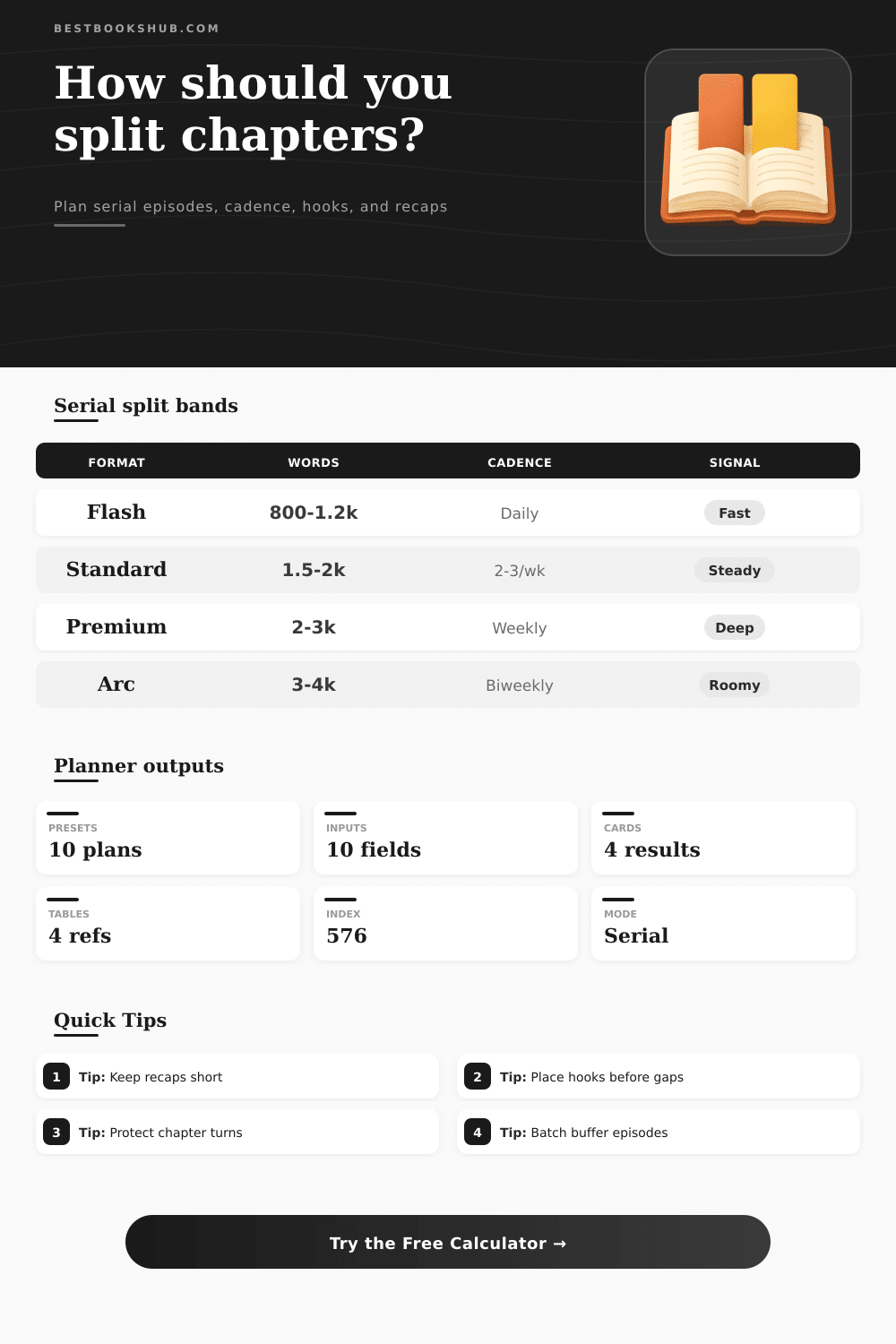
| Daily flash serial | 800-1,200 | 5-7 per week | Fast mobile reading | Recaps can overwhelm short episodes. |
| Standard web novel | 1,500-2,200 | 2-5 per week | Habit readers | Keep payoff frequent and clean. |
| Premium weekly drop | 2,500-3,500 | Weekly | Patron or newsletter releases | Long gaps need stronger reminders. |
| Arc episode | 3,000-4,500 | Biweekly | Dense fantasy or mystery arcs | Use internal scene turns, not only one end hook. |
| Cadence | Episodes/month | Good buffer | Recap range | Planning signal |
|---|---|---|---|---|
| Daily | 28-30 | 14+ episodes | 0-80 words | High production pressure. |
| 3 per week | 12-13 | 6-10 episodes | 50-150 words | Strong habit cadence. |
| Weekly | 4-5 | 4-6 episodes | 100-250 words | Needs clear previous-thread reminders. |
| Biweekly | 2-3 | 3-5 episodes | 150-350 words | Use larger episodes or richer recaps. |
This serialized chapter split calculator use manuscript words, chapters, timing, recaps, and cliffhanger room to create episode counts, split rows, release spans, and arc segments. Serializing mean you’re under a certain amount of pressure. You write the damn thing, turn in the final draft, look at the manuscript, and see what? What’s left is hard part. Instead of worrying about whether the story hold together on the page, now you have to worry about whether it can hold up against being sliced and diced into bitesized chunks.
These chunk must make an audience return for more week after week or, if you’ve got big ambitions, day after day. That’s where the tension come from. Split too much, and you run the risk of shattering momentum. Split too little, and you run the risk of losing those who hunger for a regular fix.
The Hard Work of Writing Series
It seems like a no-brainer, but then you do it and suddenly there’s an equation for the word count per episode vs. You have to consider the attention span of the reader. You also has to figure out how many episodes to keep in reserve for sickness, family emergencies, or bad writing days. If you miss a beat or talk down to them by recapping too much, you break your momentum. You lose what you built up and become just another unfinished project.
These aren’t artistic questions anymore; they’re production questions that determine whether your story builds a habit or becomes another abandoned project. It’s making product. Serialization is a trickster’s art because every decision have ripple effects. Go long on premium drops and you get richer scenes, but need better hooks and cleverer remembrances to bridge the gaps between releases. Go short and you maximize flexibility (but sacrifice some depth).
While you’re wrangling your creativity, let the calculator do math. Translate your desired release rhythm into actual episode targets by plugging in your original chapter count and total words. No more spreadsheeting in your head.
The bottom line is that a steady flow of content builds loyalty with readers… Far more than most writers appreciate. A few flashes daily create addictive little dopamine loops but require iron discipline and minimal recaps. Once weekly (or “premium”) drops let you write some meaty scenes while testing if you can tell stories compelling enough to hold readers for seven days at a time. Often, it’s somewhere in-between: roughly three releases per week, where habituation sets in before burnout. Most people don’t realize this until they see the drop-off on their analytics.
There is a quieter trap in recaps. On an extended release schedule, those “previously on” sentences are hard to do without. But they consume valuable real estate. Under a hundred words, they serve as gentle memory joggers. Over two hundred, and they begin to water down what comes next. Ideally, fold reminders into action where it makes sense because readers can follow along better than we think.
The same goes for cliffhangers. You don’t have to close every episode with a gasp-inducing revelation. Some of the best serial turns cut just before a moment of realization or decision, one that will reverse and change the meaning of all that came before it. Forcing drama into every single installment typicaly backfires. Readers will smell desperation.
And there’s another wrinkle: Arc planning. Three acts? Four movements? Eight distinct sequences? Whatever you’re planning for, those chunks has to fit on your release calendar and they each have to hold up their own emotional weight. Maybe the first fifteen percent can be a strong hook. The middle is where the reversal has to land, when readers are invested but not yet exhausted. Nail down these proportions and what was just a chapter split feels intentional.
The art lies in shielding those inherent turns in the story without chaining yourself to the story’s natural boundaries. In fact sometimes the optimal place for an episode break is right in the middle of what would of been one chapter. At other times it’s holding onto a tidy chapter end so that an emotional beat can take its time to land. You’ll be able to try all this out fast and see whether varying levels of respecting the boundaries changes your expected release timeline/episode number.
I can’t stress enough how important buffer episodes is for beginning serial writers. They’re not dead weight, they’re insurance against real life. Having six episodes in the bank might seem like overkill when nothing ever goes wrong, but then there’s that week where everything go wrong. Then it becomes the difference between a professional schedule and another broken promise to your audience.
In short, serialization is better served by writers who consider their release schedule as part of the craft and not an afterthought. The numbers gives you structure. Structure. Making each cut seem inevitable instead of calculated: that’s still the art. If you do it well enough, nobody notices the machinery. All they see is the story, pulling them forward, one perfect installment at a time.