📝 Fixed-form poem validator
Villanelle Structure Checker
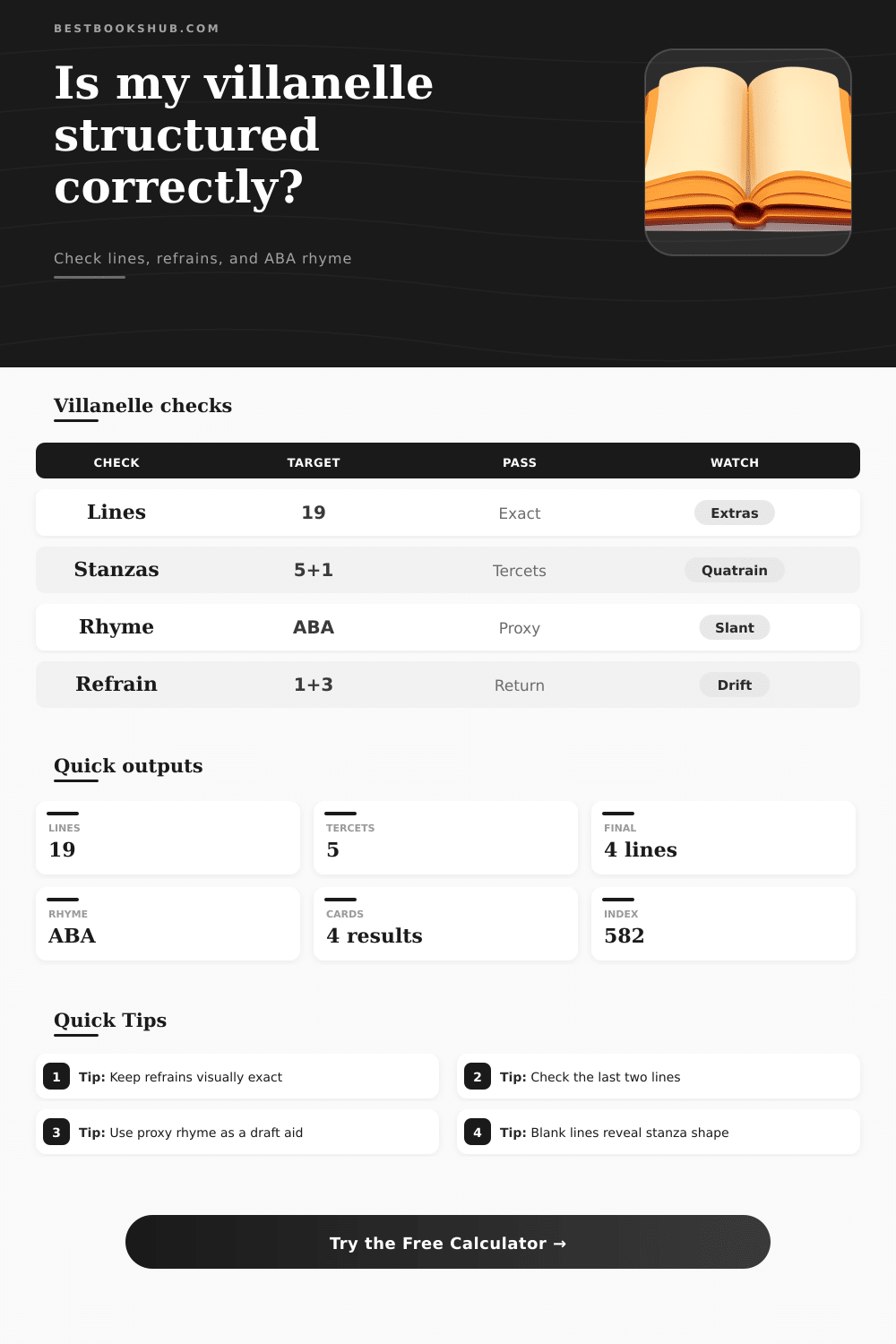
Paste a draft to check the classic 19-line villanelle frame: five tercets, one closing quatrain, ABA rhyme proxy, alternating refrains, final couplet, and a line-by-line stanza map.
These original samples are built to test strict structure, slant endings, refrain drift, missing lines, extra lines, stanza spacing, and final-couplet placement.
DISCLOSURE: This post may contain affiliate links, meaning when you click the links and make a purchase, I receive a commission. As an Amazon Associate I earn from qualifying purchases.
This dynamic map marks the expected villanelle role for each line, the detected end-rhyme key, whether the refrain matches, and any issue that should be revised.
| Line | Expected role | End word | Rhyme key | Refrain check | Line preview |
|---|---|---|---|---|---|
| Run the checker to build the stanza map. | |||||
| Stanza | Line count | Expected pattern | Refrain position | Checker focus |
|---|---|---|---|---|
| 1 | 3 | A1 / B / A2 | Lines 1 and 3 define refrains | Stores both refrain texts and A rhyme keys |
| 2 | 3 | A / B / A1 | Line 6 repeats line 1 | Checks first returning refrain |
| 3 | 3 | A / B / A2 | Line 9 repeats line 3 | Checks alternate refrain return |
| 4 | 3 | A / B / A1 | Line 12 repeats line 1 | Checks continued alternation |
| 5 | 3 | A / B / A2 | Line 15 repeats line 3 | Checks final tercet return |
| 6 | 4 | A / B / A1 / A2 | Lines 18 and 19 close together | Checks final couplet placement |
| Method | What it compares | Best use | Limitation |
|---|---|---|---|
| Last letters | Final 2 to 5 letters of the last word | Fast review of clean end rhyme | Misses pronunciation differences |
| Vowel group | Final vowel cluster plus the consonant tail | Slant rhyme and softer lyric drafts | Can group unrelated sounds |
| Loose tail | Simplified consonant and vowel tail | Early workshop drafts with rough rhymes | More forgiving than formal scansion |
| Exact word | The whole normalized final word | Testing repeated end words only | Too strict for most poems |
| Problem | Likely signal | Where to inspect | Revision move |
|---|---|---|---|
| Line count drift | Not exactly 19 nonblank lines | Whole draft | Add or remove lines before tuning rhyme |
| Broken tercets | Stanza sizes are not 3,3,3,3,3,4 | Blank-line breaks | Re-space stanzas or restore missing lines |
| Weak refrain return | Expected A1 or A2 line has low similarity | Lines 6, 9, 12, 15, 18, 19 | Make purposeful variation or restore exact line |
| Final couplet error | Lines 18 and 19 do not close with A1 then A2 | Final quatrain | Place both refrains at the end in order |
| Mixed rhyme sets | A or B roles show several rhyme keys | End words table | Revise end words before revising interiors |
One of poetry’s most unforgiving forms is the villanelle: nineteen lines, five tercet plus a quatrain, with two refrains that switch sides. It uses an ABA rhyme scheme that does not collapse into sing-song meter, making it a poem whose scaffolding hold without sagging. Write it right and the poem seems inevitable, write it wrong and you’ve got the whole thing sagging. No wonder a structure checker become your friend as you begin to feel that draft slipperiness.
The tool is a measure of things your ear will not hear when you come back to revise. You paste in the poem, and it shows how your lines matches the pattern of a classic one. These are A1, B, A2, and the returns at lines six, nine, twelve, and fifteen. It end with a final rhyming pair. Did it check? The tool isn’t just counting lines. Does the repetition sound as though it’s hitting the same emotional note again? Or have they drifted off so much that now it’s two separate idea in the same clothes?
How to Use a Tool for Writing Villanelles
Elizabeth Bishop and Dylan Thomas are the go-to examples for most poets, who figure out that the trick is rhyming. More often than not, though, the trap is easier to fall into. The problem is when you get lost counting stanzas as you scramble for a better metaphor. Or when the last quatrain spill over into a sixth line because there’s no way to make the thought obey. There’s no emotion behind these flags; just a calculator telling you what shape your poem’s taken on instead of the one you’d designed. It’s kind of sobering the first time you see it.
There’s no such thing as textbook-perfect rhyme in English. It’s a living language whose stresses are constantly shifting; its words is full of borrowed sound. That’s where the proxy settings pay off. They allow you to close down the tool so that it insist on exact end-words. Or open up to capture assonance and slant rhymes that hum along anyway. And here’s where it counts: how tight or loose do you set it?
Too tight, and a beautiful near-rhyme. Perhaps one that Bishop herself would of allowed; will get scolded. Too loose, and you risk allowing lazy choices to slip through. The key is to remember that the proxy isn’t the final judge, it’s a diagnostic light. In the end, your ear holds the casting vote.
The same goes for refrain tolerance. Certain writers consider repeated lines to be sacred text, they cannot ever be altered. Other writers tolerate minor syntactical changes: one word swapped out here; a comma added there. The tool will reflect either approach. It will not, however, allow you to pretend a major rewrite remains the original refrain. And that honesty compel better decisions. Restore the line? Or own the variation and make it purposeful?
Workshops are full of repeats. There are poems where a poet writes eighteen lines and calls it close enough, and stanzas whose second refrain is buried in the fourth stanza because that’s where the logic of the poem demand it. Most seriously, they neglect to reunite both refrains in the closing couplet with A1 followed by A2. These aren’t trivial rules. It’s their pressure which make villanelles memorable. Remove them and you lose the coiled energy of the form.
And, however, it’s a form that pays for play. After building your bones, you can bend the image and the tone. Shift the emotional direction in ways that seem like magic. The same repeating lines can shift from grief to irony to acceptance depending on what surrounds them. That transformation isn’t measurable by calculator. The only thing is that the stage was properly built so the performance had somewhere to land.
Run the map it creates. Examine the words it extracts as rhymes. Observe how the rhyme keys gather, and where they spread out. All those little clues frequentaly indicate precisely when the poem has lost its hold on itself. First fix the frame. Next allow the language to breathe within it. A really good villanelle will seem at once tightly engineered and strangely alive. That tension between the two truths is what all the fun in the form are about.
Once you’re through the pain of getting a draft that works, there’s a quiet, deep kind of satisfaction. Two refrains, six stanzas, nineteen lines; they hold together just right, and now the machine tells you so. You can get to work for real. The last step is to make it sing.