📖 Fixed-form poetry checker
Sestina Structure Checker
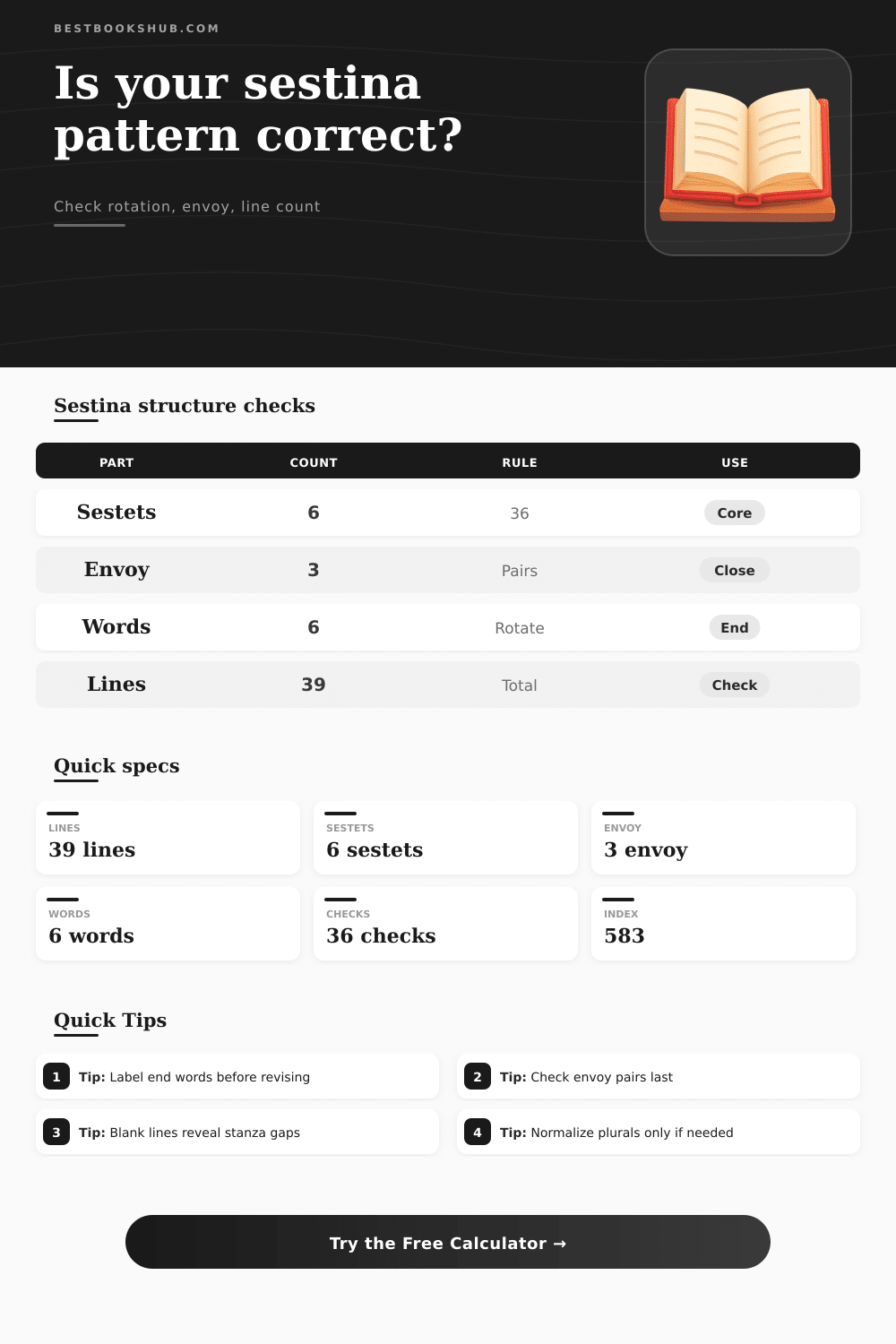
Paste a sestina draft to verify the 6 sestets plus envoy, six end words, retrogradatio cruciata rotation, envoy pair placement, line count, and stanza completeness.
These original drafts include clean, blankless, incomplete, swapped, and envoy-drift examples so the checker can show both passes and repair clues.
DISCLOSURE: This post may contain affiliate links, meaning when you click the links and make a purchase, I receive a commission. As an Amazon Associate I earn from qualifying purchases.
The six seed words are read from the first sestet unless manual words are selected. The checker compares normalized forms but keeps display words visible.
| Stanza | Expected count | Detected count | Completeness | Notes |
|---|---|---|---|---|
| Run the checker to inspect stanza completeness. | ||||
| Line | Section | Expected | Actual end | Status | Preview |
|---|---|---|---|---|---|
| Run the checker to inspect each line ending. | |||||
| Sestet | Numeric pattern | Letter pattern | How to read it | Rotation check |
|---|---|---|---|---|
| 1 | 1 2 3 4 5 6 | A B C D E F | Seed order from first six lines | Starting list |
| 2 | 6 1 5 2 4 3 | F A E B D C | Last, first, next-last pattern | Retrograde turn |
| 3 | 3 6 4 1 2 5 | C F D A B E | Repeat the same permutation | Middle crossing |
| 4 | 5 3 2 6 1 4 | E C B F A D | Carry the spiral forward | Second half |
| 5 | 4 5 1 3 6 2 | D E A C F B | Keep all six words once | No repeats in stanza |
| 6 | 2 4 6 5 3 1 | B D F E C A | Final sestet returns to word 1 | Pre-envoy close |
| Envoy line | Traditional pair | Common placement | Checker option | Purpose |
|---|---|---|---|---|
| 37 | 2 and 5 | Word 2 inside, word 5 ending | Inside + end | Starts the tercet braid |
| 38 | 4 and 3 | Word 4 inside, word 3 ending | Inside + end | Balances middle pair |
| 39 | 6 and 1 | Word 6 inside, word 1 ending | Inside + end | Closes on the first word |
Because it is easy to veer off track if you try to improvise with the form, there is no room for deviation from structure of a sestina. You select your six end words. These should be words that seems fitting for the subject matter, like morning light, river, or stone. Then you write, only to find out that by stanza two, pattern has slipped out of place.
The form looks simple enough on paper, but structure is very rigid. Structure plays an important role in this form like no other fixed form. Get the rotation incorrect and your poem cease to be musically effective. It’s called retrogradatio cruciata; it was a moddern trick, but when you try to write within those limits, it all starts to feel like math.
How to Follow the Sestina Rules
You start by creating an order of your six words (typically numbers 1-6 is assigned to them). Then the second stanza must use sixth word, and continue on precisely along a spiral to ensure no word appear twice in each set of six lines. When you get to the sixth sestet, final words will braid around one another in such a way that is at once surprising and seems meant to be from the start. One misplaced stitch and whole thing falls apart.
There is a website where you can paste a draft and have it checked against calculations for you, pointing out just where it went awry. But it is the envoy that makes such a dramatic difference to the emotional impact of this poem. In this last section of the poem, it use two of the six traditional end words, placing one within line and another at the end.
It is no ornamentation. It is here that core of what the poem means comes into view by turning on itself once more. If you put word pairs in reverse order and place both words at the end of the lines, the closing gesture becomes awkwarder. There are tools available online that allow you to experiment with alternative envoy patterns. You will be able to observe how the tension remains held in poem.
The draft’s architecture, based off blank lines, makes stanza detection easier. Leaving these lines out makes them easy to miscount; instead, including them provide a visual break that fits intended form. Matching rules must be attended to as well. A letter-for-letter check will falsely flag a line as incorrect depending on whether it include punctuation or uses the plural form instead (e.g., “mornings” vs. “morning”). “morning”).
Light normalization can forgiv much minor variations (“morning”/”mornings”) when the context clearly links them, showing the poem’s true health. Many poets nail the first five sestets and then lapse into fatigue with a limp sixth. Others get so caught up in rotation they lose sight of the fact that all these words has to fit together poetically.
Paying close attention to the details is rewarded, but so is paying too much attention with no ear for music. You can get an A+ on all your structural tests and still come up short if the language sounds forced or just plain mechanical. What makes a sestina more than just a complex framework is that as each of the six words reappears it seem to be haunted by memories that refuse to leave.
The form insists that the poet reassesses them, re-angles them from new perspectives, so they take on added emotional meaning every time. At this point, the envoy, these everyday word are more powerful, more meaningful. Writing a poem is the act of making order out of the chaos; the real work comes when you put it aside and use machine to analyze what you’ve done.
You should of run the test. Repair any seams in pattern. Read the poem aloud now: Has the machinery vanished? Does your voice sound through? That’s the only score that matters in the end (the silence following the last line).