📖 Couplets, refrain, rhyme
Ghazal Structure Checker
Paste a ghazal draft to check couplet count, radif or refrain repetition, qafia rhyme proxy, matla first-couplet pattern, optional maqta name marker, and autonomous couplet scores.
These original sample drafts stress strict radif, missing matla, weak qafia, optional maqta, compact English ghazal, and revision-problem cases.
| Couplet | Lines | Radif | Qafia proxy | Score | Diagnostic |
|---|---|---|---|---|---|
| Run the checker to see autonomous couplet scoring. | |||||
| Element | Location | Checker method | Strong signal |
|---|---|---|---|
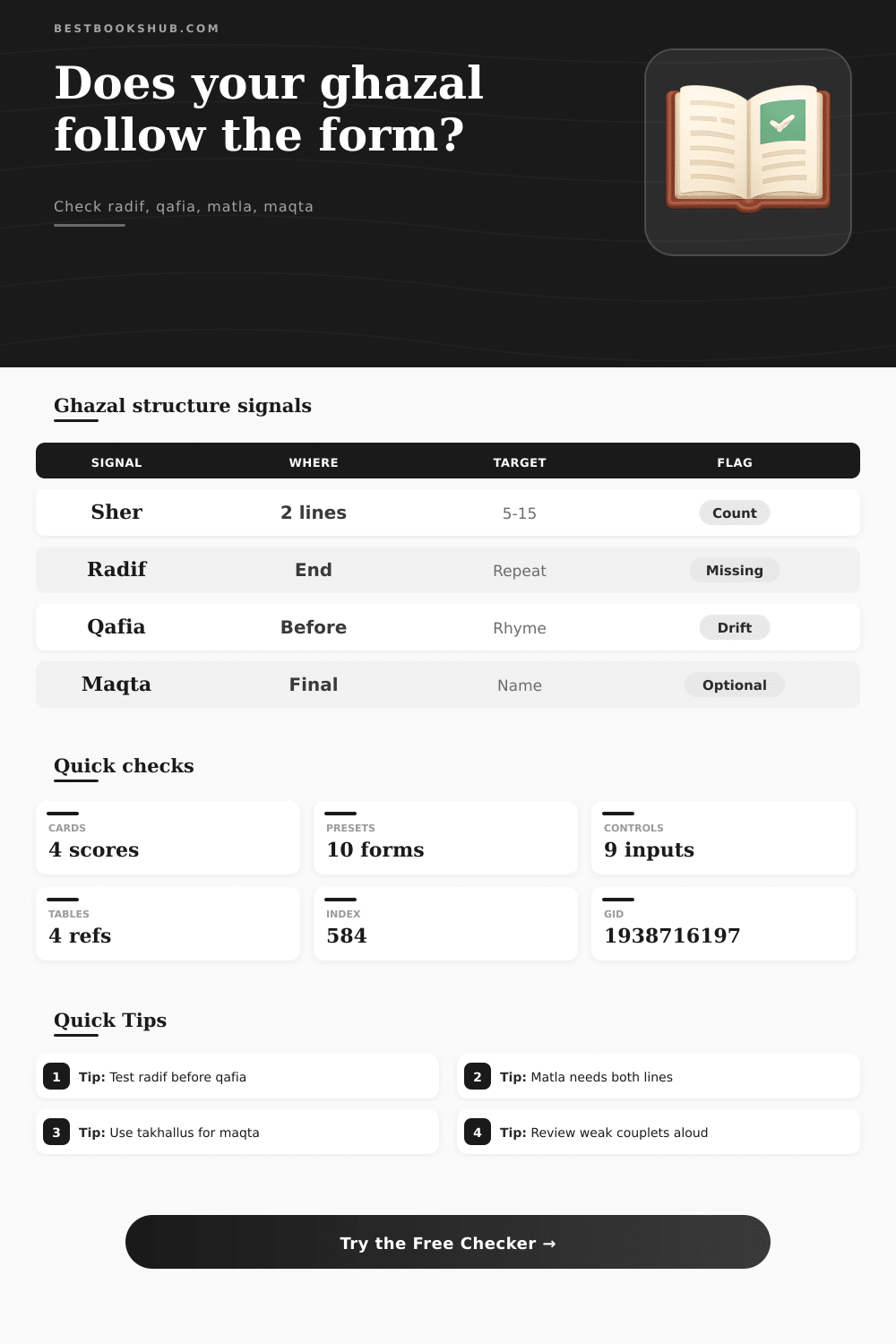
| Matla | First couplet | Both lines tested | Radif and qafia appear twice |
| Radif | Line endings | Repeated final phrase | Same phrase at expected endings |
| Qafia | Before radif | Rhyme proxy from prior word | Shared sound or spelling tail |
| Maqta | Final couplet | Name marker search | Pen name appears near close |
| Couplet count | Use case | Checker band | Interpretation |
|---|---|---|---|
| 3-4 | Fragment | Flexible only | Often too brief for full ghazal feel |
| 5-7 | Compact ghazal | Traditional pass | Common English workshop length |
| 8-12 | Full draft | Traditional pass | Enough turns for strong autonomy |
| 13-15 | Extended | Upper traditional | Watch repetition fatigue |
| Qafia depth | Best for | Strength | Risk |
|---|---|---|---|
| 2 letters | Loose English rhyme | Flexible | False positives |
| 3 letters | General drafts | Balanced | Spelling bias |
| 4 letters | Strict visual rhyme | Exacting | Misses slant rhyme |
| Vowel plus tail | Sound-like proxy | Poetic | Approximate only |
| Score band | Status | Likely issue | Next edit |
|---|---|---|---|
| 85-100 | Strong | Minor polish | Read for autonomy |
| 70-84 | Close | One form weakness | Fix flagged couplets |
| 50-69 | Drafting | Radif or qafia drift | Stabilize refrain |
| 0-49 | Structural | Form pattern missing | Rebuild end pattern |
DISCLOSURE: This post may contain affiliate links, meaning when you click the links and make a purchase, I receive a commission. As an Amazon Associate I earn from qualifying purchases.
This ghazal structure checker runs through your text to look for: • Couplets The radif repeats. This is the Qafia Rhyme Proxy. • Matla Setup This is a Maqta Marker. • Autonomous Couplet Strength
The form is deceptively simple because it uses a repeating refrain and two-line verse. You must follow the pattern that joins each couplet while also keeping each couplet independent, this pull of strict order versus freedom creates the specific music of the ghazal.
How to Use This Ghazal Checker
For the poet, the matla, that’s the opening couplet, does the heaviest lifting. Each line need to create both the radif and the qafia to give sense that we are listening to this kind of poem and not another. Without that set-up, the following verse seem aimless, not dancing along but rather meandering. Later verses only need second line to complete the pattern.
Sounds simple enough, except that each sher has to work independently as a mini-revelation in two lines. We have to get a memory of rain or a complaint against love, all in two lines before refrain takes us away again. Most writers fail here. They chase the rhyme too early and force the radif into place. Or, they get the refrain exactly right, only to find that their couplets is just repeating the same idea in different ways.
A good ghazal feels as though each line are an independent spark; but if you step back, you can see how they all combine into a single constant flame. Achieving that balance is trickier than it appears, particularly since neither English language nor its rhyming dictionary presents the many rich end-rhymes available from Persian and Urdu.
With that tool on this page, you don’t have to guess about those tensions. Paste a draft and it’ll mark off if your refrain is really repeating. It shows where the previous word has a matching sound and where opening couplet has earned its place as an anchor. It scores each sher individually so you can see who’s doing the heavy lifting and who isn’t. You can tell it to judge strictly by the matla or not; demand a signature in the last couplet, the maqta, or not. Tradition had poets tuck their pen name there like a reader-wink, a secret message.
So how does one deploy a given checker to good effect? That’s where knowing its origin comes into play. In classical ghazals, the number of couplets typically range from five to 12. The shorter range will seem fragmented. The longer range risks pounding the refrain like a hammer different than an echo.
Sometimes English-language poet break the pattern by allowing slant rhyme to do the work of qafia or by extending the concept of the radif toward something more loosely phrased. That is fair, as long as you know what you are giving up. A malleable refrain may sound contemporary and even conversational, yet it can dissolve the hypnotic power that gives a ghazal its own memorability.
Once the numbers has settled into place, read your draft out loud: the ear forgives more easily than the eye. You are getting close to level of freedom the form needs when you can remove a couplet and find it still makes sense on its own. When the refrain begins to sound routine, like an obligation rather than a returning friend, then it’s time for something to change. Often best revisions involve tightening a single weak phrase, not rewriting the whole sequence. You should of tried this before.
Ultimately, though, the point of the ghazal lies not in perfection of pattern but in the excitement of seeing unrelated moments circle the same fixed star. Once you get the structure down, the poem starts breathing on its own. Every writer of ghazals chases this quiet reward. It is the quiet reward when the couplets stop obeying you and start speaking to one another.