📖 Five-line poem form checker
Cinquain Structure Checker
Paste a five-line cinquain to validate the classic 2-4-6-8-2 syllable shape, word-count cinquain, didactic noun-adjective-action pattern, and optional title or subject fit.
Load an original sample, then switch the pattern selector to compare classic syllabic, word-count, and didactic classroom expectations.
DISCLOSURE: This post may contain affiliate links, meaning when you click the links and make a purchase, I receive a commission. As an Amazon Associate I earn from qualifying purchases.
Use one poetic line per row. Rhyme is not scored because cinquains are defined primarily by five-line shape, syllable or word pattern, and subject development.
Dynamic table updates after calculation. Automatic syllables are drafting estimates, so use overrides for names and intentional poetic sound.
| Line | Text | Words | Syllables | Target | Status | Didactic cue |
|---|---|---|---|---|---|---|
| Paste a cinquain or load a preset to populate line checks. | ||||||
| Pattern | Line 1 | Line 2 | Line 3 | Line 4 | Line 5 |
|---|---|---|---|---|---|
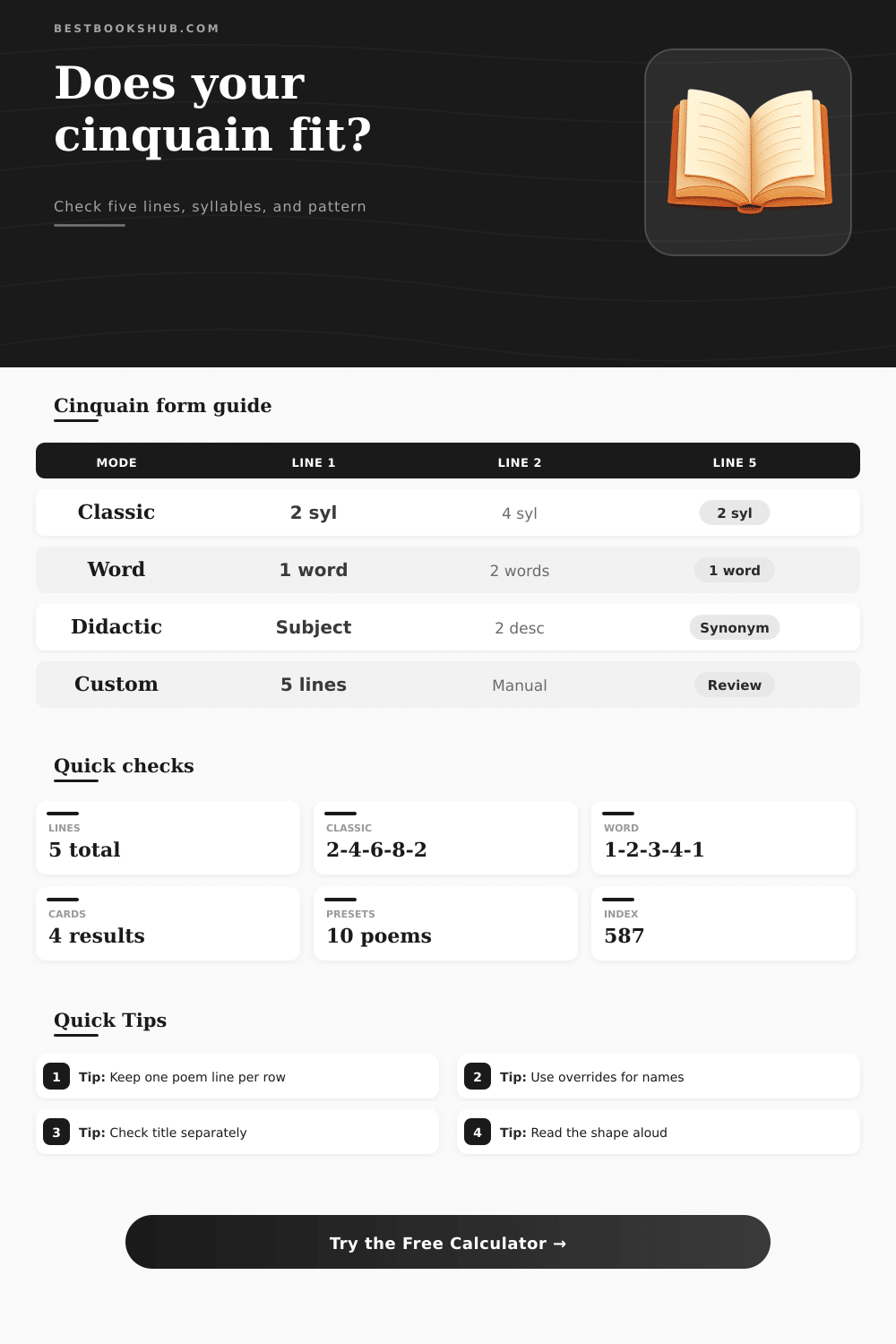
| Classic syllabic | 2 syllables | 4 syllables | 6 syllables | 8 syllables | 2 syllables |
| Word-count | 1 word | 2 words | 3 words | 4 words | 1 word |
| Didactic | Subject noun | Two descriptors | Three actions | Four-word phrase | Synonym |
| Custom | Target 1 | Target 2 | Target 3 | Target 4 | Target 5 |
| Checker mode | Primary unit | Pass signal | Common revision |
|---|---|---|---|
| Classic | Syllables | Each line equals 2-4-6-8-2 | Trim or add beats line by line. |
| Word-count | Words | Each line equals 1-2-3-4-1 | Move modifiers between lines. |
| Didactic | Words and roles | Subject, details, actions, phrase, synonym | Use clearer adjectives or -ing verbs. |
| Combined | Both | Line count plus syllable and word checks | Choose which assignment rule matters most. |
| Didactic line | Expected role | Helpful signal | Warning signal |
|---|---|---|---|
| Line 1 | Subject | One noun or clear topic | Full sentence or many words |
| Line 2 | Description | Two adjectives or qualities | Action phrase takes over |
| Line 3 | Action | Three -ing verbs or actions | Static list without movement |
| Line 4 | Feeling phrase | Four-word phrase about subject | Too short or too abstract |
| Line 5 | Synonym | One restating noun | Unrelated final idea |
| Issue | What the checker flags | Why it matters | Fix path |
|---|---|---|---|
| Six or more lines | Line-count card falls | Cinquain frame is five lines | Move title out or combine lines. |
| Wrong middle shape | Pattern card drops | Line three and four create the rise | Revise the longest lines first. |
| Missing subject | Title card warns | Didactic poems need a clear topic | Add title or sharpen line one. |
| Odd syllable estimate | Override chips appear | Names and dialect vary by speaker | Add word=number override. |
Before revision, check your cinquain with this structure checker. Make sure subject or title fits the form. Check syllable patterns and word counts. Ensure each line has its proper purpose and follows five-line poem shape.
While five neat lines in a row may look easy on paper, as you begin to write a cinquain, you’ll find there’s surprising weight to the form. Invented by Adelaide Crapsey more than a hundred years ago, the poem are almost architectural in its demand for precision. There is no room to wander or bury yourself in extra words, each beat has to earns its keep. That’s what makes it such a go-to form for so many writers who wish to sharpen their ear for rhythm but don’t quite want to commit to something more long than a sonnet.
How to Write a Cinquain Poem
The trick is that there’s an ever-growing number of variations out there traveling under the title. The first version is the count-syllable one (two, four, six, eight, two). From this, it expand into a pattern of opening gently and snapping shut. Later teachers devised the simpler word-count version for young learners, replacing syllables for a purer 1-2-3-4-1 so kids can concentrates on the image rather than on its sounds. Next was didactic cinquain, less interested in counting then in what words do. Here, line one identify the subject; line two provides two descriptors; line three states some action; line four provide a feeling using four word; and line five wraps it all up with a synonym.
Each teaches something else. Choose your set of rules and leave numbers crunching to the calculator above. It’s when these rules come into conflict, however, that the true craft kicks in. Even with perfectly balanced syllables, a poem could be dull if it collapse its teaching roles. If the syllables of English won’t remain polite, then a sparkler on word-count might clunk when spoken aloud. Here we learn something from form; we discover that neither meaning nor music want to stay boxed up separately. With the tool you get to play with both sides simultaneous, to observe where one slide out.
The last line, with its two syllables, is thought by many writers to hold some great twist of philosophy. Nope. Most effective ending lines falls gently into place, more echo than explosion. It is a soft click of recognition. It is like a little wooden box with a latch. No need for fireworks there. It is just finality. Same goes for the title. Some poets count the title as their own line; they treat it almost like a sixth, and then go from there. Other poets isolate the title completely, letting the title name what is inside. Let first line breathe. It alters the whole balance.
Certain errors are surprisingly common. Writers fill up middle lines; after all, that’s where the form give them the most space. Others get carried away trying to create perfect counts. They forget it’s a poem intended to rise and fall, not just stay flat. Still others produce lines that sound as if theyve been put together using tweezers. For such instances; names, regional pronunciations, deliberately poetic stretches, there’s the overrides option. Often a slight tweak there save an otherwise solid draft.
No computer program can ever realy substitute for one more test: reading poem out loud. A poem has a kind of shape on the page; it should require an almost silent inhale as you expand into it and contract again. Often numbers bear this out if the rhythm doesn’t work in your mouth. But sometimes the reverse is true. You read a poem that seems perfectly formed on the page but it’s bloodless when spoken aloud. Watch for both signs.
And finally, the cinquain repays patience rather than flash. It demands we listen harder, cut deeper, and believe that five brief lines are enough if each one find its rightful place within the whole emotional weather system. There’s no cage here, just a tuning fork. Hit it right, and this little poem will ring much further then its size implies.