📖 Paired-line poetry analyzer
Couplet Counter
Paste a poem to detect adjacent two-line pairs, rhymed couplet proxy matches, heroic couplet candidates, open or closed couplet behavior, stanza pairing, and incomplete couplet flags.
Load an original sample, then switch between basic, rhymed, heroic, open, and closed couplet modes to see how the same lines are classified.
| Pair | Lines | End words | Rhyme keys | Syllables | Closure | Status |
|---|---|---|---|---|---|---|
| Pair data appears after calculation. | ||||||
| Stanza | Lines | Pair candidates | Rhymed pairs | Accepted | Incomplete flag |
|---|---|---|---|---|---|
| Stanza data appears after calculation. | |||||
| Couplet mode | Primary test | Secondary cue | Best use |
|---|---|---|---|
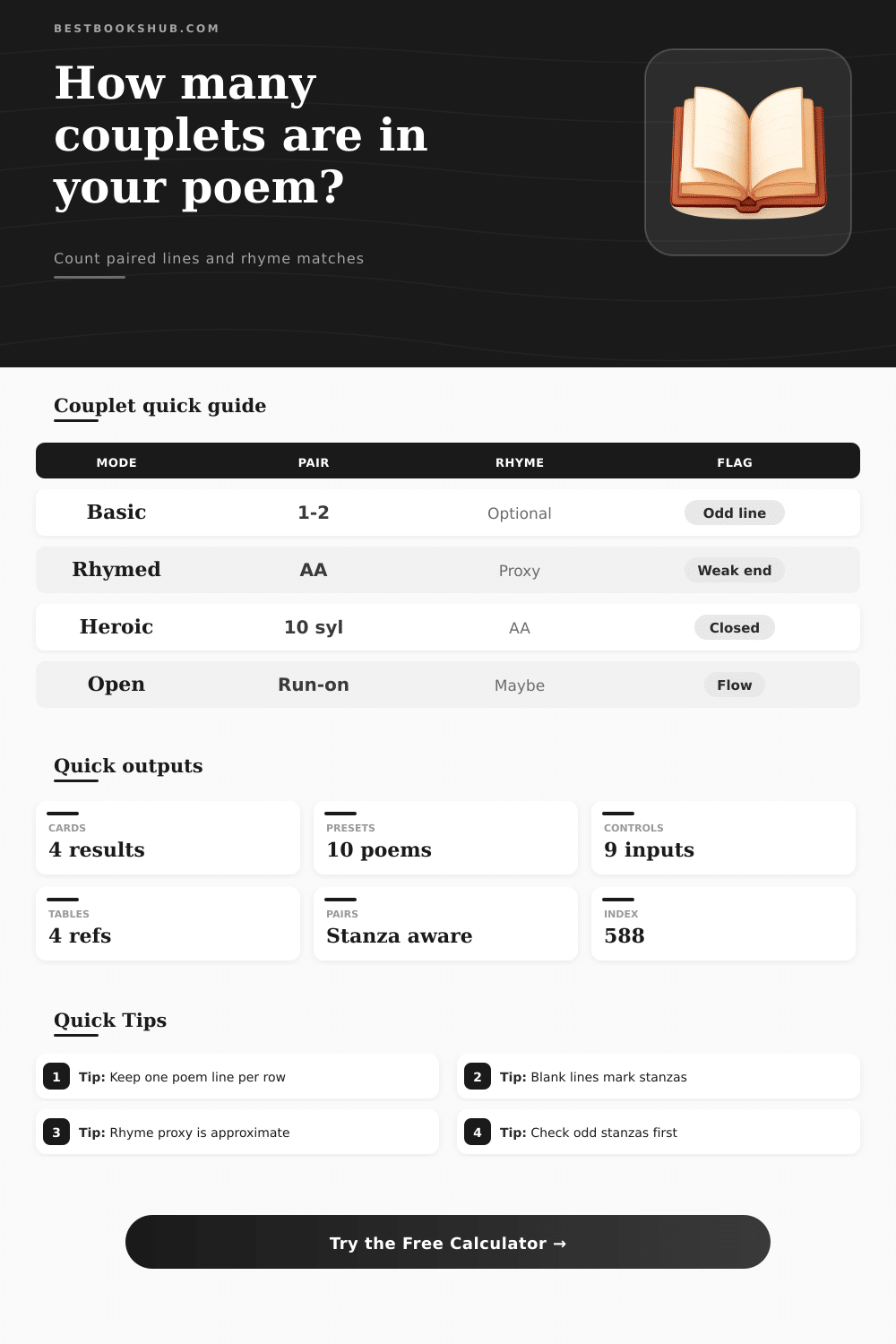
| Basic paired-line detection | Lines 1-2, 3-4 | Odd-line flags | Quickly count poem pairs before scoring rhyme. |
| Rhymed couplet proxy | End-word keys match | Rhyme sensitivity | Find likely AA pairs in drafts and exercises. |
| Heroic couplet proxy | Rhymed plus 9-11 syllables | Second-line closure | Approximate English heroic couplet structure. |
| Closed couplet mode | Pair ends with strong closure | Rhyme preferred | Review epigrammatic or argument-driven couplets. |
| Open couplet mode | Line one carries over | Weaker closure | Measure flow across a two-line unit. |
| Ending signal | Default class | Calculator effect | Revision question |
|---|---|---|---|
| Period, question, exclamation | Strong close | Raises closed-couplet score | Does the second line finish a thought? |
| Semicolon or colon | Balanced close | Counts if balanced mode is selected | Is the hinge final enough for the pair? |
| Comma | Soft pause | Can support open couplet flow | Is the syntax still moving forward? |
| No punctuation | Open line | Raises open-couplet signal | Does line two complete the pressure? |
| Dash or ellipsis | Poetic close | Counts only in poetic mode | Is the interruption intentional? |
| Form context | Typical pair use | Rhyme expectation | Common flag |
|---|---|---|---|
| Heroic couplets | Self-contained two-line units | High | Meter outside 9-11 syllables |
| Closed couplets | Argument closes at line two | Medium to high | Weak terminal punctuation |
| Open couplets | Syntax spills between lines | Optional | Pair looks closed instead |
| Quatrain couplets | Two pairs per stanza | Depends on scheme | Odd stanza length |
| Free verse pairs | Visual two-line grouping | Low | Rhyme proxy overstates fit |
DISCLOSURE: This post may contain affiliate links, meaning when you click the links and make a purchase, I receive a commission. As an Amazon Associate I earn from qualifying purchases.
A couplet counter allow you to look through your poetry to see which lines are paired together as a couplet. It will also flag potential incomplete couplets and show where rhyme match might be. It will also indicate whether the couplets align with a heroic couplet cue.
Couplets sound easy to write but then you try them out. They is two lines. They have a shared breath. Maybe they has a rhyme. But the distance from a good couplet to a bad one is slight; that tension is what makes the form so addictive.
How Couplets Work
Soon you realize what happens in the second line, does it complete the thought? Does it overthrow it? Does it lead off to the following couplet? All at once all poems becomes about balance. But for me the true craft exists in what you choose to do on the page before the reader’s eyes see it.
Should the two lines close together tightly? Or should they remains open? Is the rhyme obvious? Is it hidden? Such choices affect humor, argument and rhythm. A closed couplet can lands a sharp point. An open one allows syntax to breathe and carries momentum beyond the break.
But it changes the sound of the poem pretty fast with tiny tweaks: strip possessives from end words or allow archaic endings. Suddenly, the same lines read quite differently in their scansion. And if you shift from adjacent pairing to sliding pairs, you catch echoes you never noticed. It’s a tool for doing that math so that you can concentrate on whether this new reading make sense in the poem.
It makes clear where you think you’re rhyming and you’re really just repeating some similar consonants. A stanza might seem neatly done but end on an off line. But there’s more work added by heroic couplets. Here you count out those loose pentameter lines, and realize there are ten syllables in which a whole heap of music is hidden.
The rhyme can be weighted by an additional beat or lacking a beat. It ceases to seem decorative, and becomes architectural. In the hands of Alexander Pope it became a form used to build an argument that closed tightly at the end of each two-line couplet. Contemporary poetry often relaxes this into something sounding as if it were being thought out loud. And both succeed because distinction is intention.
Complicating the image are stanzas. What does blank line look like? Nothing. But it resets the ear. Pairing logic also changes when you treat each group of four lines as a unit. Each final pair in that grouping take on additional responsibilities.
Even if the content is complete, an odd number of lines leave a small gap that the ear notices. And that little dissatisfaction isn’t necessarily a bad thing. Sometimes it’s just what the poem requires. It establishes a planned pause before next thought emerges.
These are all tricks most writers stumble upon over time. Write something down. Read it aloud. Cross it out. Rewrite. The trick is, the calculator just accelerates one step in that cycle.
It measures. It identifies problems. It measures against other lines. It can’t judge if what you’ve got rhymes sound fresh or like they’ve been done before. For that, you need an ear, a sense of taste, and the guts to debate what you’re saying with yourself.
The tool provides clarity so you no longer have to guess whether your draft is coasting, or if it’s hanging over too far on one side (closed) or not enough (open). It shows you which pairs is pulling their weight and which ones aren’t. That knowledge allows you to revise with a purpose, rather than wandering around in yet another draft, hoping that the rhythm might get better by sheer magic.
Less a matter of rules then it is a conversation, couplets are the first line speaking, and the second answering, contradicting, or wandering thoughtfully off. That’s the best part: keeping the conversation alive on the page.
Count them. Measure them. Test them. Then listen to see what stays. They’re scaffolding. The music is up to you.