❓ Question pattern analyzer
Question sentence counter
Count question-mark sentences, estimate rhetorical questions, measure question density per 1,000 words, surface direct and indirect cues, and isolate dialogue questions.
Load a sample with a different questioning style, then adjust scope, cue rules, and rhetorical sensitivity.
DISCLOSURE: This post may contain affiliate links, meaning when you click the links and make a purchase, I receive a commission. As an Amazon Associate I earn from qualifying purchases.
The counter treats a question sentence as a sentence ending in a question mark, then scores likely rhetorical use and indirect question cues separately.
Use these references to interpret the density, cue mix, and dialogue share instead of judging only the raw question-mark count.
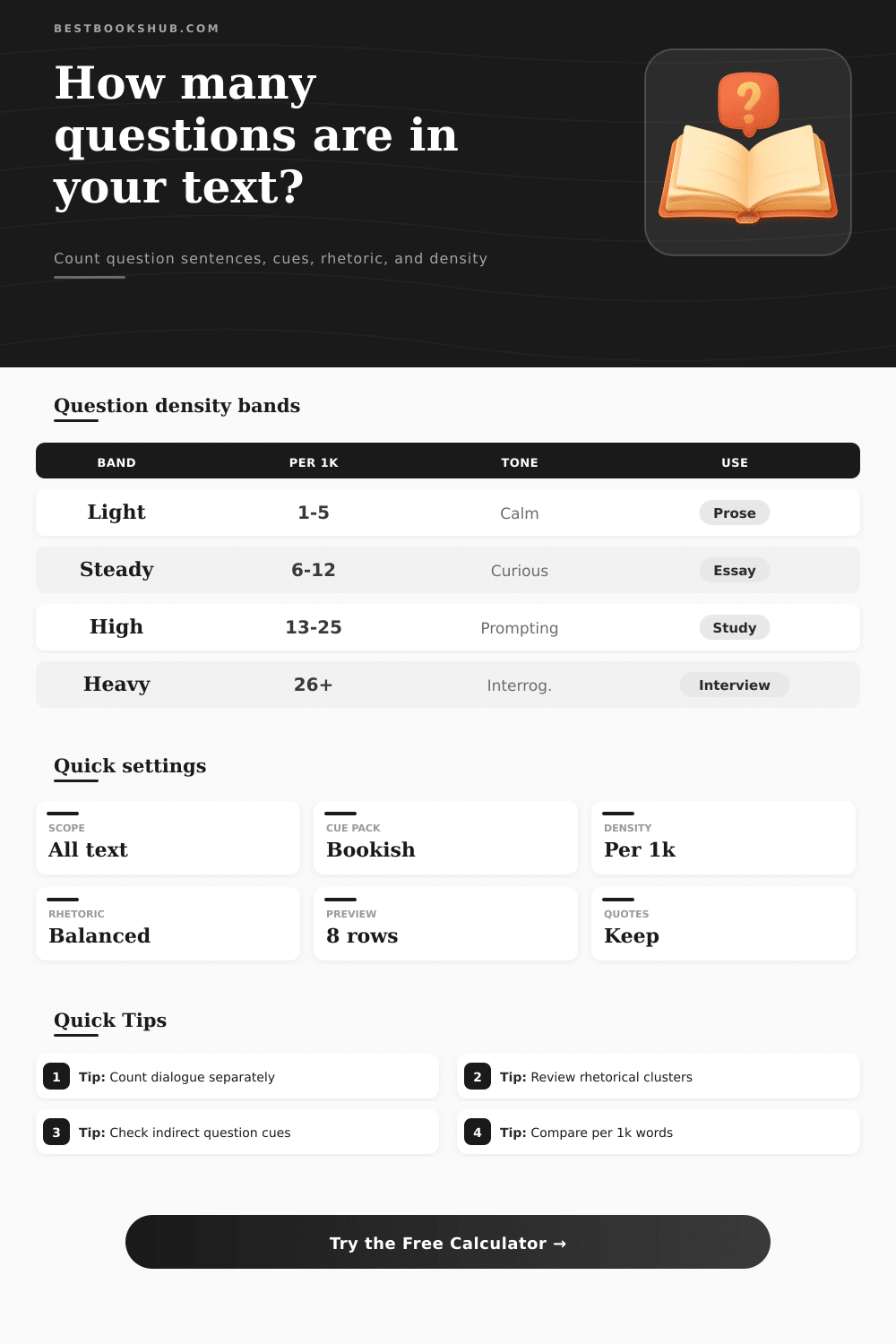
| Density band | Questions per 1k | Reader feel | Best match |
|---|---|---|---|
| Light | 1-5 | Occasional curiosity | Narrative or review |
| Steady | 6-12 | Guided reflection | Essay or commentary |
| High | 13-25 | Prompt-driven | Study material |
| Heavy | 26+ | Interrogative | Interview or FAQ |
| Cue type | Examples | Counted as | Reading note |
|---|---|---|---|
| Direct question | Why, what, how | Question mark cue | Usually explicit |
| Auxiliary opener | Do, can, will | Direct cue | Common in dialogue |
| Indirect cue | wonder whether | Cue hit only | May not end with ? |
| Reported question | asked if | Cue hit only | Counts as inquiry signal |
| Rhetorical marker | Signal | Risk | Manual check |
|---|---|---|---|
| Surely / really | Persuasion | May be sincere | Check context |
| Who could | Implied answer | Phrase-dependent | Read whole sentence |
| Is it any wonder | High rhetoric | Often emphatic | Mark as likely |
| What else | Pressure cue | Could be literal | Review speaker aim |
| Scope option | Includes | Excludes | Use when |
|---|---|---|---|
| All text | Every question | Nothing by scope | General audit |
| Dialogue-only | Quoted questions | Narration | Scene balance |
| Non-dialogue | Narrator questions | Quoted speech | Essay or notes |
| Cue scan | Direct and indirect | Raw-only totals | Inquiry texture |
A way to figure out how much your writing is peppered with questions (and maybe more importantly: question marks) is based off this question sentence counter. It count the number of dialogue questions, indirect question cues, rhetorical questions, etc. Questions are powerful tools when used well, though. The mind leans forward into the question if it’s dropped in just the right spot.
But too many questions on a page and the reader starts feeling interrogated. That is true for a novel’s dialogue. It applies to teacher’s study guide too. It even works for an essayist’s thesis nudge.
How to Use Questions Well in Writing
And while raw count matters, so does density, because the line between annoying interrogation and piquing curiosity often lies here. Six questions per thousand words on a page makes a page feel alive, whereas thirty can make it feel like someone is shouting at you.
But here’s where it gets tricky: You must understand which question you’re using. The easy ones are direct; the one punctuated by a question mark tells only half the story. Then there are indirect hints at queries; “asked if… ” or “wonder whether… These phrases signal a more subtle query that needs no punctuation at all. And then there are rhetorical questions, which pose a query when they mean to tell us something else entirely. They’re dangerous and powerful, which is why I caution against their overuse.
Overdo it, and the reader won’t trust your voice on the page anymore. One of the ways writers find out what questions they’re posing is by chance. Sometimes it’s that you’ve just finished writing a chapter and read it through and noticed the characters sound as if they are interviewin one another. Other times it will be that you have written an essay with a string of questions, answered partly each time but never giving any particular idea a chance to breathe. It doesn’t usually show itself on the first reading; it shows up once you begin to measure.
Separating dialogue from narrative makes sense, then, because these are different creatures. Conflict will carry the weight of a conversation for pages on end. Characters can fire question after question at one another and the reader won’t be exhausted; they’ll be intrigued. But the same level of weight in your writing voice will read as uncertainty instead of tension.
Adjust the scope, though, and the calculator does its work neatly: It shows you exactly where your questions bunch up, and whether they’re serving the scene or undermining it. Because some questions phrased rhetorically do not turn out to be rhetorical, this provides valuable friction in the form of a rhetorical estimate. Depending on who is speaking, “Who could blame her?” may be completely manipulative, or simply true. It flags the likely instances according to known indicators, but ultimately leaves the decision where it should: to you.
Remember that the numbers are a guide, but the context is the decider. That’s what most folks forget about it. But you’ll find density readings particularly useful for comparing types of written material. An essay often falls somewhere between those two extremes. It is structured with questions more as a means to an end than for show. In contrast, a narrative chapter will typically be lightest so that we are not constantly interrupted while the story is unfolding. Finally, a study guide should be heavy on prompts since its goal is to get your brain thinking. Knowing their typical ranges protects you from measuring each page according to the same scale.
But now, when you begin to look for them, you see common errors everywhere: Questions as crutch words (too many new writers fall into this trap). Some use rhetorical questions to hide their actual positions. There is also a hidden mistake that grows but nobody seems to notice: indirect cues (“It remains unclear whether…” “One might wonder if…”). A paragraph full of these are like a fog of uncertainty. No amount of exclamation points or question marks will clear it.
The trick is to test at multiple levels. Balance is important at the scene level, and you should consider where the pattern of questioning changes from section to chapter. Slowly ramping up to a climax can create great tension, while a sharp decline may indicate either resolution or surrender. It’s less about a number and more about rhythm.
In short, the more questions you ask of a person, the more you are asking them to do your job for you. And that’s not necessarily a bad thing, exactly; some questions can be great invitations. But if there are too many, they can feel like an unwelcome jab. But if there are too many invitations on the page, they feel burdened by responsibility for something they should of had to do (yours). Too few questions and the result is passive. There’s a sweet spot between confident direction and generous curiosity where it all works best.
It isn’t as easy as it appears, though, which is why even seasoned writers has to go back to the same basic discipline over and over again: count, consider, then choose. You get the numbers from the page; what you do with those numbers decides if the next sentence will land as a gentle tap on the shoulder or an unwelcome jab in the ribs.