❝ Manuscript quote analyzer
Quote counter
Count straight and curly quotation marks, estimate dialogue blocks, measure quoted word percentage, and flag unmatched quote pairs before proofreading.
| Quote family | Open or mark | Close | Total marks | Matched pairs | Unmatched |
|---|---|---|---|---|---|
| Load text to see quote families. | |||||
| # | Family | Words | Characters | Excerpt | Signal |
|---|---|---|---|---|---|
| Matched quote spans will appear here. | |||||
| Block | Type | Quote marks | Words | Preview |
|---|---|---|---|---|
| Dialogue-like blocks will appear here. | ||||
| Mark | Name | Common use | Watch for |
|---|---|---|---|
| " | Straight double | Plain text dialogue | Mixed with curly doubles |
| ' | Straight single | Nested quotes or plain text | Apostrophes in words |
| “” | Curly double | Typeset dialogue | Missing close mark |
| ‘’ | Curly single | Nested quotes | Possessives and contractions |
DISCLOSURE: This post may contain affiliate links, meaning when you click the links and make a purchase, I receive a commission. As an Amazon Associate I earn from qualifying purchases.
A quote counter checks for mismatched marks and curly versus straight quotes. It check for straight quotes, dialogue-like blocks, shared quoted words, and other issues in pasted manuscript text.
How often do you notice quotation marks? This continues until manuscript begins to feel off. The dialogue all runs together and what sounded like a crisp conversation in your head is now clutter on the page. An apostrophe looks like a quote mark, and a single missing closer make the whole rhythm feel off.
Why Use a Quote Counter?
This is why a quote counter comes into play. It makes that invisible layer of punctuation visible and allows you to see and fix it before anyone ever open the file, including the editor.
What counts, though, is knowing what these statistics is telling you about your narrative. If you notice that 75 percent of your quoted text is being used, does that tell you that you’re showing less and saying more (meaning your characters needs to show up)? Or does it indicate that you’ve got a swift-moving scene with dialogue where the back-and-forth are just right?
Knowing this is really the art because the online calculator will crunch numbers when you select its strictness regarding single marks and whether it scans paragraphs or lines. Why do those options matter? Because books can be formatted in tight dialogue blocks, or they can be like essays, with plenty of quotations embeded within. And all the tool does is show you which way yours fall.
Many of your email exchange and plain-text drafts are still straight-quoted. A few come in on the curly side, those typographic twins that publishers likes because they’re more distinctive than their partners. They mix it up, and the result look inconsistent when printed. It’s easy to think the difference doesn’t matter; then you look at the breakdown with both families sitting side by side. And suddenly every mismatched pair jump out.
Most people miss these errors until someone circles them in red during a proofread. Consistency isn’t optional, and it tell the reader the storyteller’s in control.
Finally, let’s acknowledge unmatched marks, which also deserve time out for themselves: A single overlooked closer at the end of a lengthy paragraph has potential to leave an entire conversation hanging. By flagging these dangling or open-ended marks, the counter enable you to track them down when the scene is still vivid in your mind. This is especially important in fiction, where emotion is driven by dialogue; each missed closer threaten to shatter that spell.
Readers don’t come to be forced to pause and ponder who said it; they come to feel what the characters is feeling.
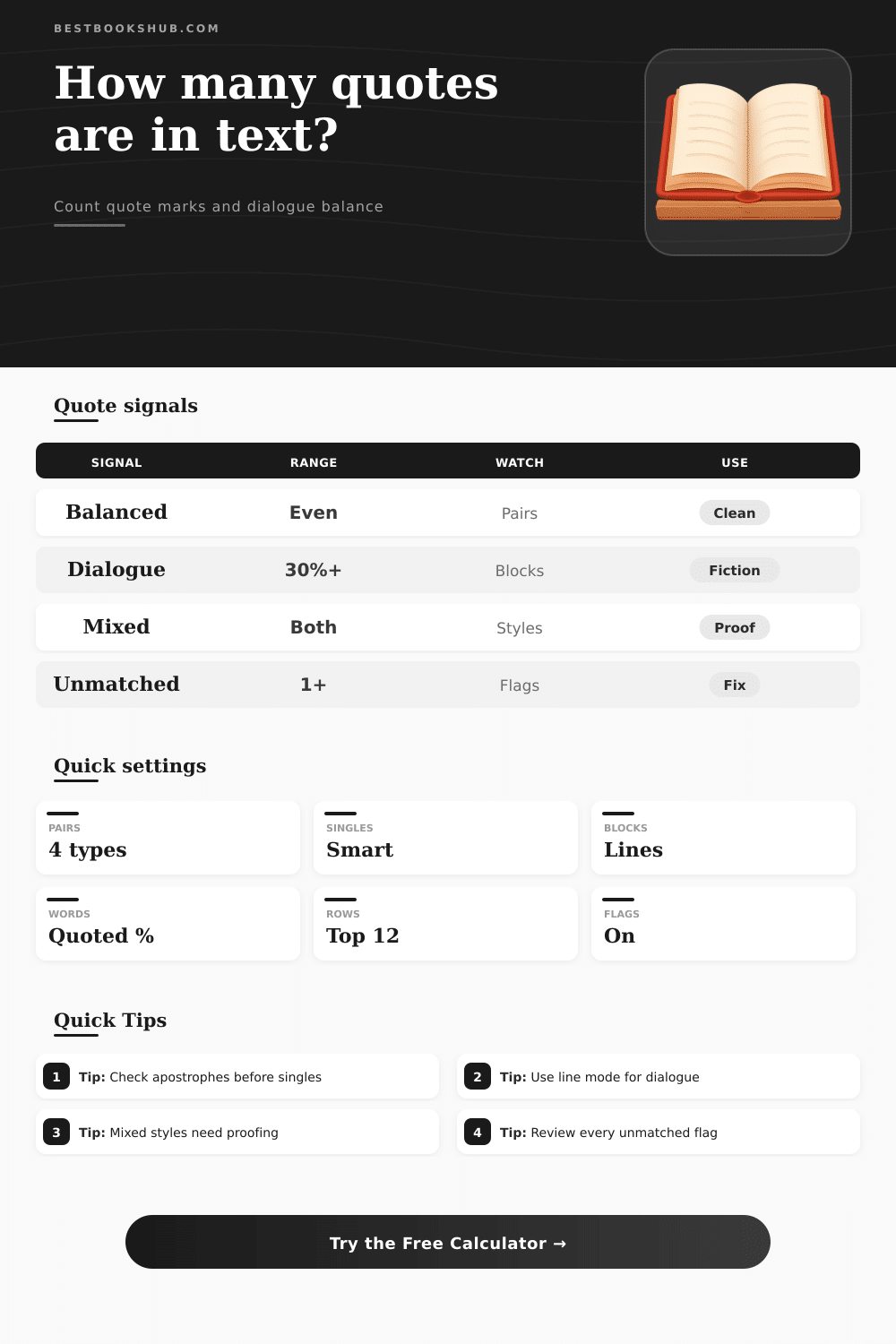
There’s also a quieter story to be told by the numbers of words spoken: At thirty percent or higher of their total word count, if you’re quoting characters often, then you’re probably writing very conversational fiction (a figure that will work wonderfuly well in some genres, but potentially squash tension in others). The block estimate show you how much is grouping naturaly into exchanges versus being spread throughout longer blocks of description.
And with smart mode enabled when adjusting your single-quote handling, the tool doesn’t count possessives and contractions as dialogue, an adjustment that makes all the difference between keeping things accurate and having artificialy-inflated counts.
The predictable missteps show up here. You trust your word processor to translate quotes for you and then copy them back into your plain editor where all those curly marks straighten out again. You also forget when dialog require double marks around inner nests. This creates a count of what seems like an alarming number of single marks, but it turns out be deliberate.
The page’s reference tables provides a cheat sheet of the expected marks and what job they usually do. You can use them to judge if yours are up to snuff or might need adjustment to better fit genre expectations.
In the end, it’s about control. If you have a clear idea of what percentage of your manuscript consists of quoted material, then you can choose if the mix work for you. Is a novella of literary fiction comfortabley at less than 15 percent quoted words? Is a thrill-a-minute ride okay with more than 40? Both are decisions, and neither is right or wrong.
So next time you’re staring at some overly weighted passage, put the text into the analyzer. You won’t get the story written for you from those numbers, but you’ll see where to find the voice on that page and perhaps where to give it a little more air.
It’s such a simple step of measurement. But so often it uncovers the precise edit the page has been begging for.