📘 Sentence ending lab
Last word of each sentence extractor
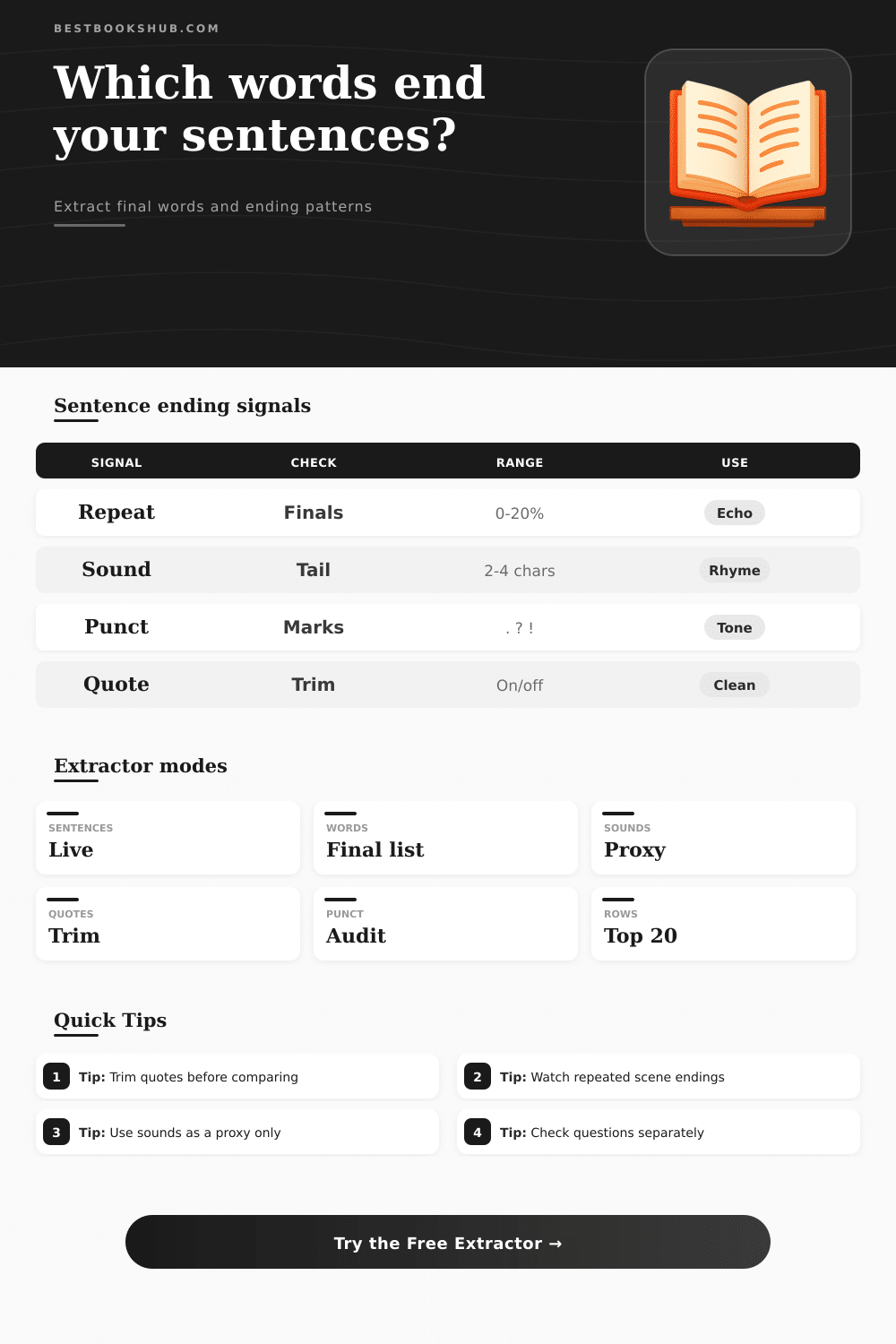
Extract the final word from every sentence, trim closing quotes, keep punctuation context, spot repeated sentence endings, and group approximate rhyme or end-sound patterns.
Load a passage style that stresses a different ending behavior: repeated words, dialogue quotes, questions, exclamations, lyrical end sounds, or list-like sentence fragments.
DISCLOSURE: This post may contain affiliate links, meaning when you click the links and make a purchase, I receive a commission. As an Amazon Associate I earn from qualifying purchases.
Copy this ordered output into revision notes, a spreadsheet, or a manuscript pass focused only on sentence-ending variety.
| # | Final word | End mark | Sound key | Repeat flag | Sentence preview |
|---|---|---|---|---|---|
| Run the extractor to fill this table. | |||||
| Final word | Count | Share | Sentence numbers | Window signal | Meter |
|---|---|---|---|---|---|
| Repeated endings will appear here. | |||||
| Sound key | Count | Share | Example finals | Proxy mode | Signal |
|---|---|---|---|---|---|
| End-sound clusters will appear here. | |||||
| Ending mark | Count | Share | Typical read | Quote trims | Example ending |
|---|---|---|---|---|---|
| Punctuation groups will appear here. | |||||
| Control | What it changes | Best use | Watch for |
|---|---|---|---|
| Boundary mode | How sentence endings are split. | Draft prose, dialogue, notes, or line lists. | Abbreviations can still confuse simple splitters. |
| Final word cleanup | How the extracted word is normalized for comparison. | Comparing echoes without case or possessive noise. | Too much cleanup can hide intentional word choice. |
| Quote trimming | Whether closing quotes, brackets, and dialogue wrappers are removed. | Dialogue-heavy pages and quoted material. | Keep mode may split identical words by typography. |
| End-sound proxy | How rough rhyme clusters are formed. | Cadence checks, poems, lyrical prose, and speech. | Letter tails are not pronunciation dictionaries. |
| Diversity band | Unique final-word share | Likely signal | Revision cue |
|---|---|---|---|
| Very varied | 85-100% | Few repeated sentence endings. | Check sound clusters, not only words. |
| Balanced | 65-84% | Some repetition with good range. | Review repeats in nearby sentences. |
| Echo-prone | 45-64% | Frequent repeated final words. | Revise endings that share scene function. |
| Heavy echo | Under 45% | Many sentences close on the same words. | Vary syntax, object, image, or rhythm. |
Using the last word of each sentence extractor, you will list final words in sentences. You will check for repetition and strip out quote marks. You will audit punctuation and look at the rough pattern of how sound on page ends. Why does the last word matter? Because it’s the note you’re holding just before you pause. If you hear that note repeating too frequent, then the paragraph have lost its rhythm. This tool make those invisible patterns show up, and allows you to revise with your ears open rather than having to guess.
Most writers give less credit than they should to the rhythm shaped by how sentences end. When you have a series of sentence that end in same pronoun or noun, that’s a dull echo. Even if you can’t put a finger on it, as you read it aloud, you feel it. After trimming optional quote marks and grouping punctuation separately, this tool pulls out every last word at the end of each sentence and displays words that continue to return. One simple list will transform your view based off your own draft.
Why the Last Word Matters
Working in dialogue is where you find another layer. The closing quote mark tends to stick to the last word and make it difficult when you try to line up the ends for comparison. First, remove those quotes. It happens automatically if you select right setting on the extractor. Once you do, you will see that “back” or “now” simply ended the last sentence for three different characters. The repetition no longer hides behind typography.
And then there’s punctuation, which has a story to tell on its own. A few question marks in a row, or exclamation points, will shift mood of a page where things seemed calmly paced. That’s why the tool separates out those kinds of marks for you to view at a glance and judge if maybe your tone has drifted away from you. It also highlights mixed punctuation and ellipses, letting you decide if they strengthens the story or just weaken the prose.
Even if words aren’t the same, how they end can matter. You might think of two sentences ending in “light” and “night.” They look different on paper but they sound similar to your ear. Using extractor you can quickly identify these near-rhymes by spotting their last couple of letters (a phonetic proxy). But it’s not a perfect pronunciation engine; that means its use as a tool comes down to highlighting pressure points you can then read aloud and decide for yourself.
After a while of doing this, you begin to see the common traps that catch so many novice writers. You spot novelists who consistently conclude their sentences with characters’ names at key moments in the story; you notice ones who over-rely on “said” in dialog tags until text sounds like it’s stuttering. You discover chapters ending on same prepositions (because the author is writing in bullets instead of prose). Before an editor or the reader gets a chance to pick up on any of these, the extractor surface them for you.
Perhaps most illuminating is the repetition window setting. It will let you request that it flag only echoes that are sitting next to one another in close proximity. Or it will scan an entire passage and let you know if there’s any sort of wider repetition going on. The former indicates sloppy drafting; the latter typically shows a deeper tic, some favorite image or verb the writer keeps reaching for when the imagination starts to tire itself out. Once they cease to be invisible, both could of been fixed.
How do we end? The ways vary as much as a child’s book, an academic note, or even poetry. A kids’ book needs an ending with some punch, something memorable, something little ones can count on hearing at the end. Academic writing demands diversity to make the argument seem more measured then chant-like. In poetry, the last word is like a bell being struck.
Try running the sentence above in various cleanup mode, changing nothing except where the words stop. You see how drasticly changing the position of ending changes the tone? And that’s where it gets interesting: take the output as revision notes, not as a report card. A sixties-out-of-ten on Diversity doesn’t indicate that your prose is crippled, but only that a single word, or couple of words, is over-working itself. You slip a couple verbs around, flip a clause, substitute a pronoun for a concrete noun, and then poof! The pattern vanishes.
The extractor give you the map. These echoes are nothing new; good writers have always heard them, although without an easy way to see them at scale. Now the pattern lies there on the screen, waiting to be cut-and-pasted into a spreadsheet or a notebook. Of course the final call is made by the ear. The tool simply takes away the guesswork that once sat between the lines. When your draft is done, you drop it in and let the extractor do its listening. How clearly it hears: you might be surprised.