📖 Functional readability lab
FORCAST readability calculator
Paste a manual, training, procedure, or nonfiction sample to count single-syllable words in a 150-word FORCAST passage and convert that count into a grade estimate.
Load a realistic text type, then adjust the sample window, technical/manual text mode, abbreviation rules, number handling, and rounding style.
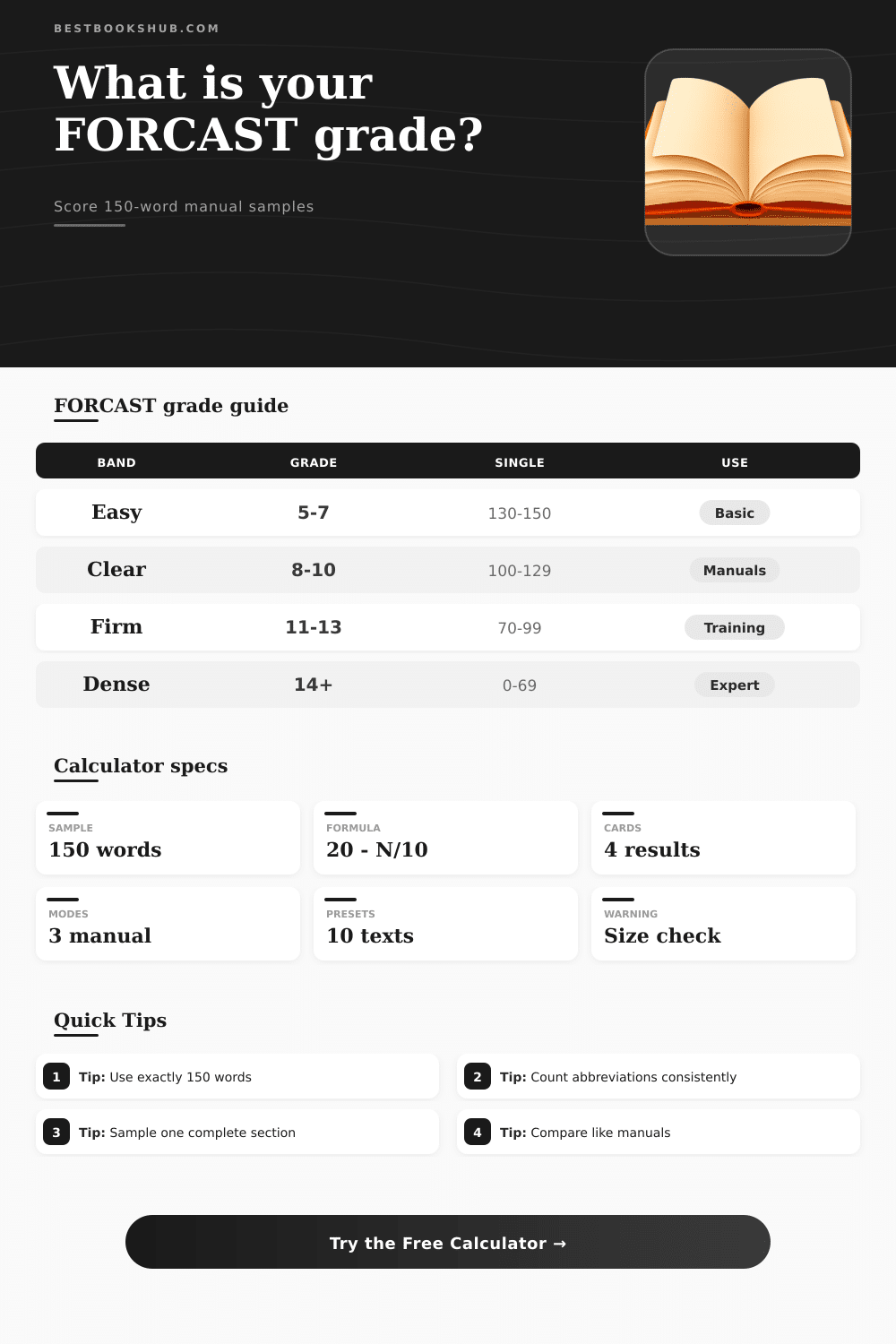
| Band | FORCAST grade | Single-syllable count in 150 words | Likely reader fit |
|---|---|---|---|
| Very easy | 5-7 | 130-150 single-syllable words | Basic workplace or quick-reference instructions. |
| General | 8-10 | 100-129 single-syllable words | Common manuals, forms, and public-facing procedures. |
| Skilled | 11-13 | 70-99 single-syllable words | Training documents with more technical terms. |
| Advanced | 14+ | 0-69 single-syllable words | Specialist, academic, legal, or expert material. |
| Sample option | When to use it | Strength | Watch for |
|---|---|---|---|
| First 150 words | Openings, notices, intro sections | Fast and repeatable | May include headings or setup language. |
| Middle 150 words | Manuals with uneven openings | Often reflects the core procedure | Can land mid-list if text is choppy. |
| Last 150 words | Warnings, summaries, closing tasks | Useful for final action steps | May overrepresent caution text. |
| Average chunks | Long sections with 300+ words | Smooths out one unusual sample | Still report that it is an average, not one classic sample. |
| Text feature | Default handling | Manual mode option | Why it matters |
|---|---|---|---|
| Hyphenated terms | Split into component words | Can keep as one token | Step-by-step may otherwise add two simple words. |
| Numerals | Count as one syllable | Can exclude from sample | Manuals often include codes, sizes, and dates. |
| Acronyms | Count as one syllable | Letters or exclude | Some workplaces read acronyms as letter names. |
| Proper nouns | No adjustment | Short caps as one syllable or exclude | Names and product labels can distort small samples. |
| Document type | Suggested window | Mode | Interpretation note |
|---|---|---|---|
| Workplace procedure | Middle 150 words | Technical manual | Check the section where the reader must act. |
| Training handout | Average chunks | Training handout | Compare core lesson text rather than quiz items. |
| Safety notice | First or middle 150 | Technical manual | Warnings should be clear without relying on headings. |
| Policy page | Middle 150 words | Standard prose | Long sentence formulas may also be worth checking. |
DISCLOSURE: This post may contain affiliate links, meaning when you click the links and make a purchase, I receive a commission. As an Amazon Associate I earn from qualifying purchases.
At work, you open up a new piece of equipment and manual is written in another language. Terms increase, sentences stretch on, and soon enough, you’re scanning for pictures rather than reading. That’s where the FORECAST formula comes into play. It was developed by the U.S. It was developed by the military to help test training materials and job aids.
Rather than typical word gymnastics involving syllables, it focuses on something much simpler: How many one-syllable words do you see within a fixed chunk of text? The fewer everyday words you see, the higher the estimated reading grade level. Its bluntness is beautiful.
Why Simple Words Matter for Safety
Workaday prose are written at grade levels 8-10. At this level, the average grownup shouldn’t find following directions to frustrating. Go lower, and it reads like kiddie stuff. Go higher and even techs with years of experience will start skimming. Once you’ve fed your passage into the calculator, it do the math.
But first you must select a representative excerpt… Not the friendly-sounding intro that dissapears forever when the serious action starts. For example, technical documents presents their own set of counting problems. When do you count something like “check-list” as one easy word, versus two? How about those long strings of part codes and model numbers, keep ’em in the sample, or strip them out? Such questions can make all the difference: one poorly chosen answer and you’re off by a full grade level.
Fortunately, the tool let you test different counting strategies side-by-side to see exactly how much each rule affects your outcome. This is handy if you’re comparing three safety manuals composed of different teams. The lab might have a perfect score, but it never translates into real world readability. Even most thoroughly designed process can go wrong because the light is poor, the user is rushed, or the illustrations don’t agree with the text.
But even then you’ve got a good yellow light blinking at you. If your onboarding docs, patient instructions, and repair guide falls in the fourteen-plus category, then you’ll be warned about impending doom well before anyone gets hurt. Humans read best when words get out of their way. Careful writers has a single habit: they skip the warm-up paragraphs and instead sample the middle of real task description. Those opening lines often use shorter, friendlier language that creates false optimism about the entire document. Either way, the calculator’s going to run the numbers. But only one side will tell you what your reader is actualy in for.
The formula is delightfully simple. Take 20, minus how many single syllable word you have (divided by ten). The resulting number will tell you if an average adult could read through your instructions without getting lost at first glance. This is because functional writing put its complexity in words instead of sentence length. It is easier to understand sentences with many complex words but few syllables than short sentences packed with jargon.
In conclusion, then: the score’s no judgment of you, or your readers’, intelligence. It’s a measure of distance between the writer and the person who has to do something with what was written. Narrow the gap, and mistakes falls away. Widen it, and even the greatest employee will improvise, sometimes perilously.
Next time you edit a manual, try running a new section and see what happens when you swap out words like “three-syllable term” for its one-syllable cousin. You’ll feel it’s a little difference … until you remember someone’s life, or at least livelihood, depends on it. And that’s where most people fail to understand.
Making text readable isn’t about dumbing down. It’s about removing obstacles so the work itself can shine through.