📖 Italian readability lab
Gulpease readability calculator
Paste Italian text to count letters, words, and sentences, then calculate the Gulpease index with education-level bands and a transparent formula breakdown.
Load a realistic Italian passage, then adjust sample mode, sentence counting, abbreviation handling, apostrophe treatment, target education level, and output precision.
| Step | Value | Formula part | Effect on score |
|---|---|---|---|
| Base | 89 | Starting constant | Neutral anchor |
| Sentence term | 0 | 300 x sentences / words | Raises score |
| Letter term | 0 | 10 x letters / words | Lowers score |
| Final | 0 | 89 + sentence term - letter term | Gulpease index |
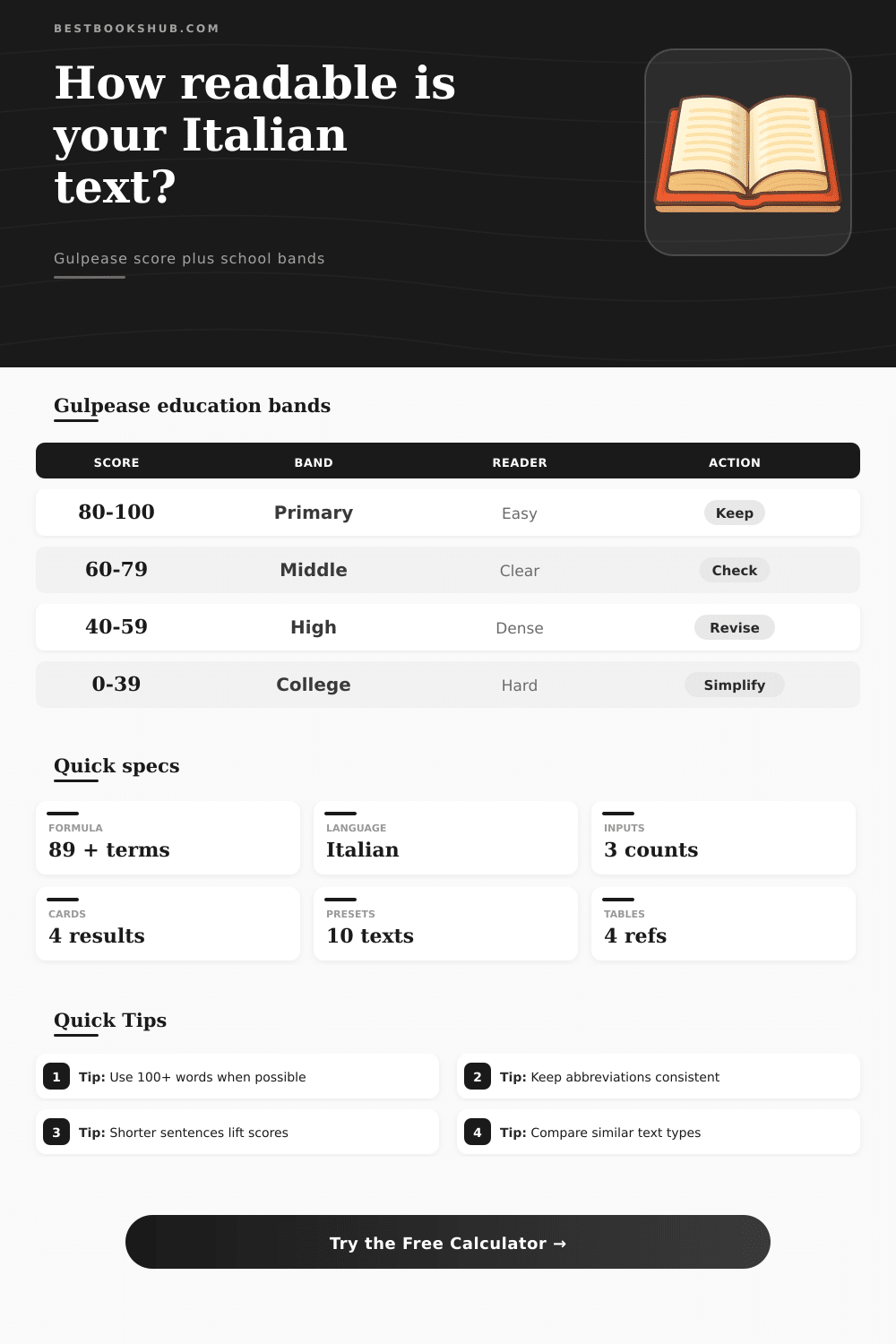
| Gulpease score | Education band | Reading interpretation | Practical target |
|---|---|---|---|
| 80-100 | Primary school friendly | Usually accessible for readers with elementary schooling. | Notices for broad public use, simple lessons, children-facing copy. |
| 60-79 | Lower secondary friendly | Usually manageable for middle-school level readers. | General articles, classroom passages, basic instructions. |
| 40-59 | Upper secondary friendly | Often requires high-school level reading confidence. | Essays, detailed explanations, specialized news or analysis. |
| 0-39 | University or specialist | Likely demanding because words are long or sentences are dense. | Academic, legal, technical, or professional material. |
| Item counted | Calculator rule | Why it matters | Setting to adjust |
|---|---|---|---|
| Letters | Counts alphabetic Italian characters, including accented vowels. | More letters per word lowers the Gulpease score. | Accent mode |
| Words | Counts Italian word tokens, with optional apostrophe splitting. | Words divide both the sentence and letter terms. | Apostrophe mode |
| Sentences | Counts sentence-ending punctuation, line breaks, or manual input. | More sentences for the same words raises the score. | Sentence mode |
| Samples | Uses all text or a controlled 100/250/custom word window. | Comparable samples make score changes easier to trust. | Italian sample mode |
| Text type | Typical Gulpease goal | Common pressure | Revision focus |
|---|---|---|---|
| Public notice | 70-85 | Official nouns and long clauses | Split obligations into shorter sentences. |
| School passage | 60-80 | Definitions and technical terms | Keep examples near new vocabulary. |
| News article | 55-75 | Names, institutions, and dates | Use direct sentence openings. |
| Academic abstract | 25-50 | Nominalizations and dense syntax | Clarify the research action first. |
| Manual instruction | 65-85 | Conditional warnings | Use one action per sentence. |
DISCLOSURE: This post may contain affiliate links, meaning when you click the links and make a purchase, I receive a commission. As an Amazon Associate I earn from qualifying purchases.
Readability calculators is available: try this one called the Gulpease readability calculator to score your own text in Italian. You can use it to score letters, words, sentences, formula steps, sample warnings, and match results to reading bands. Then compare against useful reading band level of education.
Suppose you write a crucial letter to parents. Half the families only gets as far as first paragraph before putting it aside. The problem is not usually that the idea isnt good. Much more often, the weight of the sentences and the length of the words has gently pushed it too high for where the reader wants to be. This is easy to do with Italian’s flowing vowels and detailed bureaucratic habits.
How to Use the Gulpease Readability Calculator
Having a purpose-built tool for language will alter your revising. Three simple word-counts forms the basis off the Gulpease index: sentences, words, and letters. From these three, it calculates a number between zero and a hundred. A higher number mean an easier read. Short words and short sentence are rewarded by math. Long compound words, something Italian authors like to toss around, get gently punished.
There’s no need to count syllables or apply complex phonetic formulas. Paste the text into the calculator, and let it do the math. What matters is not the number itself but what those counts of letters, words, and sentences tells you about your draft.
How about effect of sentence rhythm? If you keep cramming many ideas into one long sentence, your word count will stay small. As a result, your score plummets. Unpack those explanations or obligations as two or more sentence and watch the number rise. Nothing has changed in meaning. The same principle extend to words. One fancy noun may hold enough syllables to tip scales. That’s particularly the case with text like school stuff and formal announcements. The score shows exactly where that tension come from. From there, you can judge if it matters.
This translates practically into education bands. For general public announcements or young readers, then anything with a score around the eighties is usually comfortable. For every day news briefs and classroom texts, the scores in the sixties will be adequate. Below this, say in the forties or lower, you’re dealing with specialists or more confident older student. This isn’t hard and fast law. It’s merely an indication of when most readers at that level of schooling would stop needing to read something again.
It’s easy to conceal flaws with a long document; when we look at only the first two hundred and fifty words, we see what we do over and again while nobody is looking. What about the part right after the middle? Or even the middlish bit? Slice it up and let the tool compare it for you fairly. Sample consistently and you have more than a one-off number… You’ve got an editing compass you can trust.
There’s a common belief among writers that the more words they use, the better their thinking must be. I see it all too often in Italy: a wordy elegance where an expression will dazzle your peers but confuse your family. On the flip side, over-clipped writing reads as juvenile to grownup eyes. Often, the sweet spot comes from intentional variety. Make main ideas accessible. And let one or two richer words slip through if precision realy matters.
No, there’s no magic bullet. There is no formula. Yet, context remains most important. The Gulpease score won’t answer if your reader is familiar with the subject matter. The Gulpease score won’t say anything about whether the layout helps or hurts. Nor will it speak to cultural references that may confuse the reader. And it says nothing about tone. A great score for a paragraph can still leave us feeling condescending or cold.
This is why I think of the index not so much as a final judge but a fellow conversationalist. Note that it’s sensitive to abbreviations and apostrophes in terms of counting. You could count each word separately: “l’amico,” as two words; or treat them together, which will affect both word count and total number of letters. It makes a difference, but subtlely so. The period is not considered the end of a sentence if there is an abbreviation guard in place. Small settings. They avoid the tool reading your intentions incorretly.
The bottom line: The calculator won’t write for you. But it will hold up a mirror that lets you know what in your piece is doing more than its fair share. Paste the same passage into the calculator after each substantial edit. Notice where making those little splits and snips makes the needle jump. Gradually you’ll start feeling the score before pasting the words in. And that’s the most helpful result. It comes from checking again and again.
Next time you’re done with a draft, ask yourself: Will this get to the right folks? Run a couple of paragraphs through the tool. You might be surprised by what you see, though I’ve found its numbers are seldom wrong. Sometimes clarity and elegance tug in opposite directions. But a little honest measurement can help a lot, especially if you speak Italian.