📖 Spanish perspicuity lab
Szigriszt-Pazos readability calculator
Paste Spanish prose to count words, sentences, and syllables, then calculate the Szigriszt-Pazos perspicuity score with Spanish vowel-group controls and clear bands.
Load Spanish-style samples for public notices, education, manuals, fiction, health, legal, and academic prose. Each preset fills the controls and recalculates.
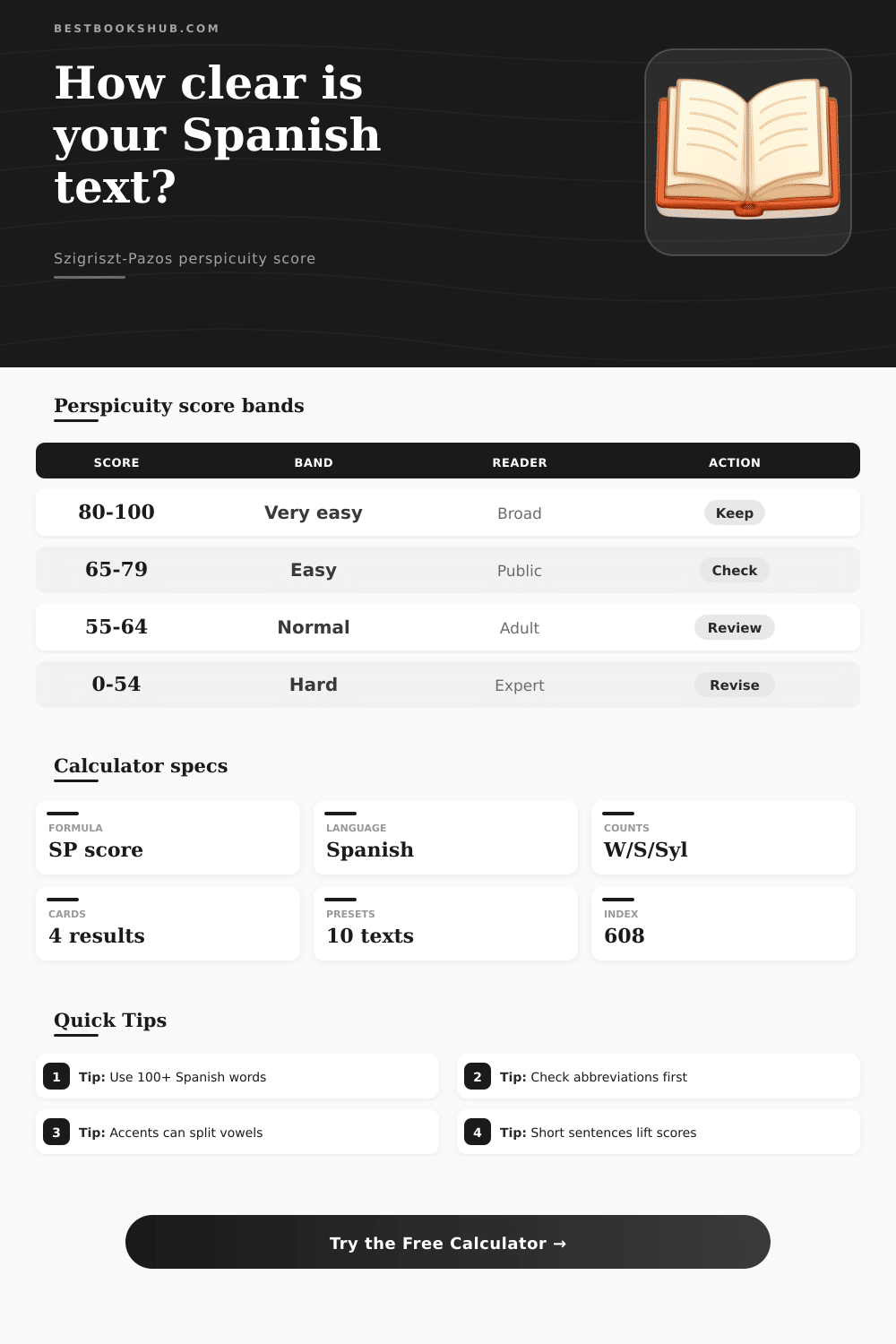
| Score range | Perspicuity band | Typical signal | Editing response |
|---|---|---|---|
| 80-100 | Very easy | Brief, direct Spanish with low sentence pressure. | Usually keep unless the tone is too simple. |
| 65-79 | Easy | Comfortable public-facing Spanish for broad audiences. | Good target for notices, help pages, and health text. |
| 55-64 | Normal | Standard adult Spanish with moderate complexity. | Review long sentences and high-syllable clusters. |
| 40-54 | Somewhat difficult | Dense adult or specialist prose. | Simplify sentence structure if access matters. |
| 0-39 | Very difficult | Academic, legal, or technical load. | Rewrite first for general readers. |
| Variable | How this calculator counts it | Formula role | Score effect |
|---|---|---|---|
| Words | Spanish letter tokens, with optional numerals. | Denominator for syllable and sentence averages. | Stabilizes the score as the sample grows. |
| Sentences | Punctuation, guarded punctuation, line breaks, or manual count. | Creates words per sentence. | More words per sentence lowers perspicuity. |
| Syllables | Spanish vowel groups with accent and hiatus settings. | Creates syllables per word. | More syllables per word lowers perspicuity. |
| Constant | 206.835 is the fixed formula anchor. | Starting point before penalties. | Keeps output on a reading-ease style scale. |
| Control | Spanish feature | Example signal | When to adjust |
|---|---|---|---|
| Standard vowel groups | Diphthongs and strong-vowel breaks. | aire, teatro, pais | Best default for most pasted Spanish prose. |
| Strict accent hiatus | Accented weak vowels split clusters. | dia, frio, poesia | Use when accents are preserved in the text. |
| Silent u removal | que, qui, gue, gui patterns. | quedar, guerra | Leave on for standard Spanish spelling. |
| Split uncertain vowels | Conservative high-syllable estimate. | leer, caoba | Use for manual audit or edge-case checking. |
| Sample size | Reliability | Best use | Watch for |
|---|---|---|---|
| Under 50 words | Low | Quick sentence check only. | One sentence can swing the score. |
| 50-99 words | Fair | Short notice or excerpt review. | Abbreviations and headings can distort counts. |
| 100-249 words | Good | Most web, book, and classroom samples. | Compare against another similar passage. |
| 250+ words | Strong | Stable editing benchmark. | Use windows for mixed-topic documents. |
DISCLOSURE: This post may contain affiliate links, meaning when you click the links and make a purchase, I receive a commission. As an Amazon Associate I earn from qualifying purchases.
The Szigriszt-Pazos calculator scores Spanish readability. This is a tool for looking at the number of syllables in a passage, the length of its sentences, and the length of its words. Compare these findings against some realistic bands then revise passages from books, classrooms or any other public setting.
Much off the time, when something written in Spanish seem difficult or easy to understand, the issue boils down to relationship between syllables and sentences. Long words has their place, but they also become barriers on the page. Spanish structures itself like music. Dense clusters cause reader to exert more effort. This is what formula tests. Modest numbers of syllables per sentence and short sentences is rewarded. Heavy ones are not.
What the Score Means
It’s Spanish-tuned: Vowels behave different in that language than they do in English, and the formula takes that into account. Some vowel combos glide; other ones separate with an accent. Drop a legal warning, school note, or health advisory into the thing, and see where the load rests.
Most people should of be able to read it easily with a score of 80+. Below 55, and now you’re asking the reader to lift a finger. That makes a difference if your audience is busy parents, elderly neighbors or students still assembling their vocabulary.
The impact of word length are large. Swap out difficult words for easier ones; the score shifts by just a few points. But what if you divide a twenty-eight-word sentence into two thoughts of fourteen words each? Odds is good that the score shifts by five or six points. That’s where the tool gets interesting: You see this exchange happen in realtime.
The calculator measures syllables based off your preference. It ranges from a hard-and-fast rule separating accented vowels, to a more lenient one allowing some merging that better matches spoken language. These aren’t cosmetic options: They reflect actual choices around audience and setting.
“No one number is ever better then context.” If an academic paragraph scores in the low forties, this might be exactly where it should be for readers expecting a dense academic style. Even well-scoring patient leaflet can still fail if vocabulary assumes knowledge the reader does not have. No matter how well a patient leaflet score, if its vocabulary is beyond what its intended audience knows, then it has failed.
The point of the bands is to provide you with a common language with which to discuss things with your colleagues and editors; they are not a substitute for judgment. Think of them as a weather report: they tell you what to pack in terms of clothing, but ultimately it’s up to you whether or not to go to the picnic.
Try out some drafts and soon you’ll find common mistakes. Older counters was easily fooled by abbreviations (every period meant end of sentence), making a hard text seem simple. That’s corrected with the guarded punctuation option. And without checking proper names and numbers, they too can skew the count. A long list of capitalized institutions or dates will pump up the number of syllables all at once. What to do? You choose. The bottom line score is based only on how it reads.
Repeated practice with this kind of tool give writers an ear for rhythm. They get to know where a paragraph might be starting to droop forward into gravity’s embrace. They realize that they don’t simplify their ideas for clarity. That makes things worse. Clarity arrives through rearranging those ideas until the ideas themselves seems to breathe.
Simpler syllable patterns makes less friction. So do short sentences, which create space. The reader doesn’t have to work at reading the container; instead, the content itself shines through.
In the final analysis, however, the score is only a mirror. It’s a mirror reflecting what you’re trying to get across to another person, and what you want them to do to try to understand. What you have to look at is the reflection; that’s the craft. Do you think it’s worth the effort? If so, then change your words until they fall lightly on their mark and land exactly where you mean them to.