📏 Sentence rhythm lab
Median Sentence Length Calculator
Paste prose to calculate median sentence length by words and characters, compare mean versus median skew, read quartiles, flag outlier sentences, and match the draft to target style bands.
Load a realistic sample, then tune splitting, word counting, character basis, style band, outlier method, and row display.
DISCLOSURE: This post may contain affiliate links, meaning when you click the links and make a purchase, I receive a commission. As an Amazon Associate I earn from qualifying purchases.
Tables show ranked sentence lengths, quartile signals, outliers, and target bands. They do not rewrite the text or make style decisions for you.
| # | Words | Chars | Band | Quartile | Outlier | Relative size | Preview |
|---|---|---|---|---|---|---|---|
| Paste text to populate sentence rows. | |||||||
| Signal | Words | Chars | Sentence | Interpretation | Action |
|---|---|---|---|---|---|
| Signals appear after calculation. | |||||
| Outlier rule | Sentence | Words | Chars | Reason | Preview |
|---|---|---|---|---|---|
| Outlier sentences appear after analysis. | |||||
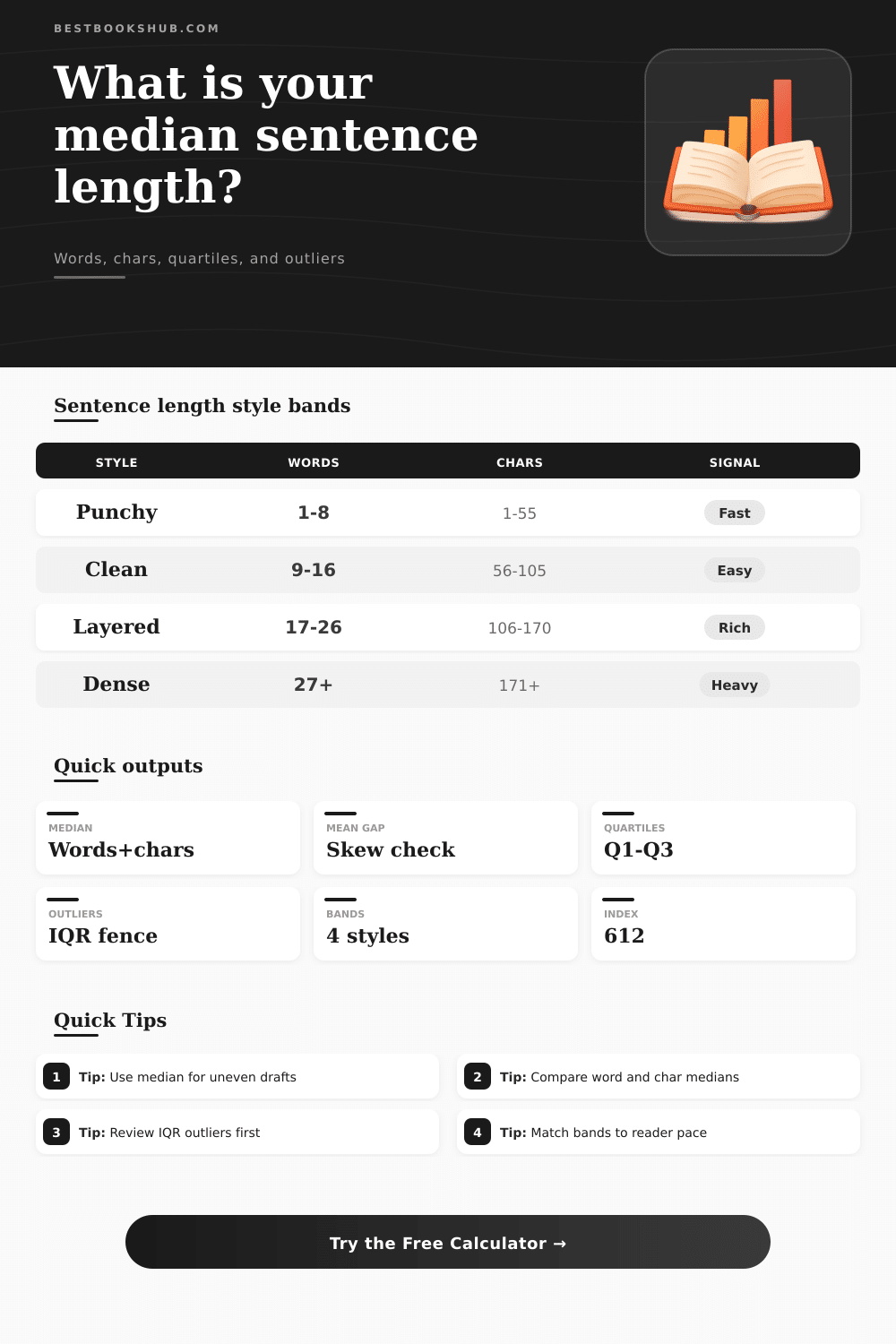
| Style band | Words | Character feel | Typical use | Watch for |
|---|---|---|---|---|
| Punchy | 1-8 | 1-55 chars | Thriller beats, dialogue, emphasis | Choppy rhythm if every line is short. |
| Clear prose | 9-16 | 56-105 chars | Reviews, web prose, study notes | Flat rhythm if all sentences match. |
| Balanced | 12-22 | 75-145 chars | General fiction and nonfiction | Weak focus if clauses stack up. |
| Layered | 17-26 | 106-170 chars | Reflective, literary, explanatory prose | Delayed verbs and buried main ideas. |
| Academic | 22-34 | 145-230 chars | Dense argument or technical explanation | Reader load rises quickly. |
So you open up your draft and think: This looks good. But there’s just something off with the rhythm, readers pull away from it. Maybe each sentence appear okay on its own, but together they create either a dragging or racing pace. More than likely, that insidious undercurrent has to do with median sentence length.
Averages is the things people talk about. But medians will tell you what a typical sentence will feel like for the majority of the page. They won’t let one big bloated paragraph skew mean.
Why Median Sentence Length Matters for Your Writing
For a couple of hundred years writers have sought perfect sentence length. Hemingway made his name writing sentences no longer than eight words long. He made each one as clear and direct as possible. Faulkner responded with running sentences capable of spanning a full breath. One wasn’t right or wrong. They was each signaling a unique experience in their own way.
This online word count tool doesn’t require guessing; it measures what’s important when revising: the length of your own draft so far. Input a few sentence and check off rules for splitting words. Click to get the word count and character counts by more than one definition. Then, know where you stand.
That’s where things get interesting, because then you begin to fiddle with settings. Do you want sentence splitting mode to draw the line at punctuation, or treat each line break as a hard stop? Should abbreviation protection prevent terms such as “U.S.” or “Dr.” from being split in two? Do you want word counts to combine or separate hyphenated compound words?
This isn’t minutiae just for its own sake. It reflects actual editorial judgment. Different types of writing require different rules: Dialogue-heavy scenes differ from grant proposals. Tweak one parameter and suddenly the whole thing look different. This is why it helps to try several settings and see how they affect your text… What your text is realy doing under the hood.
But then those numbers come in, and mean gap is your friend. If average is much higher than the median, it’s clear that several lengthy sentences is pulling much of the load. You can bet there will be lumps of ideas rather than a free-flowing sentence which is another red flag. The interquartile range flags the troublemakers, the ones you should of break up or cut first. Why do so many writers spends time revising the wrong sentences? They gloss over gunk without touching clumps, and massage the good stuff. Skipping to the statistical outliers avoids this waste.
Another lens is style bands. For instance, a punchy band likes to beat quickly, ideal for instructional web copy and thrillers. Literary writers has space to breathe in layered areas. Clear prose falls into the comfortable middle where most readers of nonfiction expect to find it. None of these are a commandment. Rather, they’re mirrors. If you see that your draft lands squarely within one band while your target audience inhabit another, this explains why beta readers said it seemed off but couldn’t pin down why.
Words don’t capture another piece… Characters. Fifteen word sentences can be breezy or dense, depending on the font and width of columns. And longer character strings gets punished much quicker by mobile screens than even an editor’s fiercest red pen. Measuring these two things in tandem avoids the temptation to write something beautiful for the printed page. When no one will ever actualy print it.
There is no substitute for taste. You can be perfectly on all the right bands and sound like a robot. Variation is as important to rhythm as consistency. Short sentences after longer, more considered ones make the best prose writing. This tool just enables you to see what kind of wave you’ve made and then choose if you want to change it or not.
So understanding median sentence length won’t magically transform your drafts into literary works. But it eliminates the mystery surrounding perhaps the most under-mentioned-yet-influential element of our craft. When you have eyes wide open on this pattern, revision no longer feels as if you’re just guessing at it; it begins to feel like conducting.
Now it’s up to you: When do I speed? When do I linger? And how will I land that last note precisely where it has to be felt by the reader?