📖 Sentence rhythm statistics
Sentence Length Variance Calculator
Paste prose to calculate sentence-length variance, standard deviation, coefficient of variation, rhythm consistency, short and long outliers, and a live distribution chart.
Load a realistic sample, then adjust the detection and threshold controls. This is a variance and rhythm tool, not a median sentence finder.
DISCLOSURE: This post may contain affiliate links, meaning when you click the links and make a purchase, I receive a commission. As an Amazon Associate I earn from qualifying purchases.
The first tables update from your sample. The reference tables describe variance, CV, and rhythm bands rather than reporting a duplicate median sentence list.
| # | Length | Difference | Squared diff | Z-score | Flag | Range position | Sentence preview |
|---|---|---|---|---|---|---|---|
| Paste text to populate sentence variance rows. | |||||||
| Flag group | Count | Share | Main signal | Review focus |
|---|---|---|---|---|
| Flags appear after calculation. | ||||
| Profile | Typical average | Comfortable CV | Variance feel | Best use |
|---|---|---|---|---|
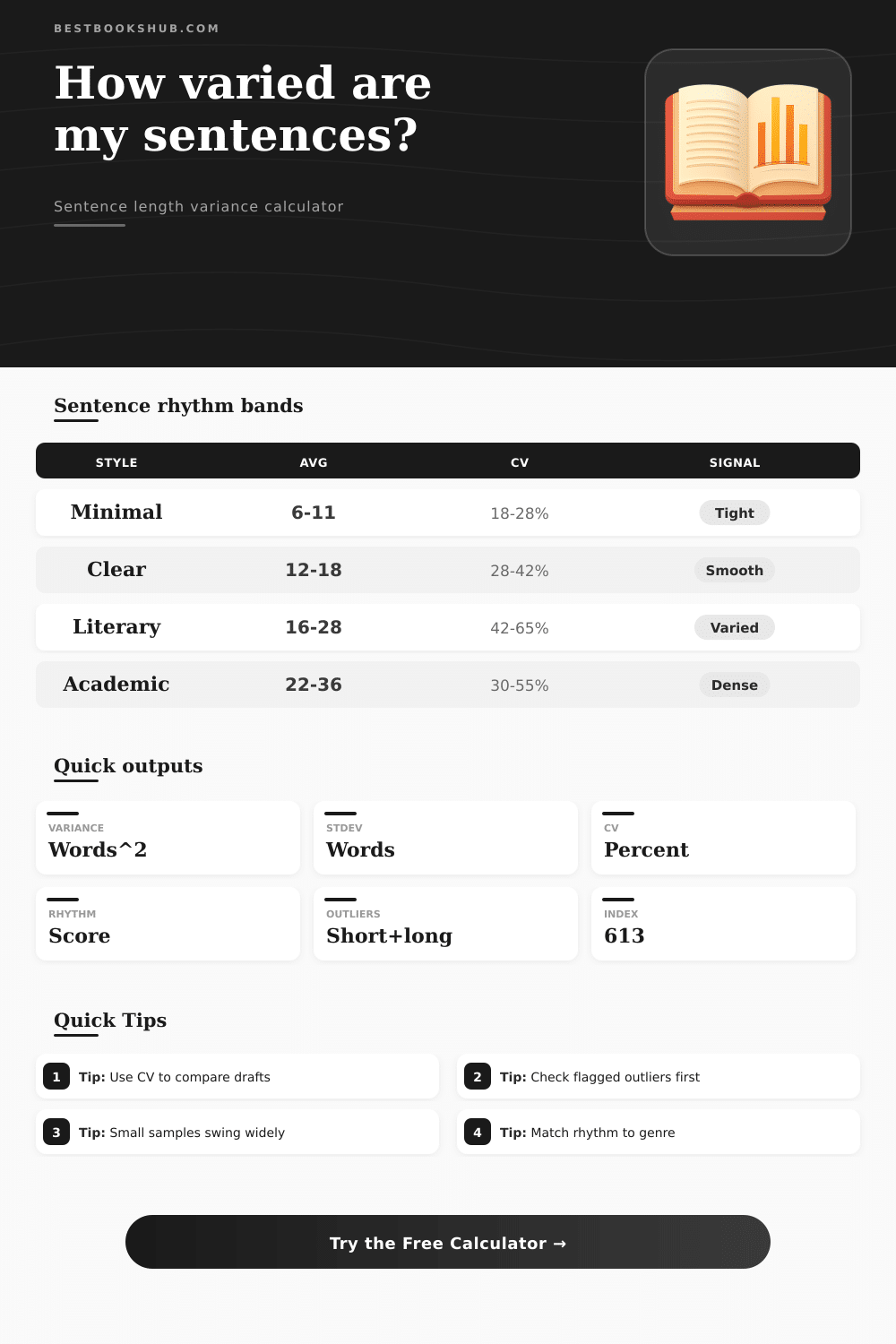
| Minimalist or early reader | 6-11 words | 18-28% | Very tight | Clear action, simple narration, controlled reading load. |
| Balanced prose | 12-18 words | 28-42% | Smooth range | Articles, reviews, commercial nonfiction, readable chapters. |
| Thriller or suspense | 8-16 words | 35-58% | Pulse shifts | Short bursts mixed with occasional longer setup sentences. |
| Literary or memoir | 16-28 words | 42-65% | Expressive variety | Voice-driven prose with intentional long and short contrast. |
| Academic or technical | 22-36 words | 30-55% | Dense but stable | Explanatory writing where long sentences should stay readable. |
| Marketing and web copy | 7-15 words | 40-70% | High contrast | Headlines, punch lines, and short calls balanced with context. |
| Statistic | Formula idea | Low value means | High value means |
|---|---|---|---|
| Variance | Average squared distance from mean | Lengths cluster closely | Large swings between sentences |
| Standard deviation | Square root of variance | Predictable rhythm | Sentence lengths differ strongly |
| Coefficient of variation | Stdev divided by mean | Consistent relative rhythm | Uneven or highly expressive rhythm |
| Z-score outlier | Distance from mean in stdevs | No statistical extremes | Specific sentences deserve review |
| Short/long flags | User threshold comparison | Fits target profile | May need pacing intent check |
The Sentence Length Variance Calculator measure the variance of sentence lengths in your text to help you revise for more effective rhythm. Often when we’re writing, we has an idea of good rhythm but are not sure what it looks like on paper. We write our piece and read it out loud. Something isn’t quite right. Maybe it’s dragging? It might also be jumping from short bursts to long explainers. Most of those feelings of discomfort stem from “variance”, how far apart are your sentences in terms of length from each other? Here is the chance to take that gut instinct and turn it into something visual that you can tweak before anyone else read it.
Sentence length control pace, emphasis, and how much effort reader spends. Use a series of short sentence for clarity/urgency, whether in instructions or action scenes. But spend too long in that lane and work begins to read as childish. Slip back into longer constructions and you run the risk of losing readers who wants to know what’s happening next. Between those two extremes lies sweet spot; and that varies different than purpose, audience and genre.
How to Check Your Sentence Rhythm
But then you begin to compare drafts, and that’s where things get realy interesting. The raw averages hides what’s going on: Two texts could have equal average lengths but be entirely distinct experiences. One may swing widely; the other may cluster tightly. That’s why coefficient of variation matter, by normalizing the spread relative to the average, it allow you to make a fair judgment about rhythm, even if one draft features longer sentences on average then another.
And that’s where most people falls short. There is always outliers. One very brief sentence at the end of a series of longer sentences will stand out like a gunshot to reader. A very long sentence must be worth its weight in how clearly it is written and actual insights it offers, or else it seem simply self-indulgent. That’s when the calculator flag things for you, saving you from hunting for them yourself.
But flags aren’t verdicts; they’re warnings. Treat them as an invitation to ask about what made this one appear here. Some genre require more variation than others. Children’s books rely on minimalism: many short sentences, little variety. The same goes for academic writing: it needs to be dense without becoming unreadable. Marketing copy thrives on contrast; literary work embrace swinging expression, colliding long thought lines with abrupt blunt observations. And minimalist fiction relies heavily on controlled restraint. If you match your rhythm to what the audience expects from form, you avoid making them feel out of place when structure and style do not fit together.
If you just feed it some small samples, results will swing like a weather vane. Run the numbers on only three paragraphs, and you’ll be misled. Feed it a whole chapter or even a scene, though, and patterns settles down. Description stretches out units; dialogue tends toward shorter ones. Compound sentence are inevitable in technical explanation. Only within context of your own narrative do these numbers begin to make sense.
Instead, when you begin to think of rhythm as a measurable layer, not some mysterious mood, revision speed up. You would of had to guess anymore because you can see exactly where the writing is dragging (or sprinting). And now you’ll have conscious choices, not random cuts. With distribution chart in hand, you can observe if your pieces are clustering too closely on one side or scattering without cause.
There’s always room for breath in prose; for acceleration, for deceleration, just as there are times in a good conversation when one person doesn’t drone on endlessly. Figure out how that works in your writing and let the work tell you what it wants. Change up based off what the piece requires. Let the numbers be your mirror. Whether readers stay for the entire tale depends on what you do in front of them, not on what the numbers say.