📖 Spoken texture lab
Syllable Density Calculator
Paste prose, dialogue, poetry, narration, or study text to estimate syllables per 100 words, syllables per sentence, complex syllable density, vocal load, and manual syllable corrections.
Load a sample, then tune the counting method, sentence handling, complexity threshold, delivery speed, and manual adjustment.
DISCLOSURE: This post may contain affiliate links, meaning when you click the links and make a purchase, I receive a commission. As an Amazon Associate I earn from qualifying purchases.
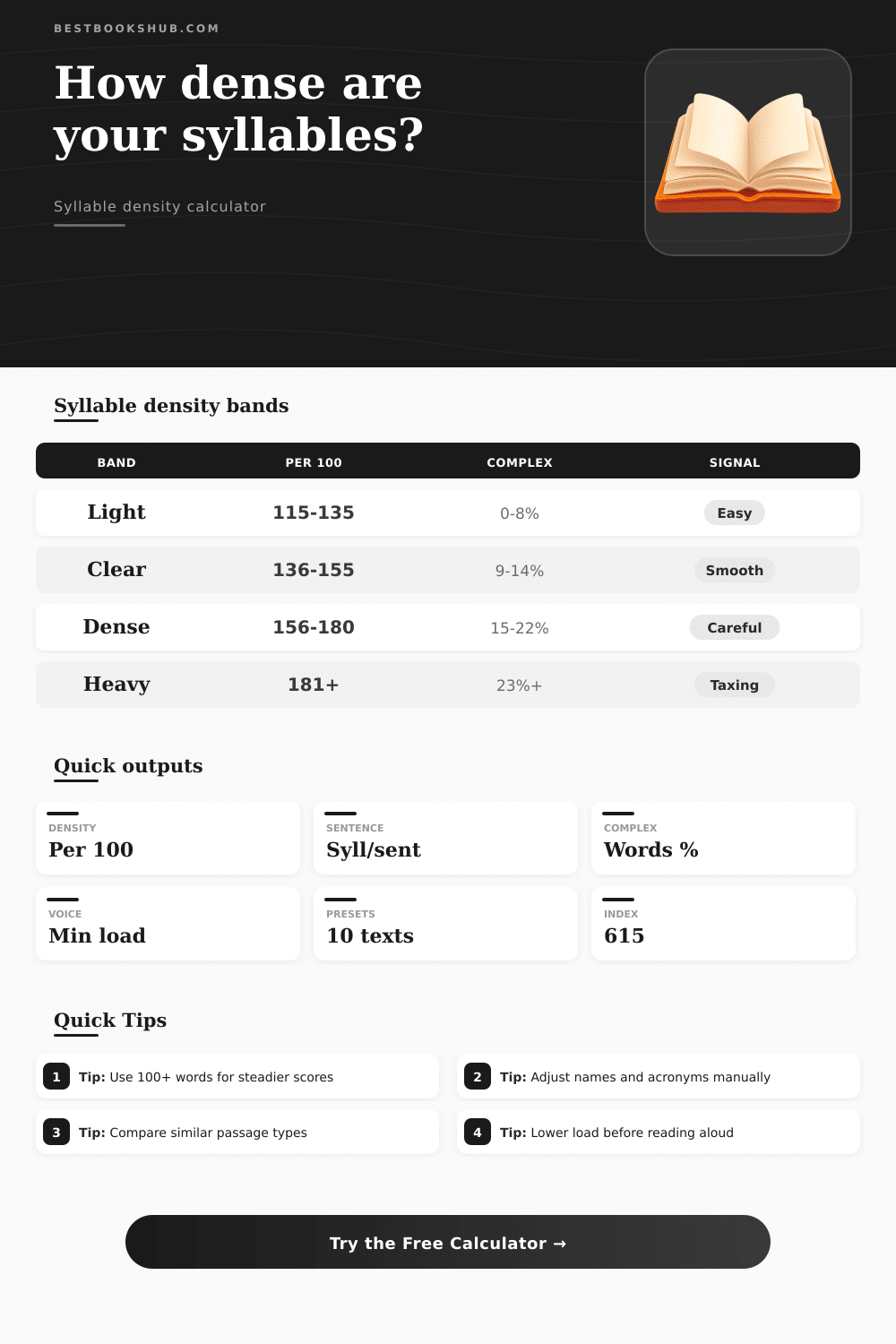
Use these tables to interpret density-specific results for reading, revision, and oral delivery.
| Density band | Syllables per 100 words | Typical feel | Revision signal |
|---|---|---|---|
| Light | 115 to 135 | Quick, plain, easy to voice | Good for young readers, dialogue, and fast explanation. |
| Clear | 136 to 155 | General nonfiction or commercial prose | Usually balanced unless sentence load is also high. |
| Dense | 156 to 180 | Literary, technical, or abstract texture | Check clustered terminology and long sentences. |
| Heavy | 181+ | Demanding vocal and cognitive load | Break sentences, swap terms, or add breathing room. |
| Syllables per sentence | Oral reading effect | Best fit | Watch for |
|---|---|---|---|
| Under 18 | Low breath demand | Dialogue, captions, early chapters | Can feel choppy if every sentence is short. |
| 18 to 30 | Comfortable narration | General essays, reviews, study guides | Usually stable for live reading. |
| 31 to 45 | Noticeable breath planning | Literary prose, complex explanation | Listeners may need pauses or resets. |
| 46+ | High vocal load | Formal lectures, dense argument | Consider splits before audiobook or speech use. |
| Complex threshold | What it captures | Use when | Manual check |
|---|---|---|---|
| 3+ syllables | Common readability pressure | Comparing prose, study pages, and web text | Names and familiar compounds may overstate load. |
| 4+ syllables | Heavier terminology | Academic, critical, or technical passages | Good middle ground for advanced readers. |
| 5+ syllables | Very long words only | Finding extreme mouthfuls in narration | Misses many moderately complex words. |
| Manual adjustment | Proper noun correction | Fantasy names, acronyms, verse, dialect | Add or subtract after reading samples aloud. |
| Passage type | Density target | Complex target | Vocal target |
|---|---|---|---|
| Children's read-aloud | 115 to 140 | 0 to 8% | Low to moderate |
| Trade nonfiction | 135 to 160 | 8 to 15% | Moderate |
| Literary fiction | 145 to 175 | 10 to 20% | Moderate to high |
| Academic prose | 160 to 195 | 16 to 28% | High |
This is the Syllable Density Calculator. This tool analyze the number of syllables per sentence and syllables per 100 words. It also looks at amount of complex words, vocal load, and manual correction for poems, prose, scripts, and passages to study.
The moment you say them out loud, you know. Sometimes a passage seem to glide right off your tongue; other times by the time you’ve said three sentences, your jaw is sore from holding a position for so long. The disparity isn’t always about raw word count. No, this one is within the very mouth-feel of the language itself, and that imperceptible texture determine if an audience will remain with you or begin to drift away.
How to Use the Syllable Density Calculator
But that’s just gut feel. Enter this thing, which I made to turn it into a number you can look at. It takes a paragraph of text, from your manuscript, or your lecture notes, or the kids’ story you’re editing, and it silently counts the number of syllables contained in it, the amount of work your voice will be doing.
The key isn’t the raw number; it’s density: the number of syllables per hundred words. Elegance is a tempting goal that writers pursue without understanding how much they’re increasing the workload of readers following their sentences. Four-syllable Latinate words may impress those reading them, but when uttered aloud? It’s like a tongue twister, which happens because writers often chase elegance without realizing they are raising the effort level for every reader who follows.
And your calculus can show you that relationship before you get to the podium or the recording booth so that you start to see a pattern. Literary fiction stays around the middle of the range, using rhythm different than density; academic writing love its clusters of complexity. This also applies to sentence length. If every idea spans forty words, even if you’re keeping syllables to a moderate level, the breath demand will climb more quickly then most readers anticipate, exhausting them without ever having much need for your syllable count.
And that’s what most writers overlook until it’s too late: what sounds like a comfortable rate of silent reading is punishing out loud. It also comes down to delivery method. A quiet read requires less effort from you; a performance or teach-in increase things as it costs you more air for tone, pause and emphasis. The tool accounts for this variation. It stops you from second-guessing if your audiobook chapter will leave narrators gasping for breath or if your conference talk should of been cut down.
Invented terms and proper nouns are riddled with common errors. On screen, fantasy names may seem easy to say. But when spoken aloud, they has three clumps of vowels. Acronyms also throw us off because we forget how people says them out loud. This is where the manual adjustment field comes into play. Speak the passage aloud once and your ear will notice something the algorithm does not. Adjust accordingly.
Never trust one number over context. What might sink a corporate training video or children’s book could be a rich passage in a quiet adult literary novel. In those books, committed readers is on board for something dense. Don’t go hunting for an absolute number. Instead, compare the same type of thing to the same type of thing. No need to make your book reviews sound like research papers. Remember that poems can break the rules because the act of breathing itself is part of their art.
Once you get in the habit of seeing them, revision accelerates. Suddenly you’re substituting “use” for “utilize” without a second thought, breaking up long sentences before you hear it on the calculator. The number stops seeming like judgement and starts feeling like a conversation with your draft. It’s still your work. The calculator just shows how much effort your words take to hear and say so that you can listen to that effort. Then respect it and decide if the texture supports the story or if the story needs some air.