📖 Sentence rhythm lab
Sentence Type Distribution Calculator
Paste a passage and measure how much of it is declarative, interrogative, imperative, or exclamatory. Compare the mix against editing targets for fiction, essays, reviews, blurbs, dialogue, and instructions.
| Writing context | Declarative | Questions | Commands | Exclamations |
|---|---|---|---|---|
| Academic abstract | 80% to 90% | 0% to 8% | 3% to 10% | 0% to 3% |
| Narrative fiction scene | 55% to 75% | 8% to 18% | 7% to 18% | 4% to 12% |
| Dialogue-heavy scene | 35% to 55% | 20% to 35% | 10% to 22% | 5% to 14% |
| Instructional handout | 25% to 45% | 0% to 8% | 45% to 65% | 0% to 7% |
| Back-cover blurb | 40% to 60% | 10% to 25% | 12% to 28% | 4% to 14% |
| Sentence type | Primary cue | Secondary cue | Common false positive |
|---|---|---|---|
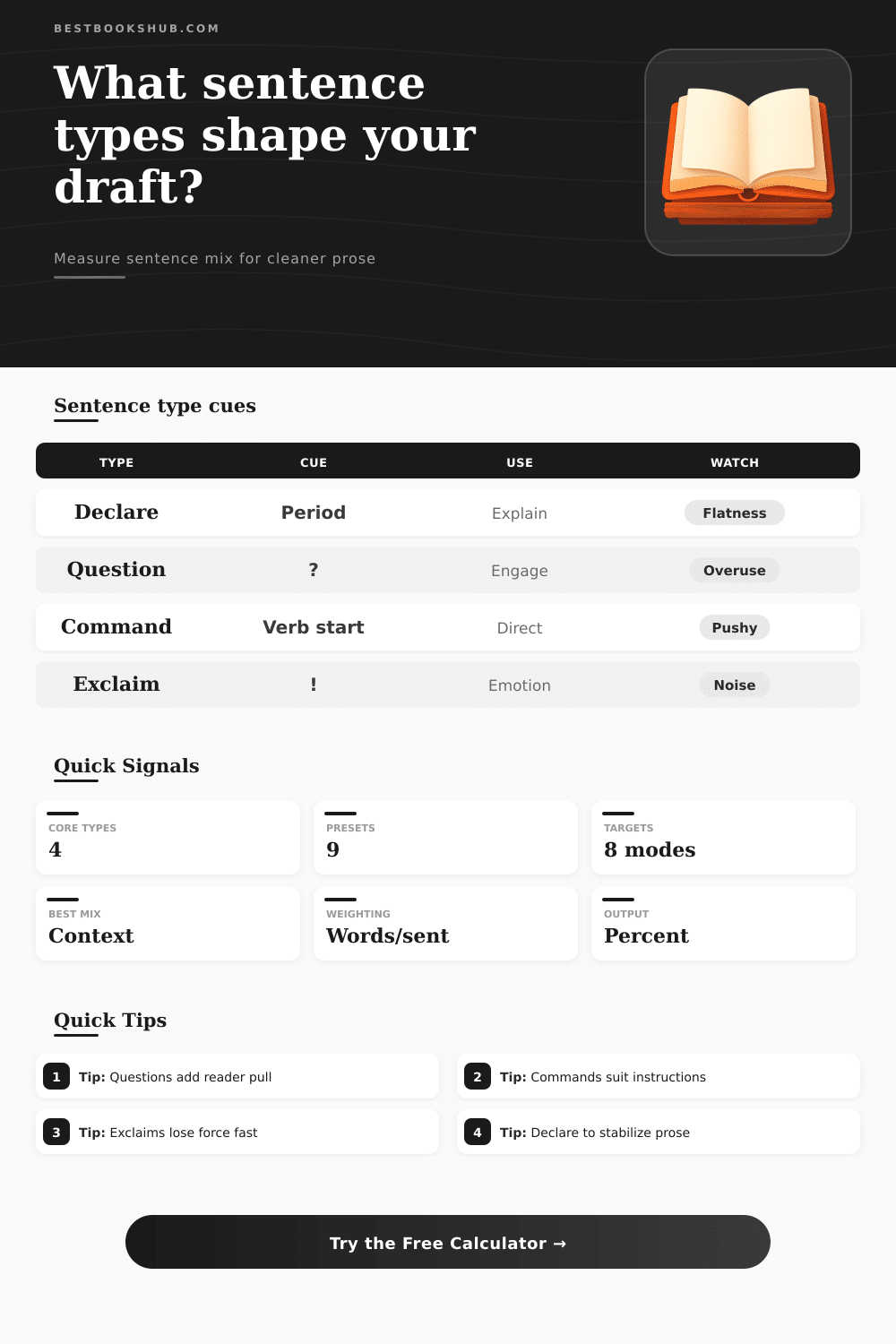
| Declarative | Period or neutral ending | Subject plus verb statement | Short headings without punctuation |
| Interrogative | Question mark | Who, what, when, where, why, how | Quoted rhetorical fragments |
| Imperative | Opening verb command | Please, do not, remember to | Dialogue with omitted subject |
| Exclamatory | Exclamation mark | What or how plus emphasis | Brand-style hype or repeated marks |
| Signal | Likely effect | Useful edit | When to keep it |
|---|---|---|---|
| Very high declaratives | Stable but possibly flat | Turn key transitions into questions | Research, exposition, summary |
| Many questions | Curious, tense, or restless | Answer some questions with statements | Dialogue, mystery, coaching copy |
| Many imperatives | Direct and action-oriented | Soften commands with context | Instructions, lessons, calls to action |
| Many exclamations | Energetic but loud | Reserve marks for real emotional peaks | Comic voice, panic, celebration |
| Target profile | Best use | Dominant type | Typical warning |
|---|---|---|---|
| Balanced general prose | Blog sections, mixed essays | Declarative | Can feel unfocused without a clear lead type |
| Academic or research prose | Abstracts, papers, reports | Declarative | Questions and exclamations stand out quickly |
| Dialogue-heavy fiction | Character exchanges | Questions | Too many questions can stall movement |
| Instructional classroom text | Worksheets, directions | Imperative | Too many commands can sound abrupt |
| Back-cover or sales blurb | Hooks, jacket copy | Declarative | Too many exclamations can weaken trust |
DISCLOSURE: This post may contain affiliate links, meaning when you click the links and make a purchase, I receive a commission. As an Amazon Associate I earn from qualifying purchases.
Here’s a type of sentence distribution calculator: Plug in a passage and find out what percentage consists of statements, questions, commands, exclamations. Then adjust the ratio against some actual editing goals.
Sentence types aren’t anything writers thinks much about. Until they hear the rhythm go wrong. Then you’ve completed a draft and is reading it through. Something isn’t quite right, it may be grammatically correct, but it still feels forced and flat. What is often bothering you? It is an imbalance you didn’t consciously notice because no one ever measure it intentionally. One type quietly dominates while other are neglected.
Why Sentence Balance Matters for Your Writing
Enter any passage here for a quick look at the form your writing are taking behind the scenes. The heavy lifting come from declarative sentences, the ones that tell us what’s going on, who did what to whom, and how things is. Push the percentage too high, however, and the writing turns gray; readers start skimming because nothing tugs at them. But go too far and the whole page goes gray. There’s no pull; readers skim. The line appears right there in the calculator. You can get away with it longer in an academic paper than a back-cover blurb.
Questions draws readers along. They establish a tiny gap, and the brain automaticly seeks to fill it. They’re naturaly in mystery openers and in dialogue. They can absorbs attention in an instructional handout. The challenge is spotting moments when questions aren’t adding interest but instead sound like nervous filler. One good question following a series of statements will jolt a whole paragraph awake. Three on a trot may leave you feeling twitchy about the prose.
More than most authors realize, it’s all about balance. Authority means commands has power. They’re instructions to the reader. Frequently they lack a subject. They are perfect for recipes, worksheets, and calls to action. In narrative fiction, however, that kind of pushy voice sounds as though author is barking an order.
With this tool, you see how many imperatives begin each sentence in a passage, and you make decision about whether that pushiness helps or hurts. Those forceful verbs are necessary in a classroom handout. Not in a novel opening.
Exclamations are the noisiest tool in this kit. So it’s not surprising that they loses their punch after just a few. A true exclamation point is a sharp jab. Two begin to look like writer is reaching, three and the reader is tuning out the siren call. Sometimes using an exclamation is best when you get rid of all but the strongest one and rely on other sentences around it to carry some of the emotional weight.
The calculator doesn’t account for context. Kids’ mysteries are full of exclamation marks and questions, people expect a book like that to be surprising and pull them in. Almost no one expects literary essays to do this at all. Scenes with lots of dialogue tend toward questions naturaly because people ask questions, challenge others, and doubt what they’re hearing. The point of instructional text is to guide you clearly, which means it usually avoid questions.
These aren’t hard-and-fast rules. They are expectations readers has about books. We might not even realize we’ve brought these expectation with us. Things really begin to pay off when you run your passage through multiple target profiles. Your new opening might have too much marketing talk, while your newsletter feels strangely scholarly. That’s when editing becomes an interesting exercise.
Here’s where you trade a quiet question for a flat statement. You soften a command by basing it off an observation. The numbers shows you the leverage points.
At the end of the day, sentence type distribution is all about breath. There are times when we must pause and settle and there are times when we want to be lifted. Settle too long and the page becomes dull. Lift too long and nothing sticks. Just because you get the mix right doesn’t mean you’re going to have beautiful prose. But what it does do is remove one of those invisible barriers between your draft and a reader who keeps on turning those pages. It’s all up to the words, as ever.