📖 Reading pace planner
Reading time by reading level calculator
Estimate total reading time, session pace, and finish-date pressure from reading level, page density, Lexile difficulty, note-taking, and audiobook support.
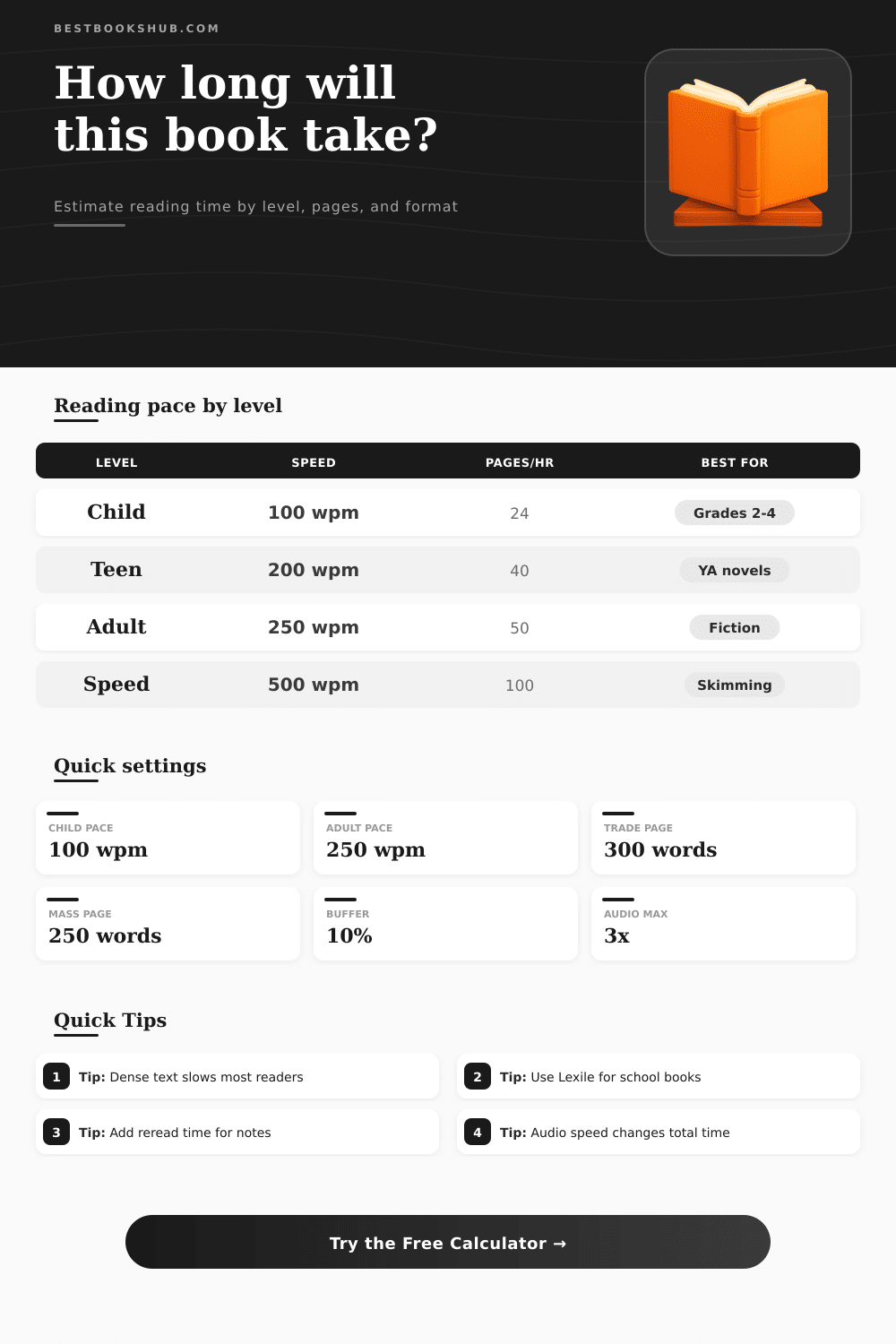
| Reader level | Typical silent speed | Useful planning range | Notes |
|---|---|---|---|
| Emergent reader, grades K to 1 | 60 to 90 wpm | Picture books and decodable text | Often includes pauses for decoding, rereading, and adult support. |
| Developing child, grades 2 to 4 | 90 to 130 wpm | About 100 wpm baseline | Good for chapter books with familiar vocabulary and short chapters. |
| Middle grade reader, grades 5 to 8 | 140 to 180 wpm | 150 wpm baseline | Works for middle grade novels and school-assigned nonfiction. |
| Teen reader, grades 9 to 12 | 180 to 230 wpm | 200 wpm baseline | Useful for YA, general nonfiction, and approachable classics. |
| Adult average reader | 200 to 300 wpm | 250 wpm baseline | Common benchmark for general fiction and trade nonfiction. |
| College proficient reader | 260 to 350 wpm | 300 wpm baseline | Assumes strong fluency; technical material still slows comprehension. |
| Trained speed reader | 500+ wpm | 500 wpm baseline | Best for review and low-density text, not deep analytical reading. |
| Book format | Typical words per page | Common use | Planning note |
|---|---|---|---|
| Picture book | 40 to 120 | Read-aloud and early literacy | Illustrations lower word count but can increase discussion time. |
| Early chapter book | 120 to 180 | Grades 2 to 4 fiction | Short paragraphs and larger type make pages faster. |
| Middle grade paperback | 200 to 250 | Grades 5 to 8 novels | Good middle setting when exact word count is unknown. |
| Mass market paperback | 250 | Compact adult fiction | Small trim and dense type keep words per page high. |
| Trade paperback | 300 | Adult fiction and nonfiction | Reliable default for many modern paperback editions. |
| Hardcover fiction | 350 | Larger trim adult books | Hardcover pages often hold more words despite wider spacing. |
| Textbook or academic page | 400 to 500 | Course reading | Higher density plus diagrams and terms slows comprehension. |
| Large print edition | 180 to 240 | Accessibility editions | Page count rises, but each page carries fewer words. |
| Grade band | Common Lexile range | Calculator difficulty choice | Reading time effect |
|---|---|---|---|
| Grades 1 to 2 | 190L to 530L | Below level or easy narrative | Use emergent or child speed; add support time for read-aloud. |
| Grades 3 to 5 | 420L to 820L | On-level general prose | Use developing child or middle grade speed. |
| Grades 6 to 8 | 740L to 1010L | On-level or dense prose | Vocabulary and nonfiction structure may need rereading. |
| Grades 9 to 10 | 925L to 1185L | Dense or classic prose | Older syntax and class discussion prep add buffer time. |
| Grades 11 to 12 | 1050L to 1335L | Classic or academic reading | Use teen or college speed with 15% to 25% comprehension buffer. |
| College and technical | 1200L+ | Academic or technical reading | Term density, diagrams, and note-taking can dominate schedule time. |
| Category or speed | Typical range | Equivalent planning value | How to use it |
|---|---|---|---|
| YA novel | 60,000 to 90,000 words | 4 to 8 hours for many readers | Use teen or adult speed depending on vocabulary and style. |
| Adult fiction | 80,000 to 100,000 words | 5 to 8 hours at 250 wpm | Trade paperback at 300 words/page is usually close. |
| Epic fantasy | 150,000+ words | 10+ hours at adult speed | Names, maps, and worldbuilding often justify extra buffer. |
| Self-help or business | 50,000 to 70,000 words | 3.5 to 6 hours | Skimmable sections can be faster than narrative nonfiction. |
| Audiobook 1.0x | Natural narration | Full listed audio time | Best for comprehension, read-along, and younger readers. |
| Audiobook 1.5x | Fast but common | About 67% of listed time | Useful for commutes when narration remains clear. |
| Audiobook 2.0x | Advanced listening | About 50% of listed time | Good for rereads, review, or familiar nonfiction. |
| Audiobook 3.0x | Rapid review | About 33% of listed time | Usually too fast for first-pass deep comprehension. |
DISCLOSURE: This post may contain affiliate links, meaning when you click the links and make a purchase, I receive a commission. As an Amazon Associate I earn from qualifying purchases.
A reader is standing in a bookstore with fat paperback in her hands. Will she get through it by beginning of her vacation? Readers love their books; they hate the feeling of having pile of unread ones.
The trouble is that a book’s word count doesn’t tell you much. A novel with three hundred pages could be read in four hours or twelve. Prose density, amount of white space, and font size all plays a part in how many minutes it takes to go from cover to end. To most people, who estimate reading speed based off book length, this means they’re frustrated when hefty book flies past quickly or skinny one drags on.
How to Calculate Your Reading Time
After plugging in your readers’ level and page count, the calculator above will do all the math for you. No need to guess at conversions or coefficients. How? It converts page numbers to an approximate number of words based on how dense content is, and then multiplies that by a reading speed that accounts for difficulty of the text.
For example, mass-market edition contains fewer word per page than trade paperback. If you don’t account for this factor, your estimate could be off by hours. Before you set out to time yourself, you must know what type of book you’re dealing with.
Most estimates fails to account for reading level. At two hundred fifty words per minute, an average adult reader will breeze through a thriller, but struggle through academic prose at half that rate. By allowing you to choose a difficulty factor, the tool takes this into account. Even if you know all the word in a piece of writing, complex sentence structures and/or technical terms will slow down your understanding.
This is where people goes wrong. They think they have a constant base reading speed when in fact it vary depending on material. Add the buffer for note taking and rereading if you’re reading for deeper analysis or school. Yes, it sounds like more time, but it’s actualy realistic time. Your projected finish date without the buffer is not realistic.
Add audiobooks as an additional factor in the mix. Reading at one and a half times speed seems like it’s efficient, but you might miss out on key points. The calculator allows you to balance how much you read versus how much you listen. In many cases, listening isn’t nearly as flexible than reading: Rewinding to understand a dense paragraph breaks your flow and wastes time.
If you’re listening in during commutes, but then switching to print when you hit tough sections, the tool will combine them into one timeline. No more jarring moments when you realize you’ve driven for three hours and only made it through ten percent of book.
Then there’s also the scheduling piece. Books aren’t generally read in one sitting. There is minutes per session and sessions per week to account for. Is it five nights a week, 45 minutes apiece? Or maybe two hours on Sunday? Total time becomes broken down into daily pace and calendar days. How many pages will you need to reach nightly if you want to reach your deadline?
That lets you know exactly what’s expected of you, turning a fuzzy goal (I want to finish this book by summer) into something you could of actualy achieve through habit. You stop worrying about if you can do it. And you start focusing on showing up for the forty-five minutes you’ve scheduled for yourself.
Publishers and genres differs greatly by number of words per page (and cognitive load required). Chapter books has fewer words per page than textbooks do, and they also demand less cognitive load. Large-print editions have fewer words per page, and while that may be easier on your eyes, it may change how long you’re able to hold your head up and read before your eyes gets tired. This will help you set realistic expectations.
It is not just about speed, but also about endurance. Know the terrain before you start walking.
So yes, planning for reading time is more about being honest with yourself; but using this tool also gives you an outline of habit + difficulty + format. It takes the mystery out of all those un-finished books on stack. You can go back to that fat book and read it without fear. Now you have a roadmap of what it’s going to cost to get through that sucker. And knowing you’ve got a plan that fits your days (not just your ambitious days) eliminates the anxiety. Reading stops feeling like a guilty secret hiding in the corner and starts getting scheduled into your daily livig.