📖 ESL reading planner
ESL Reading Time Calculator
Estimate how long an English reading assignment will take using CEFR level, text format, vocabulary load, comprehension target, review style, and weekly study rhythm.
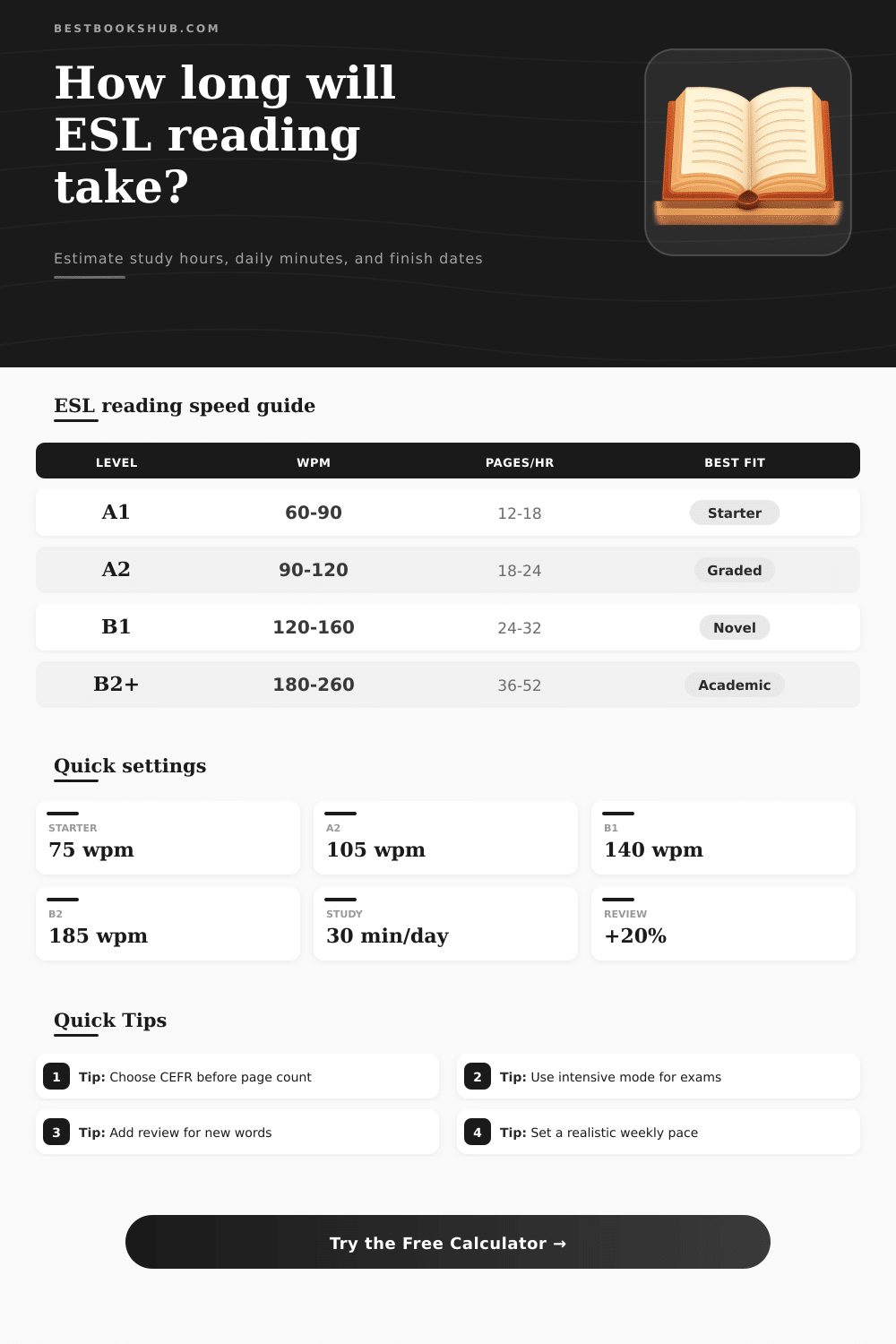
| CEFR level | Planning speed | Text fit | Study note |
|---|---|---|---|
| A1 beginner | 60-90 wpm | Starter graded readers | Use short sessions and picture support. |
| A2 elementary | 90-120 wpm | Short stories and easy articles | Pause for frequent word checks. |
| B1 intermediate | 120-160 wpm | Graded novels and YA excerpts | Good level for sustained reading. |
| B2 upper intermediate | 160-210 wpm | Book club novels and essays | Can read longer chapters with notes. |
| C1 advanced | 210-260 wpm | Academic and literary texts | Slow down for technical vocabulary. |
| C2 proficient | 250-300 wpm | Most adult reading | Near typical native adult range. |
| Format | Words per page | Best use | Planning cue |
|---|---|---|---|
| Graded reader | 160-200 | A1-B1 fluency | Short chapters, controlled vocabulary. |
| Kids chapter book | 200-240 | A2-B1 bridge | Helpful for confidence and rhythm. |
| Mass market paperback | 240-270 | Portable novels | Use 250 wpp when trim size is small. |
| Trade paperback | 280-320 | General fiction | 300 wpp is a reliable default. |
| Hardcover novel | 330-370 | Wide pages | Use 350 wpp for many hardcovers. |
| Academic textbook | 400-500 | Course reading | Add review time for definitions. |
| Reading purpose | Speed factor | Comprehension goal | When to use |
|---|---|---|---|
| Skimming | 1.25x | Gist | Previewing chapters or articles. |
| Extensive reading | 1.10x | Fluency | Enjoyable texts below hard level. |
| Balanced study | 1.00x | Class ready | Normal homework or book club pace. |
| Intensive reading | 0.70x | Detail | Notes, summaries, and vocabulary work. |
| Exam analysis | 0.62x | Accuracy | Question stems and evidence tracking. |
| Level bridge | Approx Lexile | US grade cue | Book type |
|---|---|---|---|
| A1 starter | BR-450L | Early elementary | Starter readers and picture support. |
| A2 elementary | 450L-650L | Grades 2-4 | Short chapter books and leveled stories. |
| B1 intermediate | 650L-850L | Grades 4-7 | Middle grade and graded novels. |
| B2 upper intermediate | 850L-1050L | Grades 7-10 | YA novels and accessible nonfiction. |
| C1 advanced | 1050L-1300L | High school and college | Literary fiction and academic articles. |
| C2 proficient | 1300L+ | College plus | Dense academic and professional texts. |
DISCLOSURE: This post may contain affiliate links, meaning when you click the links and make a purchase, I receive a commission. As an Amazon Associate I earn from qualifying purchases.
Good intentions be damned: You get your hands on a graded reader and find yourself abandoning it after chapter three because the number of pages feels never-ending. If you’re anything like me, this isn’t due to your lack of vocabulary size, or even your motivation level. More likely, it’s a matter of planning. The reason why most English learners struggles so much with reading is that they view it as an obligation (something they have to do) instead of something they schedule in their lives.
When you set aside study time like a limited resource, you change how you goes about it. After entering how much time you have each day, it spits out the answer, no guesswork needed about whether you’ll make it through a book before break ends. Keep in mind that trying to memorize unfamiliar words or overanalyzing the storys structure will slow down your effective reading speed dramatically. What works well while mindlessy flipping pages won’t work when studying for an exam. To reflect this, the calculator take into account different types of review (note-taking, definition lookups) to calculate your schedule to match.
Why Planning Your Reading Time Is Important
There’s one place where most students go wrong when choosing correct CEFR level: a mismatch between text density and their processing power. If you’re an A1 student who can read about familiar topics at a rate of sixty words per minute, then you’ll stall completely as soon as the sentences gets complicated. It will feel like you’re going slower, but it isn’t because you aren’t capable. It’s because the text you’ve chosen has more going on than your brain knows how to handle. If you pick a book just above your comfort zone, then yes, you should of expect to take longer to unpack it. Use vocabulary load input on the calculator and you can put that extra effort into the cost exactly.
You may believe you have an hour to get through the book, but what happens when 20% of word need looking up? The hour melts away. Most people don’t appreciate how important it is to distinguish between intensive vs. Extensive reading. Intensive reading requires close analysis: this develops depth and precision. Extensive reading develop confidence and rhythm from sheer volume. Attempting to combine these two type of reading during one session tends to result in fatigue. Instead, devote certain blocks of time to doing one type of reading or another.
When you enter ‘extensive’, the system understands that you’re going to flow with the material. When you input ‘intensive’, the system adjust the projected pace so that you have enough time to dig deep into what you’re reading. That’s exactly how native readers read technical manuals vs. It is fiction. They’ll skim the novel, but they’ll stop to pick apart contract.
Consistency trumps cramming every single day. Fifteen minutes of reading per day will rewire your brain to handle English syntax more naturaly than three hours on Sunday afternoon. The calculator will show this by splitting your total number of study hours across an achievable timeline. If it says that at thirty minutes per day, it’ll take you four months to get through a book, good for you. That’s a realistic roadmap. It is not a failure. Long timelines discourages many students, but short sessions avoid cognitive overload. When we come back to the text with fresh eyes, we retain more, instead of forcing our way through exhaustion.
Also think about the format you are learning in. Some formats uses more words per page than others. For example, a paperback grade reader is spaced out and has many fewer words per page. An academic PDF has very little space between paragraphs or words. If you don’t consider that, your time estimations will be way off based off of it. The reference table demonstrates just how different formats can be. While a mass market novel may contain two-hundred-fifty words per page, an academic journal might cram six hundred onto each page. To assume they take equal time is a formula for wasted effort and missed deadlines.
The unknown is scary. When you’re worried about whether or not you’re putting in sufficient effort, you begin to doubt yourself and question why things aren’t going well. But planning takes away this uncertainty. Suddenly, there are no more questions or “what-ifs.” You can break down the mountain and see that it is just a collection of doable actions.
Rather than focusing on the completion of the novel, think about establishing a habit. After all, you want to be able to continue reading once school ends. Reading isn’t something you consume; it’s something you learn. Make sure to treat your reading hours as seriously as you would any other time slot in your planner. Break up the page count with steady commitment. Then the number doesn’t seem so scary anymore.