⚖ Legal reading planner
Legal document reading time calculator
Estimate focused reading and review time for contracts, pleadings, policies, exhibits, schedules, defined terms, and cross-referenced clauses.
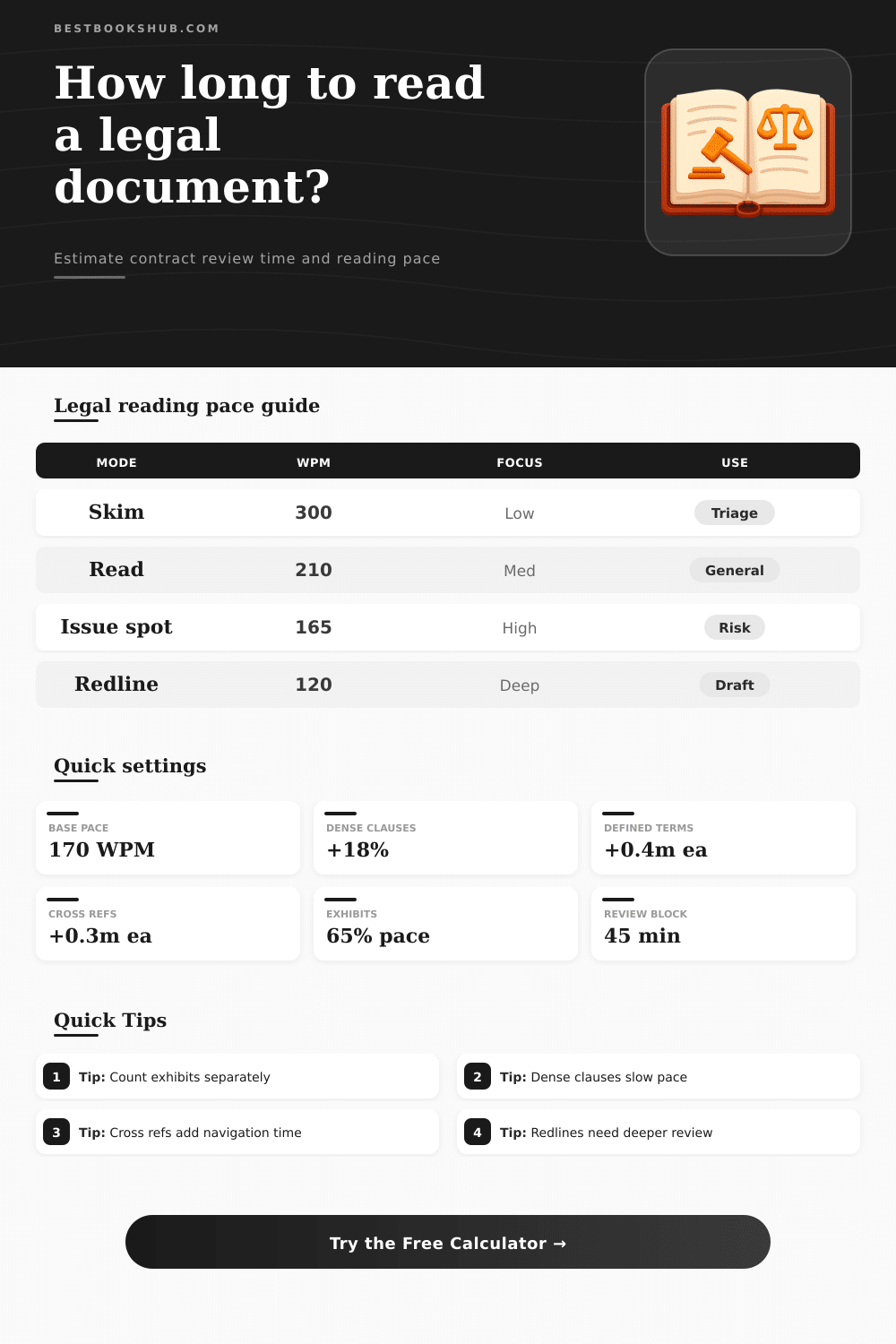
Use these reference bands to compare legal review depth, document type, and complexity triggers before blocking time on your calendar.
| Review mode | Typical WPM | Multiplier | Best use |
|---|---|---|---|
| Skim for triage | 260-320 | 0.72x | Find key clauses, parties, dates, and obvious blockers. |
| Careful read | 180-230 | 1.00x | Understand obligations, rights, notices, and standard terms. |
| Issue spotting | 140-180 | 1.22x | Flag risk allocation, remedies, compliance, and unusual drafting. |
| Signature readiness | 130-170 | 1.34x | Verify blanks, attachments, definitions, authority, and final changes. |
| Redline review | 95-145 | 1.58x | Read language against negotiation positions and fallback options. |
| Document type | Common length | Density cue | Review warning |
|---|---|---|---|
| Mutual NDA | 4-10 pages | Defined terms light | Watch residual knowledge, term, and exclusions. |
| Master services agreement | 18-45 pages | Clause dense | Check indemnity, limits, acceptance, and change orders. |
| Commercial lease | 25-80 pages | Schedule heavy | Review premises, operating expenses, renewal, and repair duties. |
| Loan agreement | 35-120 pages | Cross-ref heavy | Trace covenants, defaults, conditions, and collateral terms. |
| Purchase agreement | 60-180 pages | Definition heavy | Match reps, disclosure schedules, indemnities, and closing conditions. |
| Complexity trigger | Low load | Medium load | High load |
|---|---|---|---|
| Defined terms | 0-15 terms | 16-60 terms | 60+ terms |
| Cross-references | 0-10 refs | 11-45 refs | 45+ refs |
| Exhibits and schedules | 0-5 pages | 6-35 pages | 35+ pages |
| Risk attention | Routine | Negotiated | Critical or regulated |
| Reader profile | Base WPM | Strength | Planning note |
|---|---|---|---|
| Executive scan | 260 | Fast issue triage | Use only when detail risk is low. |
| Business reader | 220 | Commercial terms | Good for familiar vendor papers. |
| Legal reviewer | 170 | Balanced review | Default for contract reading estimates. |
| Citation checker | 145 | References and authority | Best for pleadings, statutes, and cited records. |
| New topic reader | 135 | Learning context | Use for unfamiliar laws or technical deals. |
| Scenario | Pages | Review mode | Calendar block |
|---|---|---|---|
| Short NDA | 6 + 0 exhibits | Careful read | 20-35 min |
| Vendor MSA | 28 + 12 exhibits | Issue spotting | 2-4 hours |
| Commercial lease | 55 + 22 exhibits | Signature check | 5-8 hours |
| Purchase agreement | 95 + 60 schedules | Redline review | 2-4 workdays |
DISCLOSURE: This post may contain affiliate links, meaning when you click the links and make a purchase, I receive a commission. As an Amazon Associate I earn from qualifying purchases.
It’s 40 minutes to your next meeting. Onscreen is a twenty-page vendor agreement. Looks harmless enough; until you see thirty capitalized terms and references to appendices. Do you want to panic? Or skim? Neither will help. The first because it makes you go all slow-motion, staring at paragraph four while you miss indemnity clause on page eighteen. The second because if you’re skimming you’ll miss liability caps.
You want a realistic guess about how far down the rabbit hole you can go with this review in this timeframe. How fast you read isn’t as important than how fast you plan to read. The length of a contract doesn’t depend solely on its word count. Everyone thinks that’s all there is to it. But contracts aren’t novels. Your reading isn’t just breaking down grammar; instead, you’re following an obligation (and its exceptions) as they leap between section.
How to Estimate Your Reading Time
So what constraints are you applying? Define them, and the above calculator will do math for you. When a word is capitalized, it’s treated as another layer of work because it must be looked up mentally to check that it’s consistent with other uses. By including navigation time, it recognizes that breaking your reading rhythm by leaping from section 3.2 to section 12.5 add time. Why these factors? Because they correspond to the cognitive load of reviewing legalese, not merely to number of words on page.
But there’s a big difference between an issue-spotting pass and a careful read. The former requires more focus (you’re looking for odd drafting habits or places where risks aren’t allocated), which means you go more slowly. But that’s okay because it’s what you’re being paid to do. If you’re getting ready to sign, the ante goes up again. Now you have to make sure all the blanks are filled in. You also have to make sure definitions reflect the final negotiating positions reached. This mode changes effective words per minute to match how deep you should of be focusing, basically slowing the clock to match level of concentration needed.
It’s not about reading more slowley. It’s about paying closer attention. The estimates also often fall prey to exhibits and schedules which appear to be more data than prose. You see a table in a Service Level Agreement, skim it thinking “I’ll read that later,” but the teeth of the deal are there, in those tables. The calculator recognizes the slow pace factor for exhibits because reading details in the schedules takes careful comparison to obligations in main body. It is easy to have a short agreement with ten attached schedule and spend as much or more time switching between them as you would with a longer, self-contained agreement. That’s what trips up most people when blocking out time on their calendar.
Density also matters. Contracts with dense legal language include longer sentences and nested conditions. These requires holding more information in your working memory until you reach the end of a thought. Negotiated agreements seldom do this well (plain-language contracts are more likely to flow). If you choose one of the higher-density options, the system takes into account this friction. This is a minor change in the input, but avoids common mistake of underestimating how much time it will take to untangle complex conditional logic. You aren’t just reading… You’re parsing a logic tree masquerading as a paragraph.
Familiarity with subject matter also shifts the timeline. If you’re used to skimming through dozens of similar documents (e.g. Reading a typical non-disclosure agreement), then it’s different than sitting down for the first time and trying to absorb a moddern regulatory compliance document whose terms all sound like gobbledygook. It acknowledges that understanding context takes some amount of time apart from your reading speed; so the calculator allows you to incorporate this into its calculations. Initially, it slows things down as you build up a mental model as you go.
Ultimately, estimating legal reading time is all about managing your expectations. It lets you know whether you have time to dig into details, or if you should ask someone else to give you a summary first. It allows you to treat the reading as a real task with a number of variables. You walk into that meeting knowing exactly how much of the document you’ve processed, and where most of the risks is probably hiding.
Reading a document is not an end in itself. It’s understanding what you’re agreeing to before you do so.