📖 Reading planner
Reading time range calculator
Estimate a realistic slow-to-fast reading window from pages, word count, reader speed, book difficulty, session length, and deadline pressure.
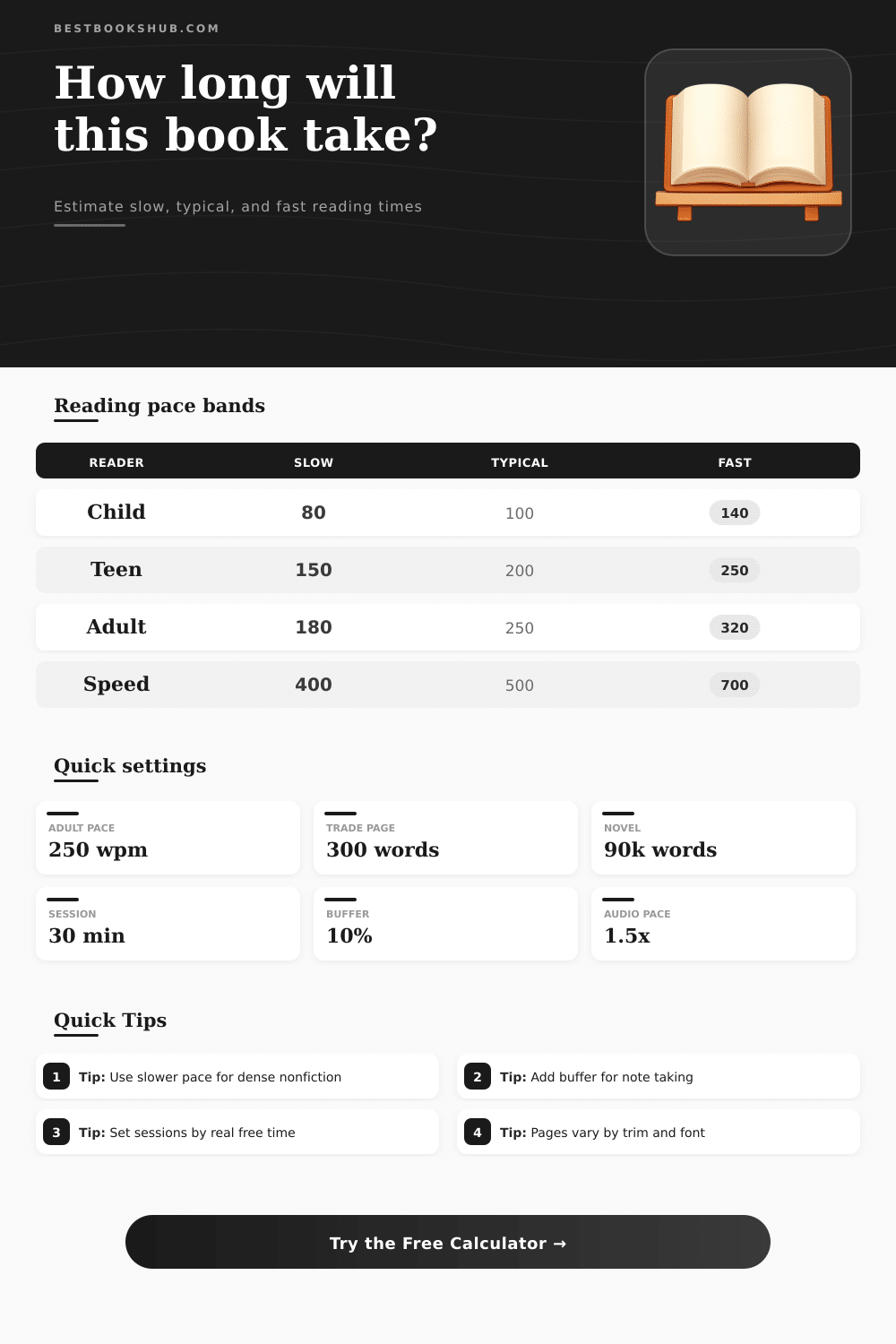
Use these tables to pick inputs when a book does not list word count. Page density changes with trim size, font size, margins, illustrations, and chapter spacing.
| Reader level | Slow pace | Typical pace | Fast pace | Best use |
|---|---|---|---|---|
| Child reader | 80 wpm | 100 wpm | 140 wpm | Chapter books, developing fluency |
| Teen reader | 150 wpm | 200 wpm | 250 wpm | YA novels, school reading |
| Adult reader | 180 wpm | 250 wpm | 320 wpm | General fiction and nonfiction |
| Careful annotator | 110 wpm | 170 wpm | 220 wpm | Study notes, close reading |
| Advanced reader | 240 wpm | 320 wpm | 420 wpm | Experienced silent reading |
| Speed reader | 400 wpm | 500 wpm | 700 wpm | Trained scanning and rapid reading |
| Book format | Typical words per page | Example page count | Estimated words | Reading note |
|---|---|---|---|---|
| Large print or illustrated | 200-240 | 250 pages | 50k-60k | More white space or images per page |
| Mass market paperback | 240-280 | 350 pages | 84k-98k | Compact trim, smaller type |
| Trade paperback | 280-320 | 320 pages | 90k-102k | Useful default for novels |
| Hardcover fiction | 320-380 | 400 pages | 128k-152k | Often wider pages and denser layout |
| Textbook page | 400-500 | 40 assigned pages | 16k-20k | Figures and problem sets change pace |
| Genre or book type | Common word range | Approx pages at 300 wpp | Adult time at 250 wpm | Planning note |
|---|---|---|---|---|
| Middle grade chapter book | 20k-55k | 70-185 pages | 1.3-3.7 hours | Often read in short school sessions |
| Young adult novel | 60k-90k | 200-300 pages | 4-6 hours | Good for weekend reading plans |
| Adult fiction | 80k-100k | 265-335 pages | 5.3-6.7 hours | Common book club range |
| Self-help nonfiction | 50k-75k | 165-250 pages | 3.3-5 hours | Add time for exercises or reflection |
| Epic fantasy | 150k-250k+ | 500-835+ pages | 10-17+ hours | Names, maps, and lore often slow pace |
| Audiobook speed | 10 hour book becomes | 12 hour book becomes | 15 hour book becomes | Use case |
|---|---|---|---|---|
| 1.0x | 10 hr | 12 hr | 15 hr | Natural narration pace |
| 1.25x | 8 hr | 9.6 hr | 12 hr | Lightly faster listening |
| 1.5x | 6.7 hr | 8 hr | 10 hr | Common experienced-listener speed |
| 2.0x | 5 hr | 6 hr | 7.5 hr | Review or simple prose |
| 3.0x | 3.3 hr | 4 hr | 5 hr | Rapid review, not close study |
DISCLOSURE: This post may contain affiliate links, meaning when you click the links and make a purchase, I receive a commission. As an Amazon Associate I earn from qualifying purchases.
There’s a moment when you pick up a fat hardback: full of good intentions but no data to support them. The book cover claims it will be an adventure; your calendar yells about how you only have Saturday morning and Tuesday night to devote to this. Page count is an easy metric we use to indicate the relative work involved.
You might assume that three hundred pages of fantasy will take the same amount of time as three hundred pages of philosophy, but that’s a mistake. Wrong! That’s a dangerous assumption; it fails to account for format, density, and attention span conspiring against our best-laid plans.
How to Plan Your Reading Time
Once you input your book’s details, however, the calculator do all the work (above). No more guess-work; no more abandoned reading piles. Instead of providing an arbitrary deadline which will always be missed, it produces a window: a slow finish date vs. There is a fast finish date.
Because, let’s face it, reading isn’t the same for everyone. What works for one book won’t necessarily work for another. Maybe you’re really good at breezing through light fiction, while getting stuck on dense academic books. Instead of slowing your progress with a goal you cannot reach, this lets you adjust your speed based off what you want to understand (do you want to skim for the main idea?). Annotate every third sentence and consider the book’s difficulty level. In short, it takes vague ambition and transforms it into a concrete schedule. It also keeps the flexibility you need when life get in the way.
Think about page density for example: Mass market paperbacks may appear small, yet they pack more words onto each square inch compared to a wide margined trade paperback. Go by what’s printed on that last page and you’re probably miscounting by thousands of word. Those reference tables on the page explain it all. They show the moving baseline of genre conventions. Epic fantasy novels, for example, are frequently longer due to complex world building. Self help titles, on the other hand, are typically short but require more active participation from readers. None is necessarily more difficult; they just use your time different than before. So will your own speed.
For regular reading, we read at roughly two hundred fifty words per minute. If you’re pausing to consider an argument, or looking up some term, it’ll be less. The calculator lets you pick a reader type: From trained speed reader to cautious annotator. Then it buffers for stops. Add in ten percent for reasonable pauses, so you don’t feel like you’re falling behind… when really, you just had to get a cup of coffee.
Reading isn’t just about eyes scanning a page; it is about physical stamina and mental thought. Most plans fail at scheduling. We tell ourselves: “I’ll find an hour one day to sit down and read.” But in reality, that’s never how it works out. Your “free time” arrives in little bits: 45 minutes on the bus, 30 minutes before bed, maybe a longer stretch on Sunday. The tool allows you to enter your days/week and session length, then converts total hours into a realistic target for each day. How many pages do you need to go through, every day, to meet your deadline? It makes it about daily units, which is possible! It focuses on daily units rather than the daunting entire book.
Another thing to note: Print vs. Audio can be valuable as well. Depending on your listen speed, like if you are listening at one point five times speed, you’ll find that a ten hour audiobook becomes quite a bit smaller. That means more time doing something else. And if you’re wondering how far you get no matter what format you’re using, the tool will give you that comparison. For some reader, alternating between audio and print helps them stay fresh when tackling big projects.
So yes: Planning isn’t about strict adherence; it’s about taking stock of reality. If you fail to account for variables, and then bail midstream, well, you’ve done so because the mountain was more significant than what you’d imagined in your head. The point of making a plan, though, isn’t to pin down one specific number and obsess over it. It’s to make a plan that is flexible, and to accept that the mountain range won’t care if you don’t reach its highest point, so you should of either. You should acknowledge that the book deserves the attention necessary to read it, and you deserve a schedule that leaves room for it without overwhelming you.
One realistic session at a time. Make it one session in which you actualy finish what you began.