🎧 Book timing tool
Reading time vs listening time comparison calculator
Compare page reading, word-count reading, and audiobook listening with playback speed, focus drag, note-taking, and daily session limits included.
| Reading pace | Words per minute | Pages per hour at 275 wpp | Best fit |
|---|---|---|---|
| Careful study reading | 120-180 wpm | 26-39 pages | Academic, technical, or annotated reading |
| Average adult reading | 200-300 wpm | 44-65 pages | Most fiction and general nonfiction |
| Fast fluent reading | 300-450 wpm | 65-98 pages | Familiar topics and light prose |
| Skimming pass | 450-700 wpm | 98-153 pages | Previewing, review, or low-detail scanning |
| Audiobook setting | Effective words per minute | 10-hour book becomes | Planning note |
|---|---|---|---|
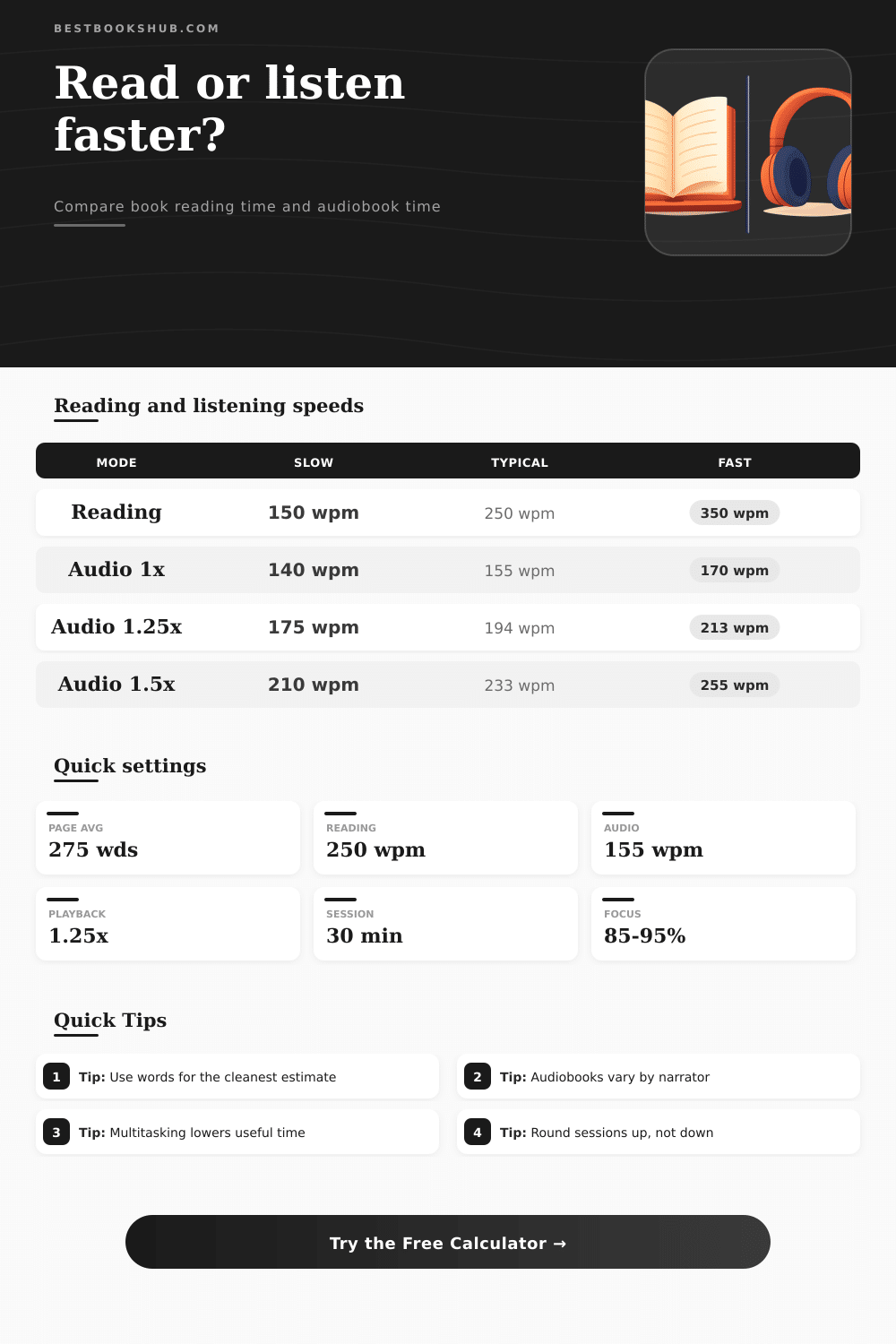
| 0.9x playback | 140 wpm at 155 base | 11 hr 07 min | Useful for dense or accented narration |
| 1.0x playback | 155 wpm at 155 base | 10 hr 00 min | Publisher listed time is usually 1x |
| 1.25x playback | 194 wpm at 155 base | 8 hr 00 min | Common speed-up without extreme compression |
| 1.5x playback | 233 wpm at 155 base | 6 hr 40 min | Fast, but focus loss matters more |
| Book category | Typical length | Words per page | Timing behavior |
|---|---|---|---|
| Short nonfiction | 45k-60k words | 250-300 | Often quicker to read than listen |
| General novel | 70k-100k words | 250-300 | Balanced between formats |
| Long genre novel | 110k-180k words | 280-340 | Playback speed can save many hours |
| Academic chapter | 6k-12k words | 350-450 | Slow reading and notes dominate |
| Plan type | Reading sessions | Listening sessions | Schedule cue |
|---|---|---|---|
| Daily 20 minutes | Slow but steady | Good for commutes | Best for small books or chapters |
| Weeknight 45 minutes | Strong fiction pace | Easy audiobook blocks | Good for book club planning |
| Weekend 90 minutes | Deep reading friendly | Long listen friendly | Good for nonfiction or study |
| Deadline sprint | Needs focus control | Needs replay buffer | Add overhead for review time |
DISCLOSURE: This post may contain affiliate links, meaning when you click the links and make a purchase, I receive a commission. As an Amazon Associate I earn from qualifying purchases.
Should you listen or should you read? The question sounds easy, except when you remember: Listening takes hours in your car, whereas reading tires out your eyes within half an hour. You’ve got two hours of phone time before a book’s due. Should you spend it reading? Or should you take back those minutes that’ll slip away when you’re scrolling or zoning out?
Your brain experiences time different based off how you’re consuming information. If you’re reading, you’re in charge of speed; reading feels like it go quickly. But if you’re listening, you can recovers some of the time lost to zoning out and scrolling. Instead, it’s about comprehension drag: how well (or poorly) do you understand what you’re reading?
Choosing Between Reading and Listening
Do you frequently need to go back and reread complicated sentences? Do you look up words? Do you take notes? How does this compare to listening? Do you often rewind to that confusing part? Pause and write something down? Lose track when you’re driving? All these distractions can be incredibly subtle, but they starts to add up.
Because let’s face it: if you sit down for a half-hour to read, you probably won’t get through a full half-hour of content. Once you enter your realistic amount of focus into the calculator above, it spit out the math so you don’t have to worry about conversions and coefficients. It makes you stare at stark contrast between clock time and actual learning time.
Audiobooks sound like they’re slow: Narrators speak at about one-hundred-fifty words per minute, compared to average reader’s two-hundred-fifty words per minute. But that difference doesn’t seem so vast when considering how easily we can multitask, and change our playback speeds. For most listeners, cranking the speed up to 1.25x (or even 1.5x) reduces the speed gap considerably without sacrificing clarity. A ten-hour audiobook becomes a seven-hour listen, which starts to rival silent reading for thick nonfiction book.
The catch? You need to pay closer attention at high speeds. 1.5x may have you missing whole paragraphs if you’re trying to listen while doing laundry. It’s about the percentage of your focus, not the absolute number of words. It recognizes that skimming at four hundred words a minute is different than studying at two hundred.
It also allows you to enter a comprehension score as an input. When you’re reading complex business strategy or academic material, your effective speed are lower since it takes time to process the argument, rather than simply recognize the words on the page. In the world of audiobooks, they has their own flavor of this issue: when the narrator’s intonation becomes distracting, or when background noise interferes. That kind of friction should of be included in your plan.
Most plans go wrong at scheduling. People often estimate how long a book will take because they divide total hours by their daily availability, but they forget that partial sessions counts as whole blocks of time. They neglect to account for part-day session. Even though they play for only 40 minutes each day, that isn’t half an hour plus ten minutes, it’s a single block of life with its own prep and wrap-up.
On the page, I present a reference table showing how much finish dates change based on what settings you use when playing back. It highlights why rounding up your session count prevents last-minute panic. You might estimate you can listen to something for 45 minutes a day, but in practice get interrupted halfway through, so you realy only get 30. That translates into weeks on a long novel.
The appropriate medium depends heavily on genre, too. The emotional feel provided by a narrator’s voice suits fiction more then nonfiction (text alone can’t do this). For nonfiction, having speed control and the ability to easily re-read key concepts help immensely. No one format will always be the faster one; it will simply suit the context in which you’re currently working better.
Tired? Audio wins. Need to remember some details? Reading typically prevails (even if it takes longer). And this isn’t about racing yourself through a book just to win the race. This is about finding your own rhythm so you can get across the line without running on fumes.
Do you like listening to it through earbuds? Or would you rather feel the pages in your hands? Knowing how fast (or slow) you actualy read enables you to make plans accordingly, not guess when you’ll be done, and create a schedule that takes into account real life. Time doesn’t stretch to suit your ambition; it stretches to support good planning.