🎤 Pitch timing tool
Elevator pitch length checker
Paste your pitch, choose a delivery context, and check whether the word count, pauses, hook, and closing ask fit the time you actually have.
| Delivery pace | Words per minute | 30 sec words | Best use |
|---|---|---|---|
| Careful and deliberate | 110-130 WPM | 55-65 words | High-stakes ask or unfamiliar audience |
| Natural conversation | 130-160 WPM | 65-80 words | Networking, career, and book pitches |
| Energetic presentation | 160-180 WPM | 80-90 words | Demo day or practiced product teaser |
| Too fast for detail | 180+ WPM | 90+ words | Only for rehearsed short taglines |
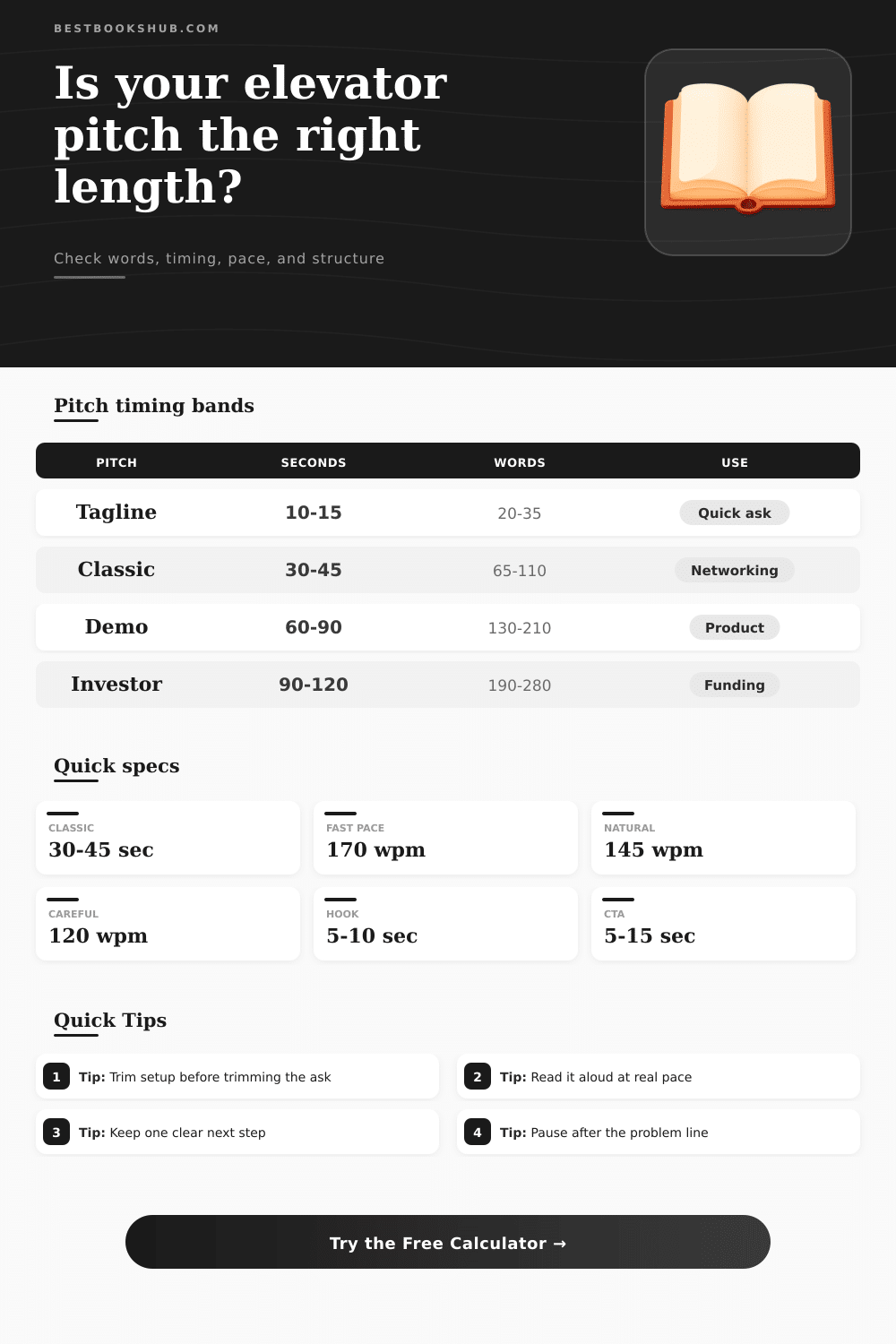
| Pitch format | Time window | Practical word band | Core job |
|---|---|---|---|
| One-line hook | 10-15 sec | 20-35 words | Name the problem and audience quickly |
| Classic elevator pitch | 30-45 sec | 65-110 words | Explain who, problem, promise, and ask |
| Meeting opener | 45-60 sec | 95-145 words | Add credibility without overloading detail |
| Demo or investor pitch | 90-120 sec | 190-280 words | Add evidence, traction, and specific next step |
| Pitch component | Lean share | Full share | Timing cue |
|---|---|---|---|
| Hook or problem | 15% | 20% | Make the listener care first |
| Audience and solution | 25% | 30% | Say who it helps and how |
| Proof or credibility | 20% | 25% | Use one concrete signal |
| Closing ask | 10% | 15% | End with a clear next action |
| Comparison setting | Recommended target | Pause style | Risk if too long |
|---|---|---|---|
| Career fair line | 30-45 sec | Tight but warm | Recruiter cannot ask a question |
| Agent or publishing query | 45-60 sec | Natural | Premise gets buried in setup |
| Investor hallway | 60-90 sec | Deliberate | Traction and ask arrive too late |
| Conference meetup | 30 sec | Conversational | Feels rehearsed instead of responsive |
DISCLOSURE: This post may contain affiliate links, meaning when you click the links and make a purchase, I receive a commission. As an Amazon Associate I earn from qualifying purchases.
It’s an attention budget. You get 45 seconds before your potential connection reach for their phone. That is how much attention people can give in social situations.
Why do so many of us bomb this test? We load up the opening with context. We stuff the problem into our pile of credentials. Then we never make space to deliver the ask, In other words: we turn a spoken intro into a written essay.
How to Keep Your Pitch Short and Clear
A great pitch is the polar opposite. It lands perfectly, yet it’s structured enough to stay out of the way. It’s light enough to be carried in conversation. Plug in your script and the calculator do the math for you. Do I need to shorten my hook? Is my pace too slow?
It’s not about the raw word count. It’s about the feel of those words within time allotted to you. At a networking event, chances are you’ve got between thirty to forty-five seconds. When spoken conversationally, this equates to about sixty-five to one hundred ten words. Use pauses for emphasis. Don’t worry about empty space because it isn’t empty. The pause signal confidence and allows your listener time to absorb your last sentence. Even if your content is solid, rushing through each beat make a pitch feel nervous. Too many job seekers and founders tries to pack in as much info as they can into the allotted time slot; this is generally unhelpful.
The listener isn’t interested in hearing everything you’ve ever done. They’re interested in why they should care about the next ten minutes of your conversation. Hook them in less than ten seconds if you can (ideally five). Name the promise or the problem simply but don’t spend time explaining why you came to that conclusion. Save that for follow-on meeting.
Your pitch should be structured like the arc of interest… Open with the pain, describe how you are the solution, provide a brief proof point, close by asking for something very specific. If you don’t ask for anything specifically, the listener won’t know what to do, and they’ll typically do…nothing.
Another thing people forget about is speed of delivery. Most adults feel comfortablely speaking at one hundred forty-five words per minute. They don’t sound like they’re broadcasting, it just sounds like a normal conversation. When they speak any quicker, they come across as anxious or eager to get to the point. Any slower and they can completely lose the rhythm.
Fortunately, the tool allows for adjustment on that end, but here’s what matters: practice speaking as quickly as you will in the moment. Your adrenaline kicks in and suddenly you’re talking faster. You don’t want a script that’s so long you blow right past the time limit if you speed up just a bit. Better to leave a few seconds of breathing room than to rush through the last line and scramble for the door.
Silently, jargon shortens the pitch. Each industry acronym or tech term need your listener’s brain to translate it. And unless they’re in the know, it will take time, distracting them from your point. Or even if they do know the term, you’ve shown you are part of the “inside circle” with your use of it. Whenever you have a word that doesn’t immediately clarify, cut it out. Explain complex things simply. Distill, don’t dumb down. Make your listener feel smart for getting what you said. Don’t tire them by trying to decode what you said.
If you break down what makes a good pitch work, it’s usually the close that’s the briefest component… but the one that makes the interaction go somewhere. Asking for someone’s calendar link (or business card) doesn’t require much explanation. Ask for it. That said, if your script lacks clarity on how it ends, or simply takes too long to get there; then shorten whatever detail lies between “hello” and “I’d love to connect.” People can fill in the blanks themselves if they’re interested.
A well-defined close can’t be ignored. And, after all, an elevator pitch isn’t an audition. It’s an invitation to follow up. So make it short. Make it clear. And instead of making people feel as though they’ve just listened to the whole thing, let them know they haven’t heard half of it yet.
You should of practiced more.