📖 Poetry scansion checker
Syllables per stanza calculator
Paste a poem, split it into stanzas, estimate syllables line by line, and compare every stanza with your chosen form target.
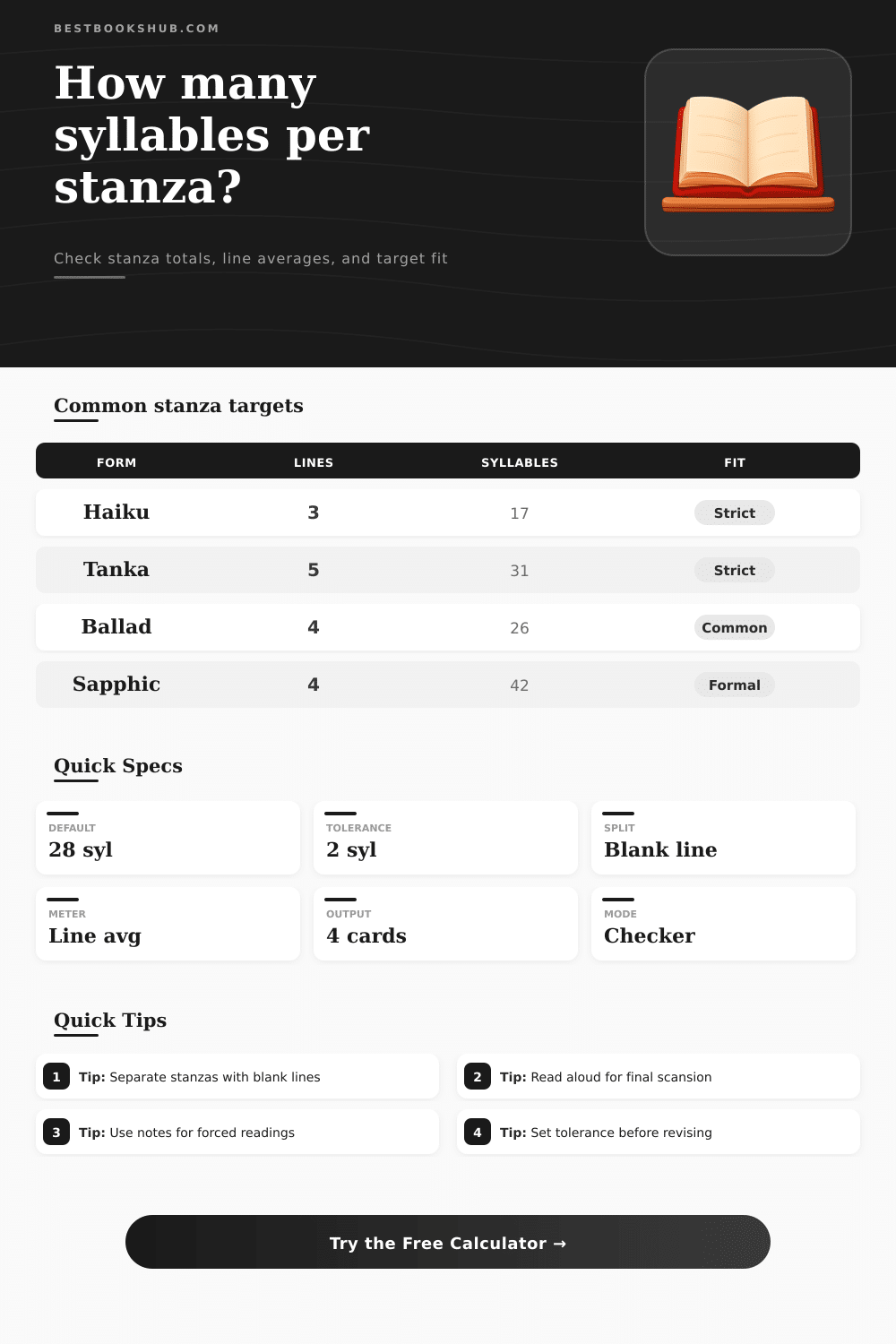
| Stanza form | Lines per stanza | Typical syllable plan | Target per stanza |
|---|---|---|---|
| Haiku | 3 | 5 / 7 / 5 | 17 syllables |
| Tanka | 5 | 5 / 7 / 5 / 7 / 7 | 31 syllables |
| Ballad quatrain | 4 | 8 / 6 / 8 / 6 | 28 syllables |
| Common meter | 4 | 8 / 6 / 8 / 6 | 28 syllables |
| Short meter | 4 | 6 / 6 / 8 / 6 | 26 syllables |
| Long meter | 4 | 8 / 8 / 8 / 8 | 32 syllables |
| Meter cue | Common line count | Approx syllables per line | Use in stanza checker |
|---|---|---|---|
| Dimeter | 2 feet | 4 syllables | Very short song lines |
| Trimeter | 3 feet | 6 syllables | Ballad second and fourth lines |
| Tetrameter | 4 feet | 8 syllables | Ballads, hymns, narrative verse |
| Pentameter | 5 feet | 10 syllables | Sonnets and blank verse |
| Hexameter | 6 feet | 12 syllables | Longer formal lines |
| Separator setting | Best for | Example break | Counting effect |
|---|---|---|---|
| Blank line | Most poems | Line, blank, line | Preserves normal stanza blocks |
| Forward slash | Copied lyrics | Verse one / Verse two | Splits at each slash mark |
| Double slash | Inline drafts | Stanza one // Stanza two | Keeps single slashes inside lines |
| Numbered headings | Workshop drafts | 1. then 2. | Removes heading numbers from counts |
| Checker mode | Counting emphasis | Likely result | Best use |
|---|---|---|---|
| Modern spoken English | Silent E and common endings | Balanced estimate | General poems |
| Poetic elision friendly | Drops some extra vowel beats | Slightly tighter count | Formal verse |
| Strict vowel-group count | Counts visible vowel groups | Higher rough count | Draft diagnostics |
| Song lyric pronunciation | Allows sung extensions | Slightly looser count | Lyrics and refrains |
| Spec comparison | Exact form | Flexible form | Checker setting |
|---|---|---|---|
| Target tolerance | 0 to 1 syllable | 2 to 5 syllables | Allowed stanza variation |
| Line count | Fixed line total | Variable lines | Expected lines per stanza |
| Pronunciation | Elision marked | Plain speech | Syllable reading style |
| Refrains | Count every repeat | Flag repeats only | Repeated refrain weighting |
DISCLOSURE: This post may contain affiliate links, meaning when you click the links and make a purchase, I receive a commission. As an Amazon Associate I earn from qualifying purchases.
When you read poetry out loud, it sounds different based off number of syllables in each line. Often it stumble because there is no clear rhythm to the words. This tool catches that problem before anyone else do. It will go through the meter one stanza at a time.
Where the structure works? Where it doesn’t work? Most poets know what kind of structure they are aiming for. Perhaps you’re writing sonnets in iambic pentameter. Maybe you’re composing ballads with six or eight syllable line per stanza. Checking each vowel group show whether draft has followed your intention.
Why Use a Syllable Counter?
Simply copy/paste into the box and the tool will do the rest. That’s faster then having to count them by hand. And you can set a tolerance range. Poetry isn’t usually so strict. Two-syllable variations can goes unnoticed when heard, but seem very obvious on the page.
It does not just show an average; it breaks things down in detail. It’s a stanza by stanza breakdown. Formal poem are consistent, which makes them sound musical. A poem with a stanza of 28 syllables followed by another of 35 will be noticed by reader. These is explained plainly on the page through reference tables.
Haiku is precise and brief. Quatrain ballads give you more leeway since they sounds like natural speech. Knowing what rules apply and when to bend or break them is essential. This is where calculator comes into play as a kind of diagnostic tool for those decisions.
The system of counting are complicated by pronunciation. There are silent letters. There are varying amounts of stress on words. You can set the system to use options for moddern spoken English or poetic elisions. For example, do you want a more poetic version that uses elisions? Or maybe you want a spoken English version of today?
How would you say “hour”? As a poem, I could says it with one syllable if performing, yet when casually reading it I may give it two. When we combine this into a phrase (like an hour), it shift the number of sounds even more. Every decision matters and can alter outcome at the end. Get the settings wrong, and you’ll get bad information. Get them right and what you hear will match what is written on paper. It makes what you see match what you hear.
This analysis is equally useful for songwriter and lyricist. How are your lyrics fitting with the melody? There is no hard and fast rule, but you know that too many syllables per line makes singer rush it. Not enough means they has awkward pausing. The meter consistency score indicate how well the words fit into the music.
The tool provides hard data so you don’t have to rely on guesswork. If there’s a pattern that you predict, then that will help keep the musical flow. Make manual tweaks for any dialects or archaic terms. These can throws standard algorithms off track. This flexibility allow for subtle language changes while still providing data.
Creativity isn’t stifled by counting syllables. It’s used as a basis for rhythm. If you understand where the beats are, you can deliberately break them. The tool strips away the anxiety of the count. You can concentrate on words being spoken.
Copy/paste your draft, count up the numbers, see if it flows with confidence or falters. Having this awareness lets you edit with intention. You end up with something that expresses what you intended. It would of helped to know sooner.