📖 Poetic form checker
Terza rima checker
Paste a draft to test tercet grouping, ABA BCB CDC rhyme chaining, final closure, syllable pacing, and line-level revision signals.
| Position | Expected rhyme | Function | Checker cue |
|---|---|---|---|
| Line 1 | A | Opens first rhyme frame | Matches line 3 |
| Line 2 | B | Introduces next tercet rhyme | Matches lines 4 and 6 |
| Line 3 | A | Completes first tercet | Closes A frame |
| Line 4 | B | Reuses the carried rhyme | Tests chain link |
| Line 5 | C | Introduces the next open rhyme | Prepares line 7 |
| Line 6 | B | Completes second tercet | Closes B frame |
| Ending type | Line count rule | Example tail | Best use |
|---|---|---|---|
| Couplet close | 3n + 2 lines | DED EE | Common English completion |
| Single-line close | 3n + 1 lines | CDC D | Compact exercise ending |
| Continuous tercets | 3n lines | CDC DED | Ongoing sequence or excerpt |
| Fragment | Any partial draft | ABA BCB C | Early structural sketch |
| Meter tradition | Typical syllables | Line feel | Checker setting |
|---|---|---|---|
| Italian hendecasyllable | 11 | Flexible stress, long line | Italian 11-syllable draft |
| English iambic pentameter | 10 | Five-beat line | English pentameter chain |
| Trimeter exercise | 6 | Fast, compact movement | Short trimeter exercise |
| Free terza rima | Variable | Rhyme chain is primary | Ignore syllable drift |
| Rhyme mode | What it compares | Strength | Tradeoff |
|---|---|---|---|
| Strict final sound key | Last vowel group plus ending | Finds clear exact rhymes | Can reject valid eye or dialect rhymes |
| Balanced rhyme ending | Final sound key or last three letters | Good for first revision | May pass some weak rhymes |
| Slant rhyme | Near endings and shared consonants | Useful for modern drafts | Needs human ear review |
| Italian emphasis | Final vowel-rich ending | Better for open vowels | Approximate outside Italian |
DISCLOSURE: This post may contain affiliate links, meaning when you click the links and make a purchase, I receive a commission. As an Amazon Associate I earn from qualifying purchases.
It’s like starting off on one of those poetry games where each stanza is chained to last through a shared middle rhyme. You’re in the flow of writing a poem, and then suddenly you come upon the second stanza and there’s this thing where you have to rhyme something from three lines back. That’s when terza rima enters the picture.
Because in terza rima, you can’t get away with what you said back at Line 3, even if now you want too. This is because in his invention of terza rima, Dante makes you move forward while looking behind you. Every tercet must be chained to previous one through matching middle words. This continues until you finally reach the conclusion.
How Terza Rima Works
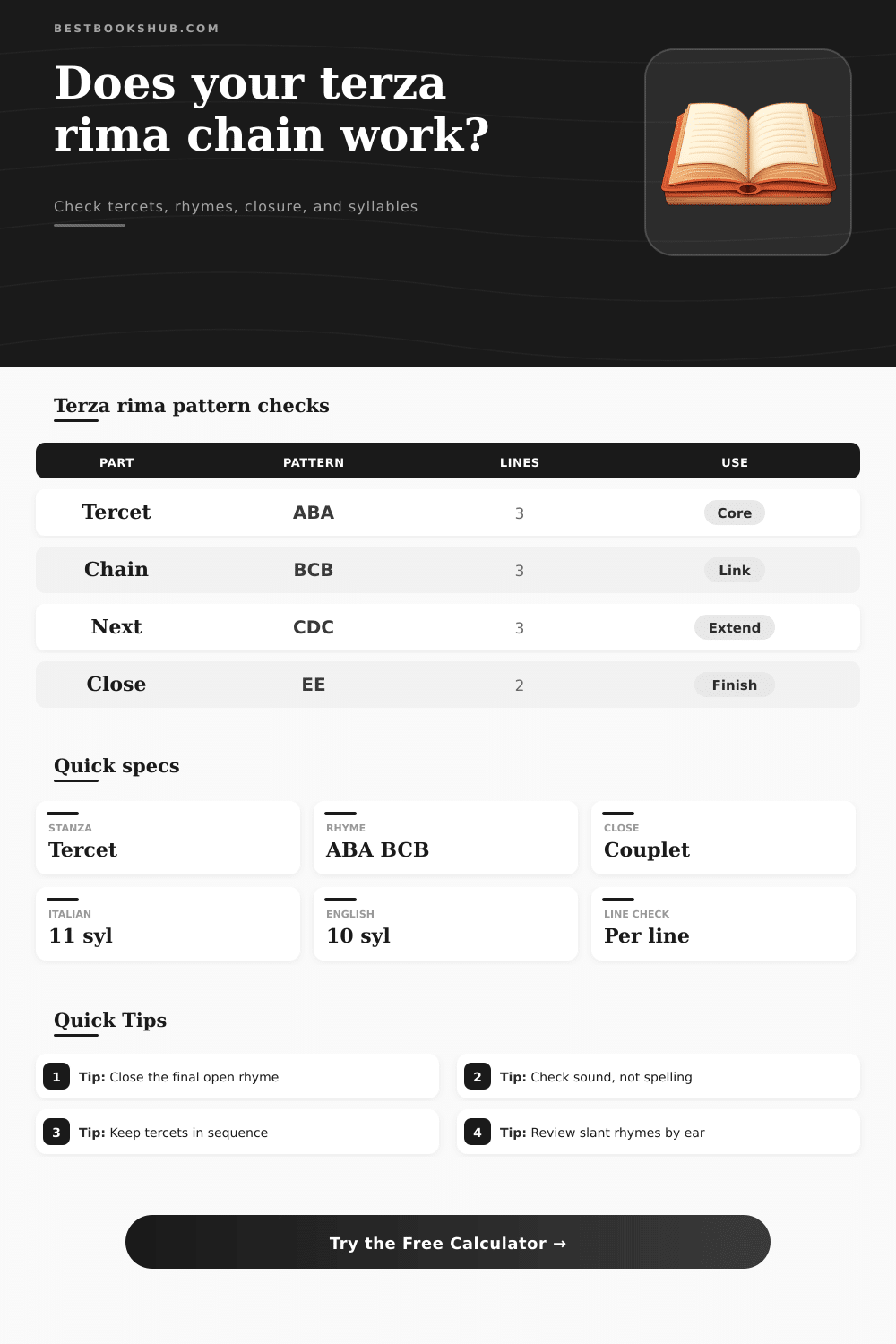
In theory, it’s easy. Use three-line stanzas with an ABA rhyme scheme, where B rhyme becomes the hook for the next stanza. Repeat this as many times as you like. Finally, close it with a couplet that repeats last open B sound.
In practice? Not so much. It sounds like a formula, and that’s part of why a poet resists learning this form initially. Poetry requires freedom, right? But form offers discipline. After plugging in your lines, the machine does math for you. This leaves you free to concentrate on whether rhyme has any merit whatsoever.
It’s important to understand that just because two words spell similarly doesn’t mean they’re going to rhyme perfectly. Many writers makes this false assumption. Because of how quirky English spelling can be for poetry, “love” and “move,” for example, may look like matches, but don’t be fooled. Say them aloud. What do you notice about how they differ? Is there a different vowel quality? Are the last consonants the same (or are there extra consonant clusters)?
You’d be surprised how often one word will rhyme with another if you play around with strictness setting in the tool, which is much more important than anyone realizes. In strict mode, for instance, it spits back any rhyme that doesn’t match exactly on sound level. That makes you find something stronger as opposed to falling back on an eye rhyme that fails under examination.
Syllable count is another element that throws off the flow. While English poets tends to adjust this to run in iambic pentameter (ten syllables per line), other poets like Dante write in hendecasyllables (eleven syllables per line). It doesn’t seem like much of a difference, yet it completely alters the rhythm. Ten syllables feel more urgent and tight. Eleven leave more space for secondary stresses and natural places to pause.
This isn’t just about counting vowels, this is about creating a consistent heartbeat for the reader. If you drift from ten to twelve syllables without reason, the rhythm stumble. The tool flags these discrepancies for you so you can iron them out before anyone else catches on.
Most attempts at terza rima fail because of closure. Writers get so caught up in the chain they pull forward that they simply forget to tie it off, and there’s no “stopping” at the end because the last couplet has to complete the last open rhyme. If your last three-line stanza closes out with a C sound, then the last two lines has to also be CC to return the circle back to rest. That closure provides a sense of completion to the poem. Without it, the poem feels incomplete, like a sentence ending without a period.
It’s all laid out nicely on the page with these reference tables that make clear how every line works in greater context. Line one opens a frame. Line two hands off the baton. Line three closes the first segment and ready it for the next.
If you’re writing in contemporary English, don’t dismiss the option of slant rhyme. It offers a little more complexity and texture to your poem by having one word share consonants with another, while the other vowel does not, or vice versa. This is why you need to use your ear to make sure they match. It is something a computer can never completly capture. Use the tool as a guide, not as a judge. It can highlight where patterns breaks down so you can fix them, but it won’t be able to tell whether line has soul.
That’s the beauty of this form; it mirrors the way our minds work. Our thinking doesn’t move in a straight line; instead, it loops and links previous thoughts with current ones until finally finding rest. If you’re noticing your chain score increase, you know you’ve got yourself a poem with a spine.
Trust the structure to support you. Let the rhyme and rhythm flow and allow the structure to lift you along. Only by following the path you cut out for the river does it find its own direction.