📖 stanza form checker
Ottava rima checker
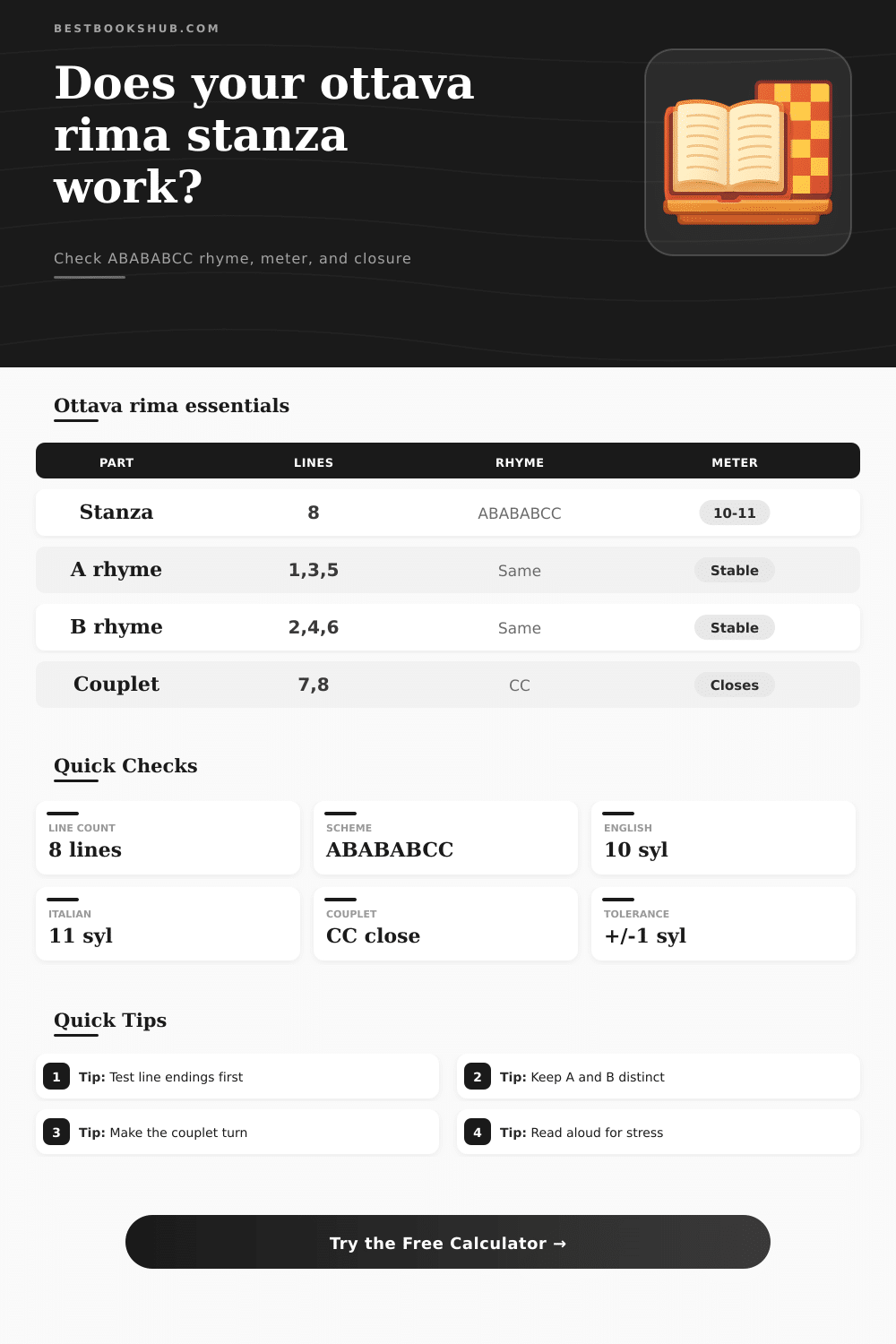
Test whether an eight-line stanza follows ottava rima: ABABABCC rhyme, consistent syllable length, and a closing couplet that feels deliberate.
| Ottava rima feature | Standard expectation | Checker test | Revision cue |
|---|---|---|---|
| Line count | Eight lines per stanza | Counts nonblank rows | Add or cut lines before rhyme repair |
| Rhyme order | ABABABCC | Compares ending keys | Repair A, B, or C groups separately |
| Meter in English | Commonly iambic pentameter | Uses 10 syllables as default | Revise long or short lines aloud |
| Meter in Italian | Commonly hendecasyllabic | Uses 11 syllables as preset | Allow elision and feminine endings |
| Couplet role | Final CC completes the stanza | Checks rhyme and cue words | Use a turn, summary, or punchline |
| Rhyme slot | Line positions | Required match | Common failure |
|---|---|---|---|
| A rhyme | 1, 3, 5 | All three should share an ending sound | Line 5 drifts after the narrative moves |
| B rhyme | 2, 4, 6 | All three should share a separate ending sound | A and B become too similar |
| C rhyme | 7, 8 | The couplet needs a direct pair | Line 8 answers sense but not sound |
| Slot contrast | A versus B versus C | Each rhyme family should be distinct | Repeating one sound weakens the form |
| Meter setting | Target | Usual use | Best tolerance |
|---|---|---|---|
| Strict pentameter | 10 syllables | Formal English ottava rima | 0 or 1 syllable |
| Hendecasyllable | 11 syllables | Italianate or translated cadence | 1 syllable with elision review |
| Comic narrative | 10 syllables | Byronic pacing and punchline turns | 1 or 2 syllables |
| Loose adaptation | 8 to 12 syllables | Modern stanza homage | 2 syllables or custom |
| Form comparison | Lines | Rhyme scheme | How it differs |
|---|---|---|---|
| Ottava rima | 8 | ABABABCC | Alternating sestet plus closing couplet |
| Rhyme royal | 7 | ABABBCC | Seven-line stanza with different turn point |
| Spenserian stanza | 9 | ABABBCBCC | Interlocked rhymes with an alexandrine close |
| Italian sonnet octave | 8 | ABBAABBA | Same line count, different enclosed rhyme logic |
| Terza rima | 3-line units | ABA BCB CDC | Chain rhyme rather than a closed octave |
DISCLOSURE: This post may contain affiliate links, meaning when you click the links and make a purchase, I receive a commission. As an Amazon Associate I earn from qualifying purchases.
The challenge of writing ottava rima are maintaining the rhythm and the narrative expectation while working in a tight form: six lines, one rhyming pair alternating with another, then a concluding couplet. Because ottava rima builds up as it goes, it develops both momentum and an ending; thus the last turn tend to be difficult for many poets.
Verification happens automaticly, as seen on the above checkers page. There’s no need to count off syllables in your head, allowing you to concentrate on artistry of the line.
How to Write Ottava Rima Poems
In its origins, in Italian epic poems, the form were an engine for longer narrative verse. When it moved into the hands of English poets like Byron and Tennyson, it adapted itself to iambic pentameter. It kept its ABA-BAB-CC rhyme scheme. It also maintained the way the first six lines develops an argument or pushed the story forward, giving the impression of suspension. Finally, the couplet arrives acting as a pivot point and a sort of brake on action.
If the couplet doesn’t provide some shift of logic or image or tone, then the entire stanza fall flat and all you have is rhyme, not structural poetry. As you’ll see, it lets you switch back and forth from Italian hendecasyllable form to English pentameter. Why does that matter? The stress patterns of each language are very different than one another. Italian lines depends heavily on elisions and word endings that simply aren’t translatable; English verse leans more towards a solid da-DUM cadence. Get those target syllables right, and no more false meters!
If you write in English, the meter checker will mark nearly every line for having too few syllable. You should of also play with the tolerance slider, especially if you use feminine endings. Feminine endings adds that extra unstressed beat that can mess up rigidly counted meter, yet isn’t really against the flow of the line.
Where drafts are prone to breaking down is in rhyme quality. To check this, the checker examines the final sounds of each line (lines 1,3,5 should match; lines 2,4,6 should match), then looks for a unique pair in lines 7 and 8. A common mistake are letting the B rhyme bleed into the A sound. Another issue is that the couplet reiterate a previous rhyme scheme rather than bringing something new with closure. You get to choose just how rigidly you’d like it to work with the slant rhyme allowance setting. Perfect rhymes sounds more finished but can feel stilted when spoken out loud; near rhymes maintains the natural flow but run the risk of sounding unintentional. Read the lines out loud after the checker’s verdict to find what feels right for you.
A good turn is not simply a decorative bow on the end of stanza; it has to do some work. You want the turn to feel earned. It could be a clever reversal, a deep summary, or even just a single image that change how you see what came before. The calculator scans for those cue words which signal a shift, “thus,” “yet,” etc.
Does your ending not feel integrated, but rather like it was tacked on? Then this will help you figure out if it’s tonal. Did you have perfect rhyme and meter but the score dropped anyway? Odds are the problem is tonal: the last two lines should answers the energy built up over preceding six.
But how does that work? Where’s your guide? There are reference tables that shows you where you’ve strayed from the norm. These give you a chance to match up with expected line counts. Rhyme groups don’t isolate correctly? The reference tables point out where things goes wrong. But these are just numbers. These numbers tell half of the story.
A poem can mathematically be perfect but completely emotionally dead. It can be just a bit off, and yet utterly compelling. Once the form fits, then the tool make sure that you have mastered the architecture. Now you can put down the ruler, quit counting, and start to feel. That is when the real poetry starts.