📖 Fixed-form poem diagnostic
Triolet structure checker
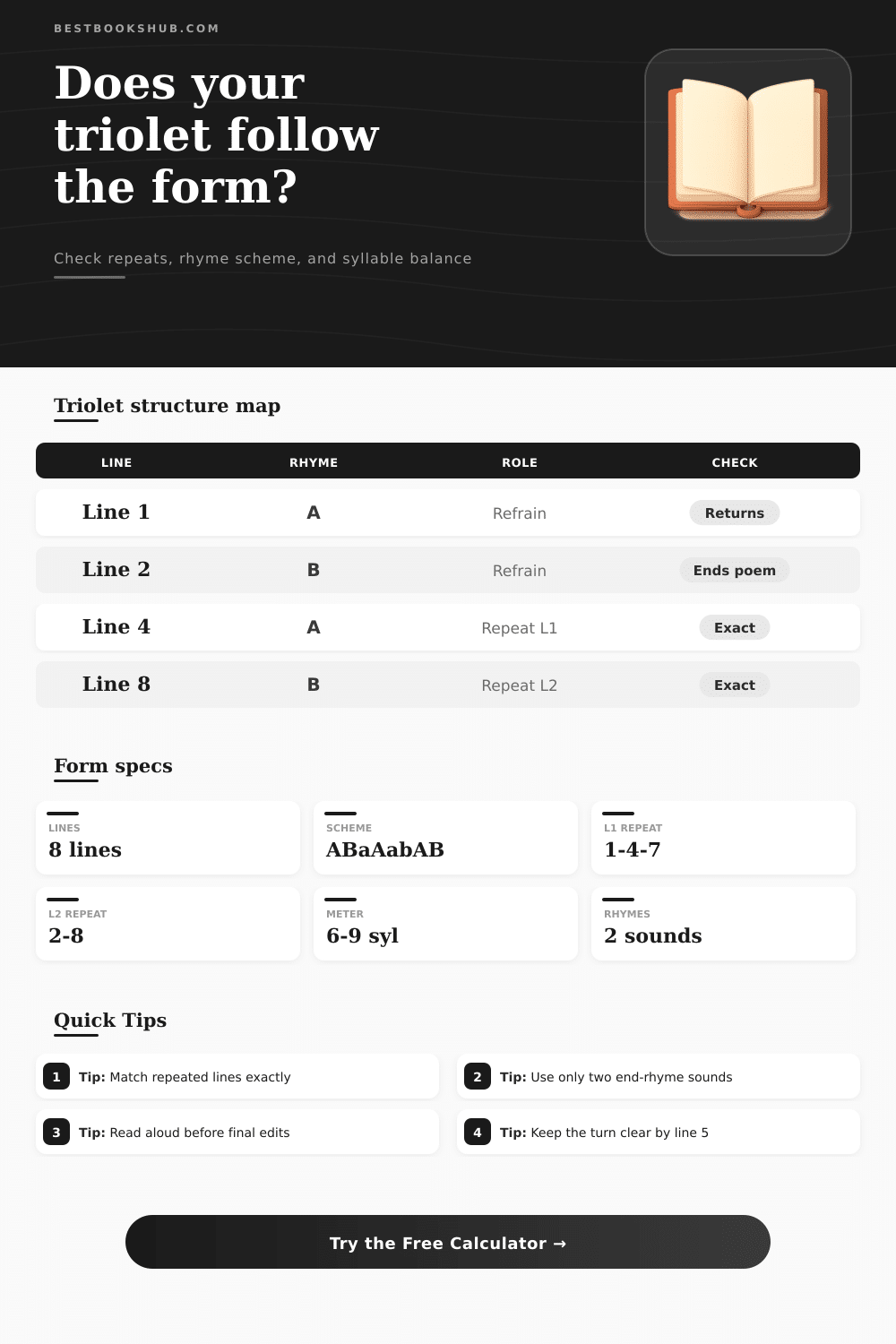
Test an eight-line triolet against its repeat pattern, ABaAabAB rhyme scheme, end words, syllable balance, and closing refrain.
| Line | Rhyme mark | Structural role | Checker expectation |
|---|---|---|---|
| 1 | A | Opening refrain | Sets the A rhyme and returns at lines 4 and 7 |
| 2 | B | Second refrain | Sets the B rhyme and returns as line 8 |
| 3 | a | First turn | New wording that rhymes with line 1 |
| 4 | A | First repeated refrain | Matches line 1 under the selected strictness rule |
| 5 | a | Pressure line | New wording that rhymes with line 1 |
| 6 | b | Hinge line | New wording that rhymes with line 2 |
| 7 | A | Second repeated refrain | Matches line 1 under the selected strictness rule |
| 8 | B | Closing refrain | Matches line 2 and resolves the poem |
| Check type | Strict setting | Balanced setting | Editorial use |
|---|---|---|---|
| Refrain identity | Exact text and punctuation | Case ignored | Confirms repeated lines are deliberate |
| Punctuation pass | Comma and period must match | Punctuation can vary | Useful when line 8 needs closure |
| Rhyme sound | Longer vowel tail | Final sound tail | Finds end-rhyme drift before revision |
| Meter band | Exact syllable target | One syllable tolerance | Helps keep the refrain singable |
| Common meter | Typical line length | Best fit | Checker setting |
|---|---|---|---|
| Iambic trimeter | About 6 syllables | Light lyric triolets | 6-syllable trimeter |
| Seven-syllable lyric | About 7 syllables | Quick refrains with lift | 7-syllable light song |
| Iambic tetrameter | About 8 syllables | Traditional English triolets | 8-syllable tetrameter |
| Loose accentual line | Variable syllables | Modern drafts and comic triolets | No fixed syllable target |
| Form | Lines | Refrain behavior | Why it differs from a triolet |
|---|---|---|---|
| Triolet | 8 | Lines 1, 4, 7 and lines 2, 8 repeat | Two rhymes and tight refrain cycling |
| Rondeau | 13-15 | Short refrain phrase returns | Longer stanza shape with a refrain phrase |
| Villanelle | 19 | Two refrains alternate through tercets | Five tercets plus a quatrain |
| Kyrielle | Flexible | Repeated line closes each stanza | Stanzaic form rather than a fixed octet |
DISCLOSURE: This post may contain affiliate links, meaning when you click the links and make a purchase, I receive a commission. As an Amazon Associate I earn from qualifying purchases.
It is a short form with an apparently straightforward appearance on paper. It consist of eight lines of verse in triolet. Knowing how to find rhymes may lead you to believe this will be an easy form to learn. Yet, as with all mechanical forms, there needs to be precision. Get this wrong and your poem could snap like a twig under pressure.
The form look for two lines to echo back into the piece. Two specific lines return three and two times respectively. One line appear three times and the other appears twice. This results in the beginning matching the end; a kind of poetic circle. The echoing words are used structuraly rather than for decoration. There is nothing worse then the same line having different weights when it echoes, making the poem feel unstable.
How to Write a Triolet Poem
This repetition is what most writers don’t get. When writing a triolet you are creating an echo chamber, copying text is not enough. On this page there’s a calculator that will tell you if line one and four matches exactly. And this matters for how strict the tradition is. What makes this form powerful is how it plays with the reader recognising the return immediately. Alter a word or two so as to suit a different context and you’re out of rules of the form. Precision are demanded from the refrain. Around that locked-in language the meaning can shift. It’s that tension that brings the poem to life.
It appears simple: ABaAabAB But filling it out isn’t as easy. For one thing, you have only two rhyming sound across the whole poem. That limits you to digging deep in your own vocabulary. And since word is important, you can’t just select anything ending in -ight. No, you must find words whose naturaly rhythm fits the metre and whose meaning carries weight. The mechanism on this page test that. Does your ‘a’ line connect to your ‘A’ line? Is your ‘b’ rhyme strong enough to stand up to the test in the middle section? Precision is what this form demands; no slant rhyme will do.
Meter also play a small but important part. Iambic tetrameter is a traditional choice for triolet form. So there’s an eight-syllable foundation to each line. But you don’t have to limit the form to this rhythm. You can set a syllable goal by using the checker. It will alert you if any lines exceeds your chosen number and throw off the sing-songy nature of the verse. If your first line is six syllables but your seventh repeat it as nine, the rhythm stumbles. Keeping the syllable count steady even allows refrain to return with same musical weight as when it began.
The one mistake I see people make most often is to allow those middle four line to wander aimlessly. Lines 3-6 should of doing some hard work. You want them to bring something new to the stanza, like an argumentative twist or a new image. This makes the repeated lines feel deserved rather than just repetitive. Otherwise, when you get back to the repeated lines they’ll sound like you’ve run out of ideas.
That’s where the reference tables on the page come in handy: they break down what each line does structurally. They remind us that line six is the hinge. It’s supposed to pivot the poem towards its eventual resolution. When there’s no pivot, the closing refrain doesn’t land with impact but with a thud.
In other words, editing a triolet is as much a matter of trimming as it is composing. Eight lines are probably what you’ll begin with. Two of those must be repeated. So out come some extra phrases in order to make space for the repetitions. It feel unnatural at first. But before long, the limitations begin offering suggestions. You discover that there’s a word that works both on meter and in the rhyme spot but doesn’t sound contrived. Because you can’t afford any filler, the forms strictness hones your wording. Every syllable counts and have a purpose.
Read the draft out loud when you review it. What your eye might miss, your ear picks up on. Where does the rhyme feel cheap? Where did the rhythm stutter? When that refrain comes back around, does it feel flat because the lines in between has altered its meaning? A good triolet will make the repeated line say something new every time it comes back round.
It’s a little circle, but by the end of it, it takes you someplace new. It’s a loop, but not a closed circle. It’s a spiral that dips deeper into the subject with each turn. Let the repetition do the work for you. Trust the structure.