📖 Puzzle and poem checker
Acrostic validator
Check whether a poem, puzzle clue, dedication, or stanza spells the intended hidden message by initials, final letters, paired edges, or word starts.
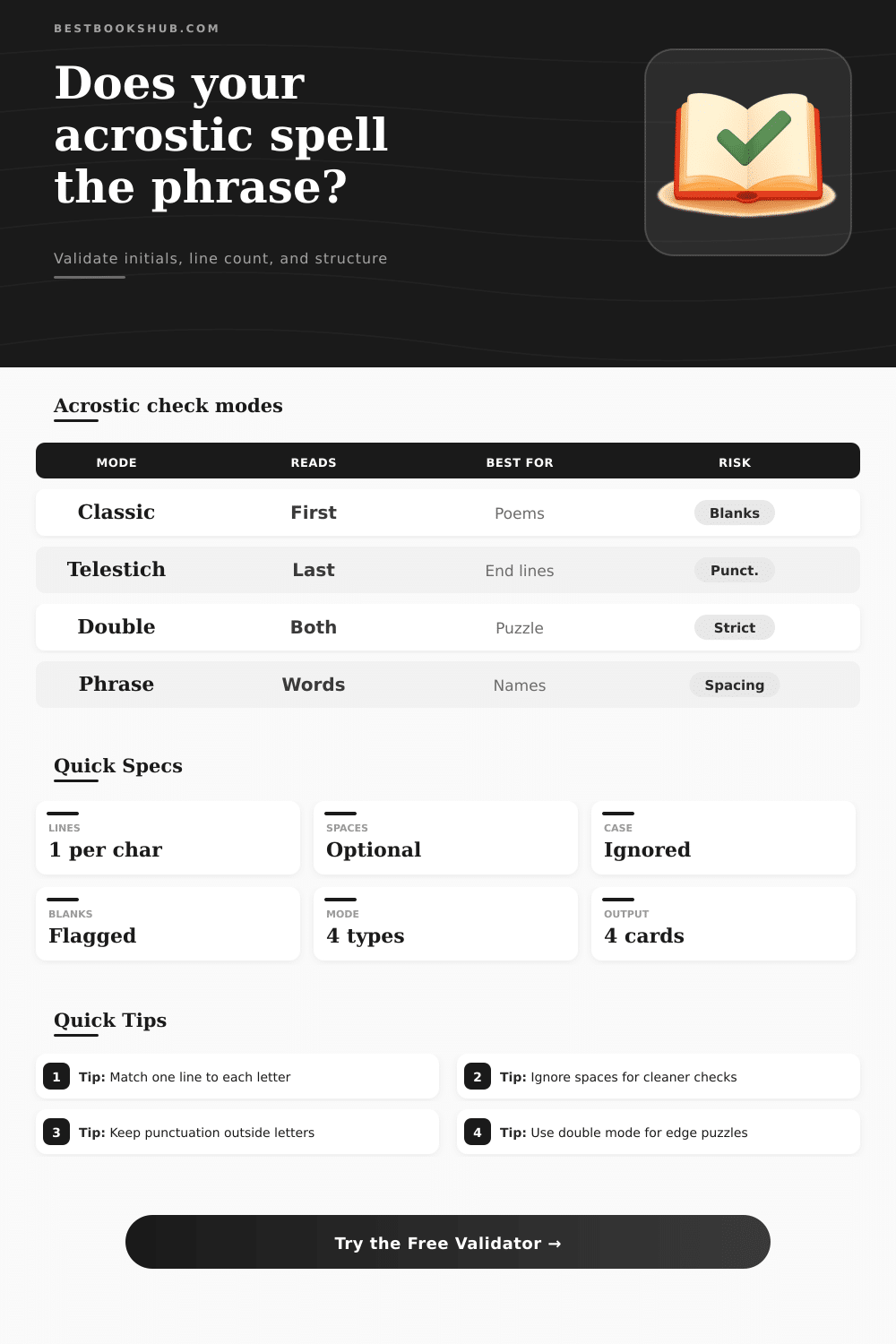
| Acrostic type | Extraction rule | Line requirement | Best validation use |
|---|---|---|---|
| Classic acrostic | First letter of each line | One line per target letter | Poems, classroom verse, dedications |
| Telestich | Last letter of each line | One line per target letter | End-line puzzles and hidden finales |
| Double acrostic | First and last letters | One line per paired letters | Symmetry puzzles and contest drafts |
| Word-start acrostic | Initials from consecutive words | One word per target letter | Phrase hiding inside compact prose |
| Setting | Strict option | Draft option | Validator effect |
|---|---|---|---|
| Case | Case must match | Ignore case | Strict catches decorative capitals |
| Spaces | Respect phrase spaces | Ignore spaces | Ignoring spaces checks letter stream only |
| Blanks | Count blanks as gaps | Skip stanza breaks | Counting blanks exposes missing lines |
| Punctuation | Literal characters | Strip punctuation | Stripping reads clean alphabetic edges |
| Target length | Classic lines | Double lines | Common risk |
|---|---|---|---|
| Short name, 3-5 letters | 3-5 lines | 3-5 lines | Too obvious if every line is short |
| Word, 6-8 letters | 6-8 lines | 6-8 lines | Middle lines often drift off theme |
| Phrase, 9-14 letters | 9-14 lines | 9-14 lines | Spaces create false mismatch reports |
| Alphabet drill, 26 letters | 26 lines | 26 lines | Repeated weak line openings |
| Issue found | What it means | Fast correction | Severity |
|---|---|---|---|
| Wrong initial | A line starts with a different letter | Rewrite the opening word | High |
| Line shortfall | Fewer usable lines than target letters | Add one line per missing letter | High |
| Extra active lines | More usable lines than target letters | Move note lines outside the poem | Medium |
| Blank stanza break | An empty row interrupts the count | Skip or count blanks consistently | Low |
DISCLOSURE: This post may contain affiliate links, meaning when you click the links and make a purchase, I receive a commission. As an Amazon Associate I earn from qualifying purchases.
Something about the secret word-in-a-poem thing is delightful. You weave every line carefuly, so it flows naturaly, and secretly forms a name or word. And then you reveal it to another person, who doesn’t see a thing. It happens more times than you’d guess. It is not because you’re a bad writer… Well, not always. Usually, it’s some small structural mistake that snap the fragile link between letters. Perhaps there is one stray space too many. Or maybe forgetting a title line. That kills the trick.
Here’s the validator for catching those little lapses before you present it to the world. By pasting your poems in the text box, and specifying what message you want to hide, the tool does the rest. The tool pulls out the letters and spits them back depending on the type of acrostic you choose.
How the Acrostic Validator Works
A classic acrostic uses first letter of each line, which is perfect for dedications and school poems. A telestich do the reverse by looking for final letter of each line. There’s double acrostics (checking both edges) and acrostics by phrases (pulling out the first initial of words instead of lines). Then there are the tricky ones, like trying to make sure the last letter of each sentence matches up… Telestiches.
With all of these types of acrostic, the calculator on top will do the number crunching for you. This saves you the headache of keeping track of where you are as you trace the letters with your finger halfway through a stanza.
And then there are blank lines. These is tricky because poets rely on them for rhythm and breath. But in an acrostic, too many can be fatal. Depending on how you have set the validator, it will either skip blank rows or count them. So the gap doesn’t get counted. Or else it does count. In that case, the validator marks that gap as missing letters and creates a mismatch. So what’s the solution? Do you consider your stanza breaks to be part of the puzzle, or merely aesthetic pauses? The validator allow you to select either option, but you must be consistent: mixing policies confuses things, and you pick one rule and go with it.
And then there’s the unexpected part: punctuation. On occasion, that last character could of been a period instead of the letter you expected. To read with a telestich, strip out the punctuation first and the system will only see the alphabetic edge rather than what was ‘literally entered’ (which would include symbols). Toggle the setting to keep punctuation literal if you’d like to include punctuation when reading. This is great if your puzzle demands exactness, but less so if your poem is more playful. By default most writers opt to strip punctuation since that is how their readers are likely to interpret what they read. Readers seek letters; they do not expect to see commas.
Another way to adjust strictness is case. When I write a more formal dedication in which capitalization matters, I’d prefer the validator catch any lowercase mismatches. On the other hand, when it’s just for fun, you probably don’t care about case. That way a small formatting mistake doesn’t cause an otherwise perfect poem to fail validation.
These checks get aggregated into a quality score in the results panel. This is one number for how far away your draft is from the target. Typically, if your score is low, there will be something obvious, such as incorrect initials or extra lines. The more you know about why something didn’t work. The quicker you can make it right.
When the validator points out a bad first letter, look at how that line starts. Perhaps you began with The rather than An? Often small changes fix bigger problems. The same goes for line shortfalls. This indicates you’ve got less active lines than letters in your intended phrase. Either reduce the secret message, or add some text.
So this is the balancing act of an acrostic: structure versus flow. This tool does not care about your rhyme scheme, or even how great your imagery is. It simply cares that the skeleton hold up.
When the bones are sturdy, let the poem breathe. Let your ear carry the load (after you check in with the tool). Keep the secret message safe till you’re ready to share it.