📖 Prosody scanner
Blank verse line analyzer
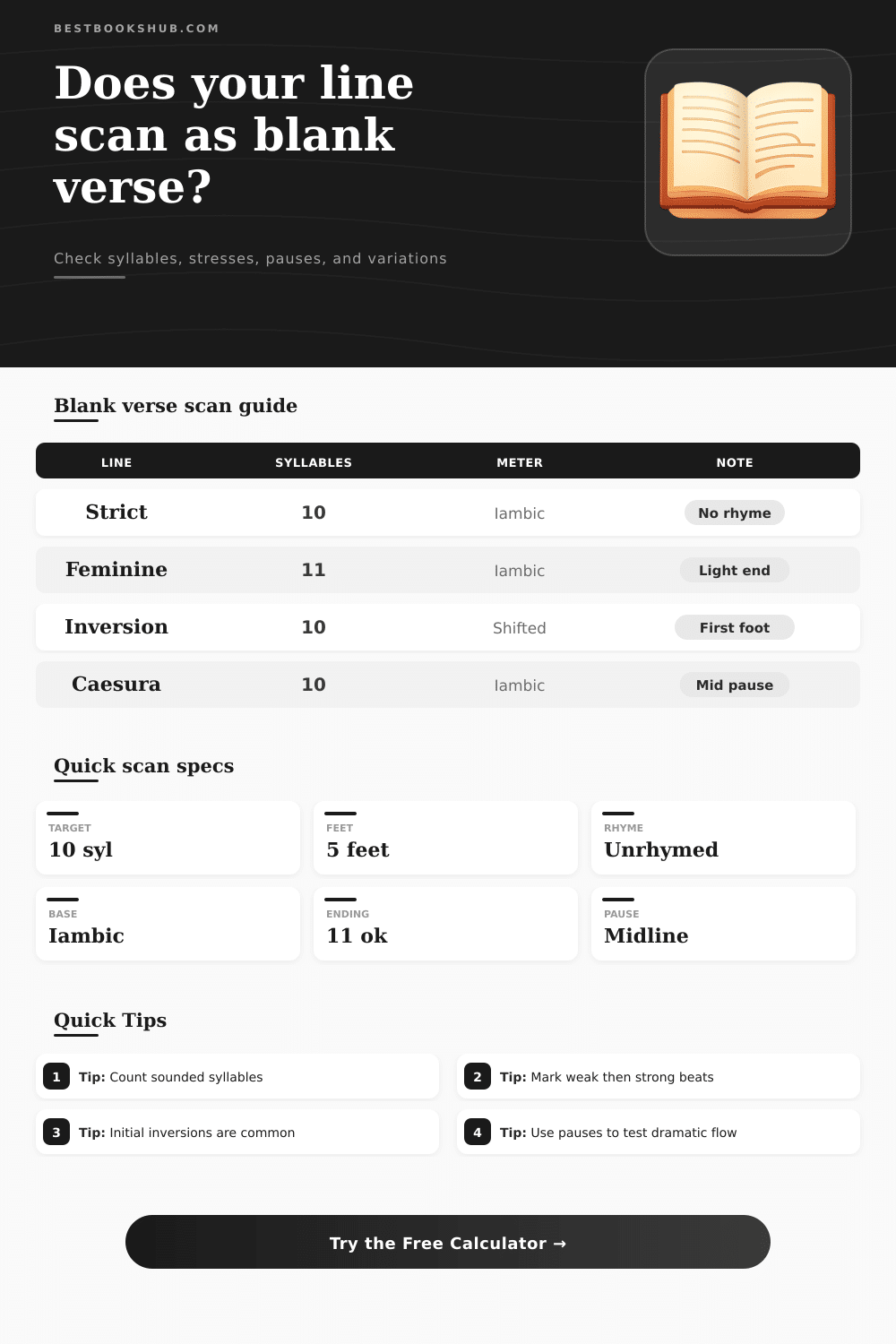
Scan one unrhymed iambic line for syllable count, stress movement, metrical substitutions, caesura placement, and line ending strength.
| Blank verse pattern | Syllable range | Stress base | Scansion cue |
|---|---|---|---|
| Regular iambic pentameter | 10 | 0 1 repeated five times | Most beats rise from weak to strong. |
| Feminine ending | 11 | Ten-beat base plus light ending | Final extra syllable is normally unstressed. |
| Initial inversion | 10 | First foot may be 1 0 | Often adds dramatic force at the opening. |
| Loose dramatic line | 9 to 12 | Iambic frame with substitutions | Needs strong phrase logic to remain verse. |
| Foot type | Stress pattern | Blank verse role | Typical effect |
|---|---|---|---|
| Iamb | 0 1 | Primary blank verse foot | Forward, rising movement. |
| Trochee | 1 0 | Common as first-foot inversion | Emphasis, command, interruption. |
| Spondee | 1 1 | Useful local substitution | Weight, pressure, collision. |
| Pyrrhic | 0 0 | Usually paired with a heavier foot | Speed, lightness, connective motion. |
| Pause marker | Usual strength | Caesura value | How to read it |
|---|---|---|---|
| Comma | Light to medium | Can mark a soft caesura | Brief turn without closing the sentence. |
| Semicolon or colon | Medium to strong | Clear rhetorical hinge | Often divides argument or contrast. |
| Dash | Variable | Interruptive caesura | May break rhythm deliberately. |
| Period or question mark | Strong | End-stop if final | Closes the line unless syntax continues. |
| Verse form | Meter | Rhyme | Comparison note |
|---|---|---|---|
| Blank verse | Iambic pentameter | Unrhymed | Drama and epic often use this form. |
| Heroic couplet | Iambic pentameter | Rhymed pairs | Closed couplets create stronger end pressure. |
| Free verse | No fixed meter | Optional | Line breaks carry more structural weight. |
| Prose line | No line meter | None required | Rhythm exists, but not as metrical verse. |
DISCLOSURE: This post may contain affiliate links, meaning when you click the links and make a purchase, I receive a commission. As an Amazon Associate I earn from qualifying purchases.
To analyze any piece of text, paste it in a single line. Then you can view the meter.
Many assume blank verse is just ten-syllable lines with no rhyme. But as simple as that sounds, that’s not very practical. Simply counting syllables has the potential to makes your lines robotic and rigid. No one would of want to hear that kind of flow in a dramatic context. Instead, the focus should be on movement. Where do the syllables pause? How do they move? Which stress moves forward, back?
How to Use the Blank Verse Tool
That is how the tool helps. Effective blank verse dont require impeccable iambic pentameter. In fact, Shakespeare rarely wrote perfect meters. He was more interested in achieving a dramatic effect different than adhering rigidly to any set of rules. The tool can be toggled from strict textbook scanning to flexible options that considers the natural rhythm of speech. Selecting an option allowing for poetic elision, the words ‘o’er’ or ‘heav’n’, for example, will be scanned as they would have been spoke in performance. (This is important, since in the early moddern period these contractions was understood by the audience as one beat each.)
It will then give you back a number: the syllable count. This is bare bones of what we’re looking for. But pay attention to the iambic fit percentage if you want a better understanding of the meter. Having a low score doesn’t always imply a poor poem. More times than not, it means there’s some variation intended, like starting with an inverted foot, a stressed syllable as lead-off of the first foot. It creates instant impact. It is great for shocking passages and directives.
Mid-line pauses is also noted by the scan, indicated by punctuation that interrupts the iambic flow. That means a rhetorical shift has occurred. The reference tables within site describe the effect of each kind of pause marker on the meter. For example, a dash causes a sudden stop; a comma allows for a softer breath. Knowing this lets you control the pace of the scene without altering a single word.
Words often have feminine endings. These add an eleventh unstressed syllable to the line. This softens the rhythm making it sound more conversational than a marching song. You can alter the setting of this rule on the analyzer and then it will flag these up automaticly. That’s good as feminine endings became frequent in later Shakespeare plays and indicate exhaustion or mental depth.
So maybe you find a line scanning regularly iambic but just feels flat? Adding an extra syllable may give it the lift it needs. Or you may have a line that feels crowded. Check for pyrrhic feet to see what is dragging the meter down. In other words, a pyrrhic foot are two unstressed syllables placed one after the other.
Poetry lives in the spaces in-between rules, so don’t expect every line to cleanly fall into one category or another. That’s normal. You can get a break-down of all the feet, identifying which are spondees, trochees, iambs, or pyrrhics. A spondee is two stressed syllables that adds collision to a line. They are good for times of physical action or tension. Recognizing the substitution can help you determine if an odd rhythm is accidental. Or did the poet mean to write it that way? If the words aren’t emphasized in the way you expected, perhaps they should be swapped out instead of just moved around.
But the best test of any line is whether you can read it out loud. There’s no software program that can perfectly catch the emotion in a line as well as human being who breathes it in. But having a visual representation of how your meter falls will help you identify patterns that might not have been apparent without one. Where does the energy stall? Where does it build? How can I adjust it?
Apply that feedback loop: paste the line; scan it; read it; adjust the setting; repeat. The more you do this, the better sense you’ll get of what feels right. Let the calculator do the math first so you can spend more time working on the art of variation instead of the arithmetic of the beat. Perfection in blank verse is not perfection at all; it’s perfecting imperfection inside of a framework. Build your frame out of ten-syllable units, then furnish those rooms with substitutions, inversions, and pauses. Learn to feel when some deviation feels right. Stop counting, start feeling; then you know why. Let your line breathe.