📖 Prosody pause checker
Caesura counter
Count internal poetic pauses, weigh punctuation strength, map early and medial breaks, and test whether a line is clipped, balanced, or heavily interrupted.
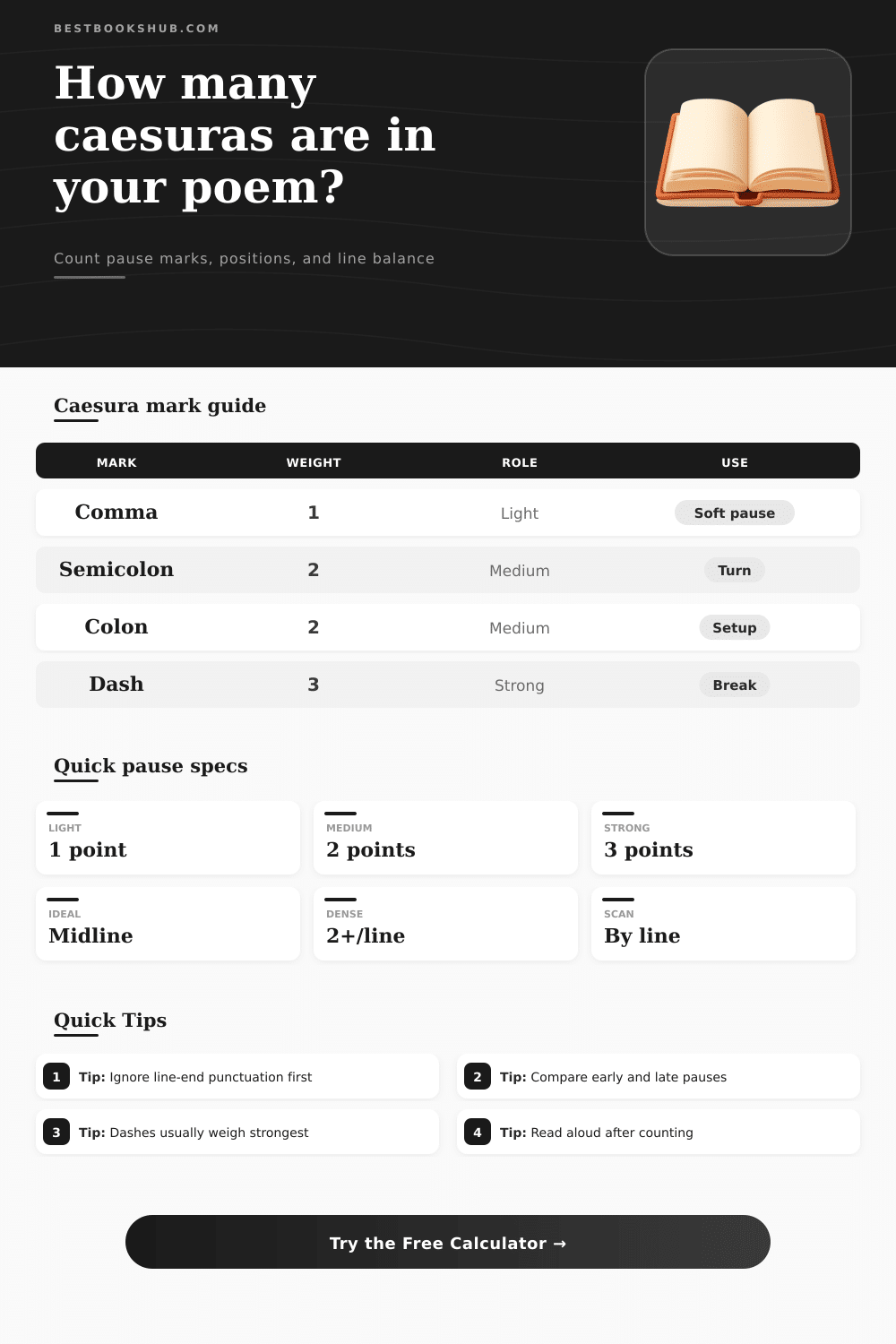
| Pause mark | Default weight | Caesura role | Common reading effect |
|---|---|---|---|
| Comma | 1 | Light caesura | Brief breath or phrase hinge |
| Semicolon | 2 | Medial turn | Balanced syntactic division |
| Colon | 2 | Anticipatory pause | Prepares explanation or list |
| Dash | 3 | Strong caesura | Interrupts rhythm or thought |
| Parenthesis | 2 | Inserted aside | Creates secondary voice |
| Line position | Range in line | Classical cue | Interpretive use |
|---|---|---|---|
| Initial pause | 0-25% | Opening check | Stalls the launch of the line |
| Early caesura | 25-40% | First-half break | Turns quickly after setup |
| Medial caesura | 40-60% | Central division | Balances two hemistichs |
| Late caesura | 60-80% | Second-half break | Delays the line's pivot |
| Terminal pause | 80-100% | Line closure | Often counts as end-stop |
| Verse form | Usual density | Preferred position | Specification cue |
|---|---|---|---|
| Alliterative long line | 1 per line | Medial | Two half-lines divided by a pause |
| Blank verse | 0.5-1 per line | Varied midline | Speech rhythm inside pentameter |
| Heroic couplet | 1 per line | Medial or late | Balanced wit and antithesis |
| Free verse | Variable | Breath-led | Lineation and punctuation share work |
| Spoken-word line | 1-2 per line | Rhetorical | Performance breath and emphasis |
| Comparison pattern | Count signal | Balance signal | Revision clue |
|---|---|---|---|
| Sparse line | 0 pauses | Smooth run | Add a mark only if sense turns |
| Balanced line | 1 pause | 40-60% | Good medial caesura candidate |
| Interrupted line | 2 pauses | Heavy score | Check whether syntax feels choppy |
| Fragmented line | 3+ pauses | Very dense | Use deliberately for pressure |
DISCLOSURE: This post may contain affiliate links, meaning when you click the links and make a purchase, I receive a commission. As an Amazon Associate I earn from qualifying purchases.
Read a poem out loud. Where does it cause you to catch your breath? That pause is not a mistake; it is heartbeat of that line’s structure. An internal pause, or caesura, in a metrical line make something written on paper come alive. As you scan through a poem, look for those cracks, where meaning pivots and the syntax turns. There’s a way to count and weight them with a tool: to make clear what your ear knows but cannot quite measure.
Poets know how punctuation controls the breath, but not many of us tells the difference between a simple grammatical comma and a dramatic dash. With this calculator, we’ll do the math for you. We will weight each mark according to its impact on the rhythm to help you perceive texture.
How Punctuation Changes Poem Rhythm
A single comma may count as a tiny point of friction, enough to let the line slip through without much drag. Semicolons has some weight, frequently indicating a balanced turn or a change in argumentative direction. The dash is the heavyweight champ. It stops the reader in their tracks and marks a rupture. It makes a difference what mark you choose, since it alters experience of reading physically. You can’t treat a soft breath like a shouted interruption and expect to get the same rhythm.
Punctuation matters, but so does placement. A mid-line pause, or pause within middle of a line, establishes a sense of balance, a symmetry that’s intentional and stabilizing. By splitting the line into its hemistichs equally it offers the reader an even split: two equally-weighted halves to digest. Early placement stalls the line’s launch, setting up tension from very first word. Late placement holds the pivot off until the line’s end, requiring the reader to keep momentum over a longer span before releasing her breath. The table of references on the page is clear about all this, charting location against effect.
If you notice yourself pausing only at line-endings, you’re probably using end-stops instead of pauses within lines. Which produces a list-like, choppy rhythm more suited for prose different than sophisticated verse.
The pressure of the poem depends on its density. A few beats scattered across lines allows ideas to flow easy, which is good for narrative and lyrical passages. In contrast, many beats (two or more per line) breaks up the thought process. This is helpful for portraying rapid-fire dialogue, confusion, anxiety, or anything that feels jagged and resembles how people speak under emotional circumstances. But too much of it will tire the reader in the middle of a passage meant to be uninterrupted. You can compare this ratio to what tone you’re trying to achieve.
For example, if you were shooting for something closer to blank verse (which mimics naturaly patterns of speech), you’d want to have a moderate amount that changes from line to line. Sometimes free verse use lineation alone to set off pauses; at this point, internal punctuation is no longer required. Compare this to the established set-ups of other poetic forms. The medial line break is crucial in old English alliterative verse (think Beowulf), where two linked half lines depends not on rhyme but on a robust link between sound. A late or medial caesura is useful in heroic couplets: they invite a balance of argument and playfully opposed contrasts. If you’re writing moddernism, you may flout these traditional rules altogether; your line-breaks will be erratic, reflecting scrambled mental states. Knowing the rules lets you see if you’ve deliberately made your own variations, or stumbled into flaws of structure.
That’s where this kind of analysis pays off most: editing. When you try saying a line out loud and it doesn’t sound right, look at the pauses. See if a comma is a bit too near to another break, and you’ve got yourself a stammer. See if a dash isn’t doing too much work and a plain old period would of just be more cleanly closing. Read it aloud, again and again. Your ear will confirm the numbers. And then tinker with commas until the breath fits the meaning.
When you get there, when the internal rhythm lines up with the external structure, then the poem no longer sounds like words on a piece of paper; it begins to feel like music in the air. That is the clarity that makes the pause worth counting.