✍ Revision checker
Adverb-ly word counter
Paste a draft to count probable -ly adverbs, separate false friends, measure density per 1,000 words, and find repeated clusters worth revising.
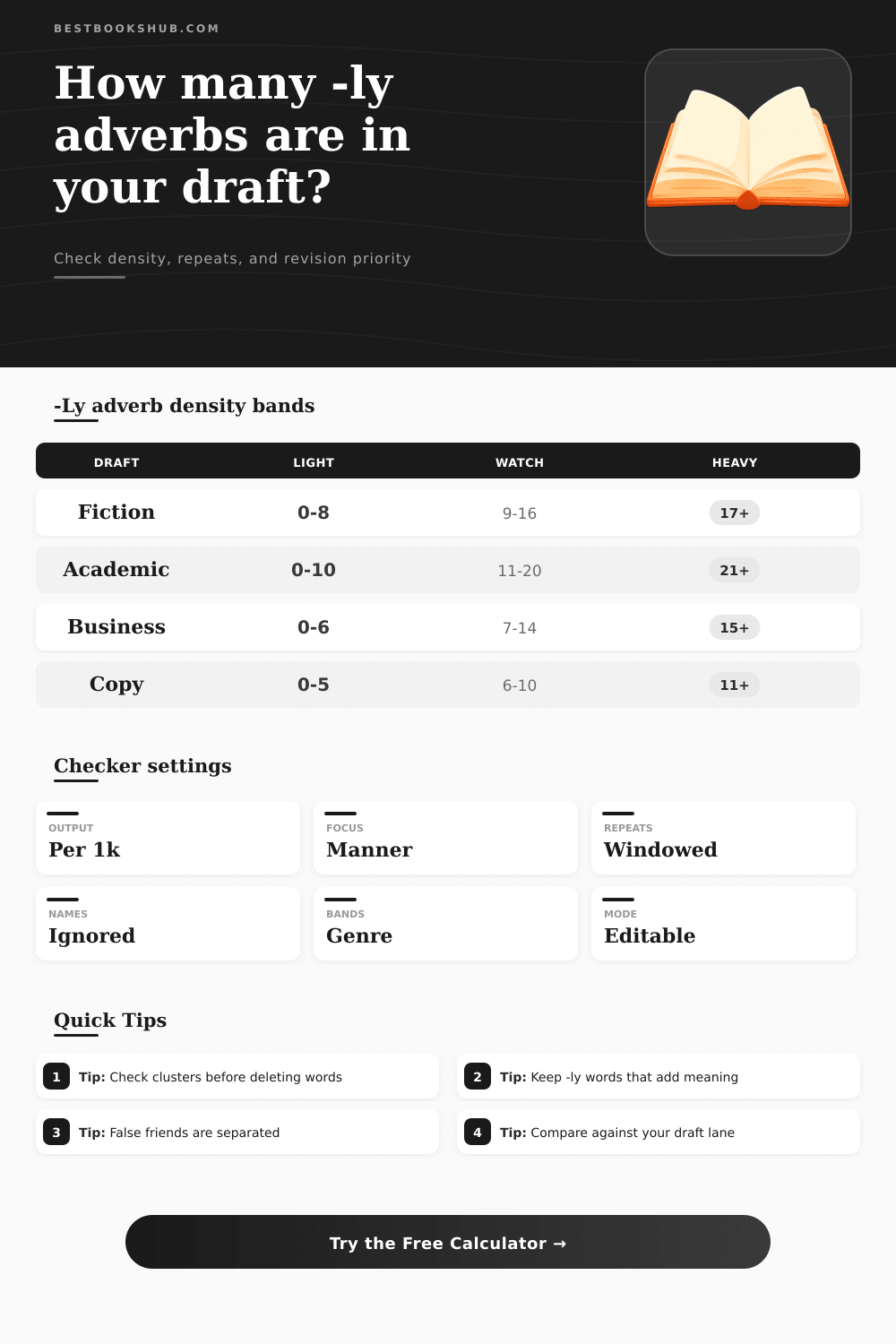
| Draft lane | Light -ly density | Watch range | Heavy range |
|---|---|---|---|
| Fiction narration | 0-8 per 1,000 | 9-16 per 1,000 | 17+ per 1,000 |
| Dialogue-heavy scene | 0-10 per 1,000 | 11-20 per 1,000 | 21+ per 1,000 |
| Academic prose | 0-10 per 1,000 | 11-20 per 1,000 | 21+ per 1,000 |
| Business communication | 0-6 per 1,000 | 7-14 per 1,000 | 15+ per 1,000 |
| Sales or web copy | 0-5 per 1,000 | 6-10 per 1,000 | 11+ per 1,000 |
| -Ly category | Examples | Default treatment | Editorial use |
|---|---|---|---|
| Manner adverbs | quietly, sharply, slowly | Flagged | Check whether the verb can be stronger. |
| Intensifiers | really, totally, absolutely | Flagged | Often removable or replaceable. |
| Sentence adverbs | clearly, probably, generally | Flagged | Useful for stance, but easy to repeat. |
| False friends | family, early, friendly | Separated | Usually not a target adverb. |
| Time frequency | daily, weekly, monthly | Separated | Usually factual, not style clutter. |
| Signal | Calculation | Why it matters | Best next check |
|---|---|---|---|
| Density | Adverbs divided by words | Shows overall reliance on -ly wording. | Compare with lane band. |
| Repeat pressure | Same adverb in local window | Repeated words draw attention fast. | Revise nearby duplicates first. |
| Cluster pressure | Adverbs close together | Clusters can make prose feel padded. | Read the paragraph aloud. |
| Priority score | Density plus repeats plus clusters | Ranks how urgent the pass is. | Start above 60/100. |
| Comparison pass | What to keep | What to question | Typical fix |
|---|---|---|---|
| Fiction line edit | Voice, rhythm, contradiction | Weak verb support | Use a sharper verb or image. |
| Academic revision | Stance and probability | Repeated hedges | Vary claim strength precisely. |
| Business polish | Accuracy and tone | Vague assurance words | Replace with specific action. |
| Copy tightening | Meaningful emphasis | Stacked intensifiers | Cut one and make the claim concrete. |
DISCLOSURE: This post may contain affiliate links, meaning when you click the links and make a purchase, I receive a commission. As an Amazon Associate I earn from qualifying purchases.
We’ve all heard it. Write better verbs. And don’t use adverbs. On the surface of things, that’s a neat rule. But most writers does not work that way; language doesn’t work like that. If it were so simple, there’d be no point in learning about the craft of writing. It’s messier than that and you can’t really know what those little word are doing without understanding why they’re in your sentence in the first place. Some of them has weight. Others simply add noise.
So how does it work? That’s where the calculator comes in; it scans through your draft and picks out likely candidates for -ly words. It differentiates between true adverbs that modify verbs and other word like early or family. These words also end in -ly, but they aren’t actualy adverbs. Why is this important? Because if you counted all words that ends in ly, you’d load your score up on meaningless data. Want to track your use of speed, or maybe quietness? It is not about whether you just talked about a weekly meeting. The software singles out manner adverbs, words that weakens verbs, and highlights them so you can look back over them.
How to Use Adverbs in Your Writing
Most writers fall into density. Twenty adverb per thousand words may seem like a bad habit, but one often goes unnoticed. This is spelled out in the page’s reference table with specific bands for different genres. Business copy can’t be as loosey-goosey as fiction (fiction often relies on rhythm rather than raw facts, and your voice need it). Before worrying about a high score, see which lane you’re in. A thrill-ride scene will tend toward higher density then an abstract from academia, and that’s okay… It depends on context.
The true villain is repetition. Once is okay, doing it slowly works. But thrice in a hundred words and it become an echo chamber in the reader’s head. Within a certain window, this tool will scan and tell you when you’ve used the same modifier repeatedly. You might be unsure about the verb or unsure if that sentence needs more description. Instead of fixing the verb, you shore it up with an adverb. That matter for pacing. Take the word sharply as an example. Did the door slam sharply? Perhaps. But the door slammed sharply tells the reader twice there was noise. Adverbs is often redundant with strong verbs. Repeat pressure highlights those redundancies in the calculator for you. It shows you where you used the same crutch word more than once in a short space of writing. This allows you to decide which one are the strongest and cut the rest.
But not all -ly words are bad! There are also sentence adverbs (e.g., probably, clearly), which indicate tone and stance. These word show confidence in a statement. For academic writers, these kinds of hedges is important to help be precise. For fiction writers, using too many might muddle the action. With this tool, you can filter for intensity vs. Manner adverbs, and focus on where your edits should go.
Don’t blindly delete things based off word count. Read what’s flagged out loud. Delete it if taking away doesn’t change anything. Keep it if it alters the voice or meaning. Mostly it’s about knowing what you’re realy measuring. It’s looking for places where an adverb has to pile in and do the descriptive work. Read that paragraph out loud when you see a cluster flag. Often, you’ll hear the rhythm stumble at the place where the adverbs pile up. Sharpen the verbs or nouns around there; smooth those spots. The number’s just a guide to tell you where to look closer, trust your ear more than the score.
It’s a matter of cutting down on clarity, which isn’t a set of rules but an editing process that can be refined. You should of looked at it sooner. You’re trying to get the reader to see what you’re showing them instead of reading your tags describing it. So cut out the noise (use the counter), leave in the signal (trust your judgement). Begin with the easy ones first. The ones that are easiest to fix. And work outwards from there, because you’ll end up tightening up your prose without taking away its soul. That’s the balance you’re after all along.