📖 Draft rhythm audit
Sentence opener diversity calculator
Paste a passage to measure first-word variety, opener-type balance, repeated starts, and revision pressure across fiction, essays, and nonfiction drafts.
| Opener type | Typical marker | Rhythm effect | Revision cue |
|---|---|---|---|
| Subject or noun start | The, a name, a thing | Clear and direct | Watch stacked subject starts |
| Pronoun start | I, he, she, they | Fast viewpoint tracking | Limit clusters in narration |
| Transition start | However, therefore | Logical bridge | Too many can feel mechanical |
| Adverb start | Quietly, finally | Instant tone or pacing | Check if the verb can carry it |
| Prepositional phrase | In, on, after, beside | Places reader before action | Good for scene orientation |
| Dependent clause | When, because, although | Builds cause or timing | Avoid long delay every line |
| Participial phrase | Running, holding | Continuous motion | Check for dangling action |
| Question or command | Why, how, do, remember | Creates pressure | Use sparingly outside dialogue |
| Diversity score | Interpretation | Likely draft feel | Best next action |
|---|---|---|---|
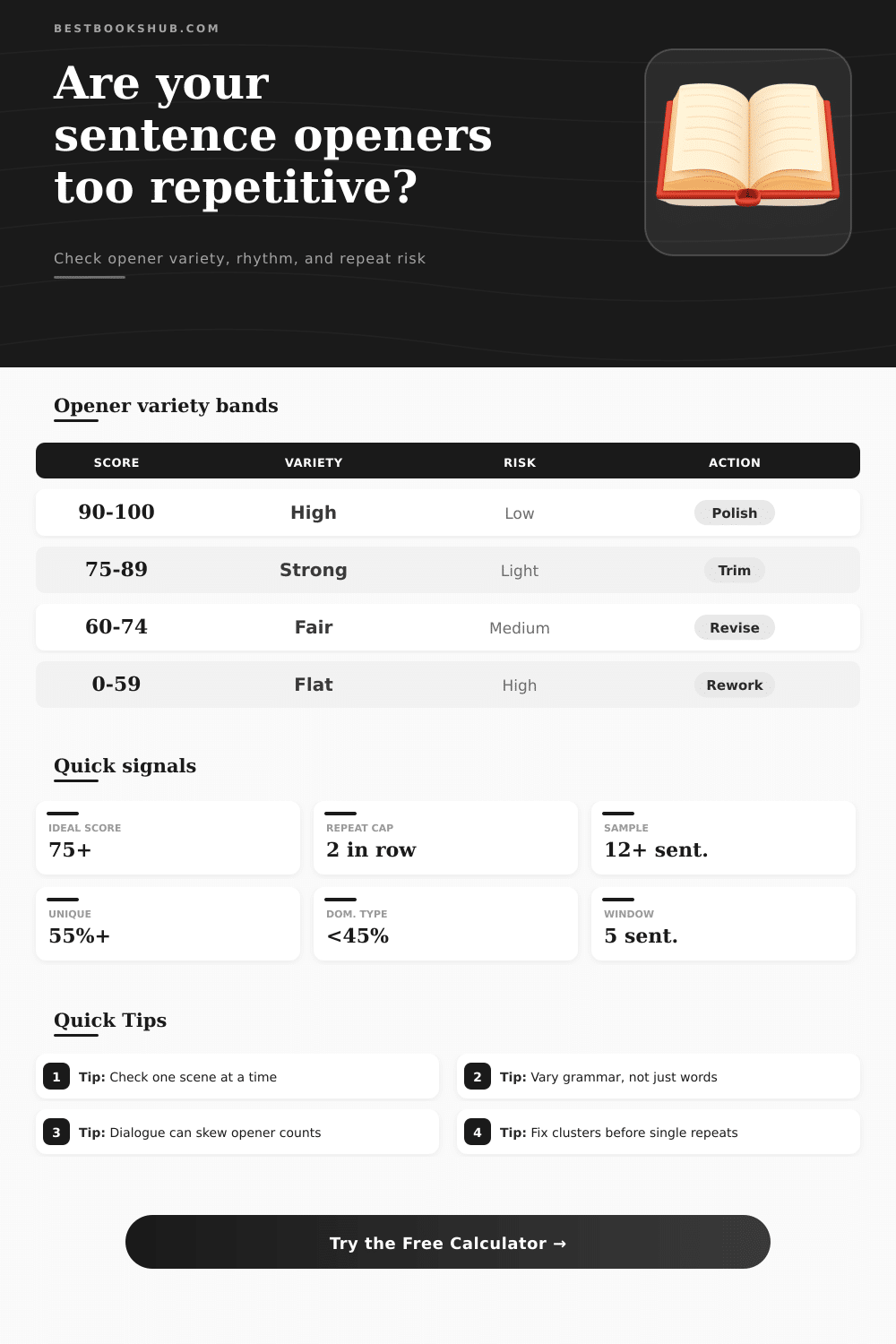
| 90-100 | High variety | Flexible, controlled rhythm | Polish for voice consistency |
| 75-89 | Strong variety | Readable with minor clusters | Fix the top repeated opener |
| 60-74 | Fair variety | Some flat or patterned runs | Revise local repeat windows |
| 40-59 | Low variety | Noticeable repeated structure | Change sentence grammar types |
| 0-39 | Very low variety | Monotone or list-like motion | Rewrite paragraph openings first |
| Writing profile | Healthy unique ratio | Dominant type cap | Why it differs |
|---|---|---|---|
| Literary fiction | 60-75% | 35-42% | Rhythm carries voice and image |
| Commercial fiction | 52-68% | 40-48% | Clarity and pace share weight |
| Dialogue-heavy chapter | 45-62% | 45-55% | Speech patterns repeat naturally |
| Academic prose | 48-62% | 45-55% | Topic continuity can be useful |
| Technical explainer | 40-58% | 50-60% | Steps and definitions repeat by design |
| Query or pitch letter | 55-70% | 38-48% | Short samples need quick movement |
| Comparison setting | Best for | Tradeoff | Use when |
|---|---|---|---|
| First word | Line-level repetition | Misses phrase patterns | You hear same starts aloud |
| First two words | Subject phrase habits | More sensitive to small samples | Names or pronouns repeat |
| First three words | Opening phrase texture | Can overstate variety | You are polishing prose rhythm |
| Opener type only | Syntax balance | Ignores repeated vocabulary | Every line feels built the same |
DISCLOSURE: This post may contain affiliate links, meaning when you click the links and make a purchase, I receive a commission. As an Amazon Associate I earn from qualifying purchases.
This is a diversity calculator that measures the diversity of way you open sentences. It takes something that’s a matter of taste (your sentence rhythm) and makes it measurable, something you can use to make your writing better. Want to know if your writing sounds monotonous? You don’t need to guess: this calculator shows you exactly which parts of your text has a repetitive beat.
It does this by scanning through your draft and classifying where each sentence begins. Does it begin with the first word? Or does it look deeper and study the first couple of words (because that can make all the differance)? Clearly, five sentences beginning with the word “He” raise a red flag. And while five sentences beginning with “He walked,” “He ran,” and “He stood” may sound fine on the surface, they’re establishing the same sort of subject-verb cadence. So the system lets you determine whether it’s looking only at first word … or whether you’d prefer a bit more nuance, checking phrases of two or three words instead.
How to Use the Calculator for Better Writing
Depending on what you hope to achieve from revising, system adjusts. If you’re polishing opening to a thriller, for instance, you might be willing to live with some more repetition. Short, punchy sentences is common in that kind of book where pace is key. With memoirs and literary fiction, though, you’ll likely want tighter reins: The style of the prose are most important in these forms, and you want the rhythm to feel deliberate… Not something that just happened.
This difference between a useful audit and a baffling list of digits lies in understanding the genre context. For example, in academic texts, a topic sentence restating key terms can be essential for clarity. Technical explainers requires precise wording different than poetry. The calculator takes this into consideration through its option to choose a writing profile standard. If you opt for “technical” or “academic,” system knows it should of adjust expectations accordingly. It won’t penalize you for repetition because that is required.
In a novel, having 45 percent of your sentences start with the same type of opener are terrible. Is it okay in a research abstract? That’s fine. It helps avoid over-editing something where variety isn’t as important than clarity. So many writers get caught up counting unique first words that they don’t realize they’re writing identical structures. Yes, you might start your story with two dozen different words. But if they’re all pronouns or nouns + an active verb, your sentences reads similarly. The tool slices open the kinds of openers you use so you can see it.
Does it point out that you’ve got a lot of “therefores” and “howevers,” making your text sound argumentative instead of narrative? Does it point out a pileup of prepositional phrases that put reader in a setting without enough action? Often the value in fixing those is greater then achieving a perfect diversity score. Three sentences in sequence matter more for readability than adjusting a single random opener at some other spot in the piece.
The other issue with analyzing rhythm is how to handle dialogue. People naturaly use pronouns and repeated word patterns when they speak. So if you analyze each line of dialogue like a paragraph of narrative prose, you’ll probably end up with a lot of false positives. The tool may even tell you to revise your natural speech because it achieves the desired target. You can use the settings to address this by grouping the quoted text or even excluding it from the count altogether. That way, you know your revisions are concentrated where they should be: in the true problem spots. And those tend to be the narrative glue of the storys.
Nobody wants a magic number. The goal is to remove the friction between your ideas and your reader’s understanding. If there is variety, so that rhythm doesn’t get boring, then you have a high score here. It doesn’t distract from what you’re saying. If you’re getting a lower score, then you’re locked into a loop that you need to break. Look at the clusters the feedback flags up. Replace heavy transitions with stronger verbs. Vary the structure of your clauses. Read the piece out loud once more. The rhythmic wall should have dissapears. It’ll be replaced by a flow that pulls reader along, without their even noticing the mechanics behind it.