💬 Fiction dialogue checker
Dialogue tag variety counter
Paste a scene to count dialogue tags, measure said balance, find repeated speaker cues, and separate invisible tags from loud attribution verbs.
The checker looks for speech verbs near quoted lines, estimates dialogue density, and highlights tag repetition. Results are editorial signals, not grammar verdicts.
DISCLOSURE: This post may contain affiliate links, meaning when you click the links and make a purchase, I receive a commission. As an Amazon Associate I earn from qualifying purchases.
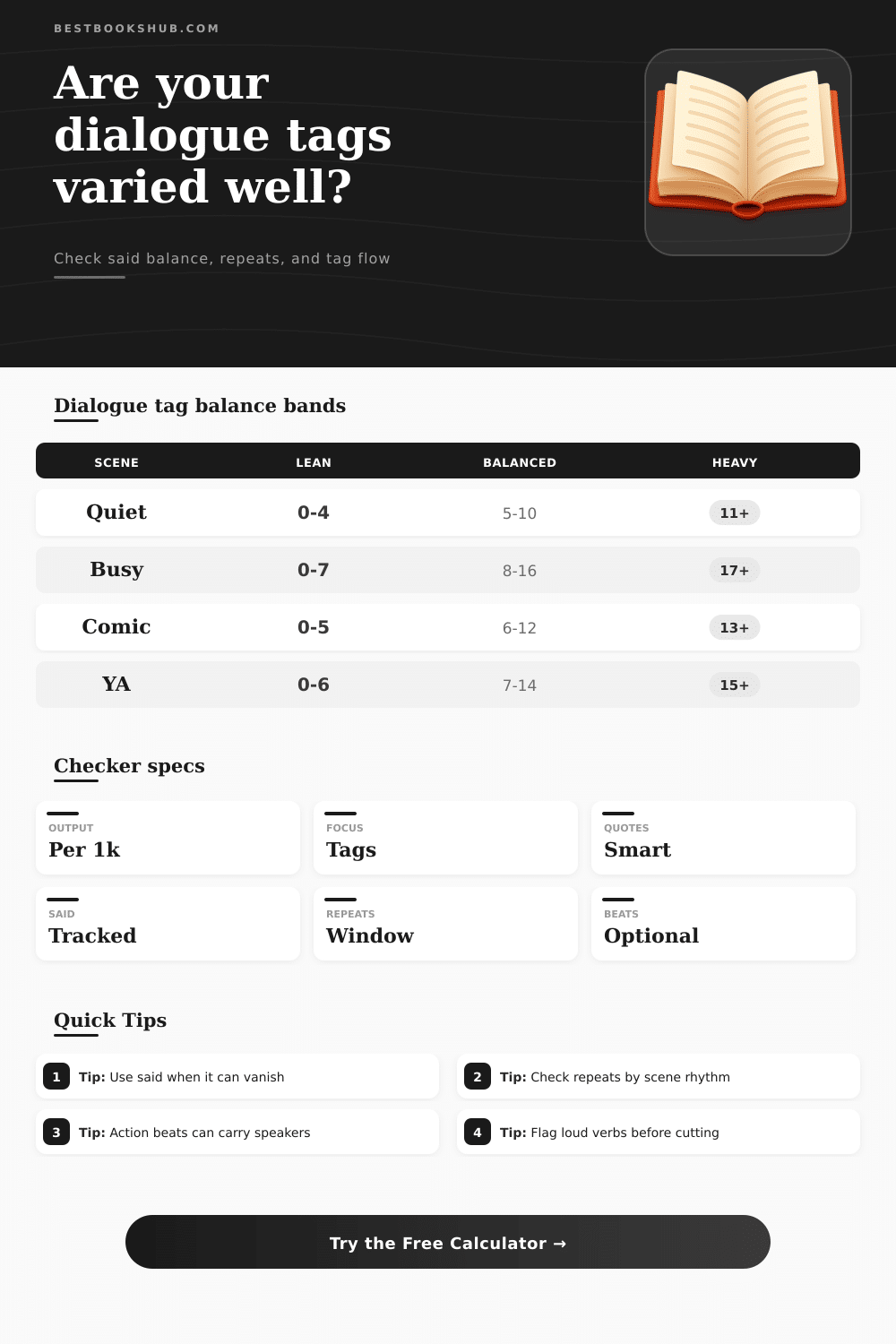
Dialogue tag balance by scene type
| Scene type | Light tags | Balanced tags | Heavy tags |
|---|---|---|---|
| Two-person quiet scene | 0 to 8 per 1,000 words | 9 to 18 per 1,000 words | 19+ per 1,000 words |
| Busy multi-speaker scene | 0 to 12 per 1,000 words | 13 to 26 per 1,000 words | 27+ per 1,000 words |
| Interview or hearing | 0 to 15 per 1,000 words | 16 to 32 per 1,000 words | 33+ per 1,000 words |
| Fast comic banter | 0 to 10 per 1,000 words | 11 to 24 per 1,000 words | 25+ per 1,000 words |
Common tag families and editorial role
| Tag family | Examples | Best use | Watch for |
|---|---|---|---|
| Invisible | said, asked, replied | Speaker clarity without drawing attention | Repeated phrasing in the same rhythm |
| Volume | shouted, whispered, yelled | Actual sound level changes | Replacing punctuation or context |
| Emotion | snapped, pleaded, groaned | Moments where tone is not otherwise clear | Explaining feelings the line already shows |
| Continuation | continued, added, finished | Long exchanges or resumed comments | Over-marking every turn in a dialogue chain |
Comparison grid for attribution methods
| Method | Speed | Clarity | Revision signal |
|---|---|---|---|
| Simple tag | Fast | High | Keep when speaker might blur |
| Action beat | Medium | Medium to high | Use when movement matters |
| Untagged exchange | Fastest | Depends on turn order | Best for short two-speaker runs |
| Loud speech verb | Slowest | High but noticeable | Reserve for real emphasis |
Revision targets by score band
| Score band | Likely read | Priority check | Next pass |
|---|---|---|---|
| 80 to 100 | Controlled and clear | Only local repeats | Read aloud for rhythm |
| 60 to 79 | Generally balanced | Said share and clusters | Smooth repeated patterns |
| 40 to 59 | Noticeable tagging | Loud verbs and density | Replace some tags with beats |
| 0 to 39 | Likely tag-heavy or unclear | Speaker flow | Rewrite attribution strategy |
What’s wrong with dialogue tags? Most writers use them as a coloring book activity. You’ve got some speech and now you want a verb. Said’s boring; let’s try whispered or shouted. The reason behind the urge is your desire to indicate emotion and tone, but result is almost always to yank the reader right out of the scene. If dialogue attribution are doing its job, you won’t even notice it, and will find yourself guided toward what the ear wants to hear (not what’s being announced to it).
You can plug in your tags and hit calculate. It will do the math for you, so you don’t have to think about conversions and coefficients or anything else that might distract from the flow of voices in your head. More important: it’s not just about did I use enough variety? It’s also about how dense are the tags compared to word count? Does it notice if words clusters up too much?
How to Use Dialogue Tags Correctly
An argument between two character is handled different than one involving three. And no, said isn’t evil: It’s the default, which fades back to nothing after a sentence or two. Swap in declared or exclaimed and readers will begin hearing the voice instead of seeing the word said, but they’ll also be adding volume where none was required. A busy courtroom exchange require more attribution than a simple literary moment because the risk of getting confused about who says what is higher in one than the other. This is laid out in reference table on the page, where you can see how tag density varies according to scene type.
For example, it recognizes certain contexts, the formality of a court proceeding vs. The casual back-and-forth of two comedians’ banter, and lets you tweak your inputs accordingly. That way, the tool doesn’t penalize a genre movie with needed heavy handedness. There’s an option to count action beats and you can turn it off if a slam-of-the-door is followed by some dialogue. Since that doesn’t require a “he said,” the calculator gives you the option to count that towards clarity.
The problem is that many writers don’t realize that mused and opined has a judgmental quality and a tone that jars against neutral dialogue, so they vary for varietys sake when what they really should of do is just say said three times in a row. Which is why the variety score penalizes unusual attribution choices more heavily then it rewards simple repetition (hence the term “variety score”). If the reader never loses the speaker and the lines convey emotion, then even a high said share can be healthy.
Look at the repeat risk indicator when you scan your results. This flags where the same pattern appear too close together to create a rhythmic stutter in the prose. If your score dips into lower bands, this usually means you are relying on verbs that tell rather than show, or over-explaining who is talking. The tool suggests a pass based off your particular mix to help you achieve a tighter polish. This allows you to revise by either cutting tags out completely or replacing them with action beats when the turn order is obvious.
The idea isn’t to have it write the scene for you; it’s highlighting what the scaffolding looks like so then you want to clean up the structure and have conversation standing on its own. Finally, as I said above, dialogue tags aren’t there for decoration; they’re like traffic signs. They guide the reader through the flow of information. When they work, the reader does not even notice them, simply following the voices from line to line without being distracted by the connecting words. This is the sweet spot each scene strives for, so listen to your ear to get there (since the math points out the bumps) and use that insight to smooth the ride.