📚 Entity density checker
Proper noun counter
Paste prose, nonfiction, notes, or manuscript pages to count proper nouns, repeated entities, acronym load, title words, and name density.
This checker uses capitalization, acronym, honorific, and title-pattern signals. It is designed for editorial review, not legal identity verification.
DISCLOSURE: This post may contain affiliate links, meaning when you click the links and make a purchase, I receive a commission. As an Amazon Associate I earn from qualifying purchases.
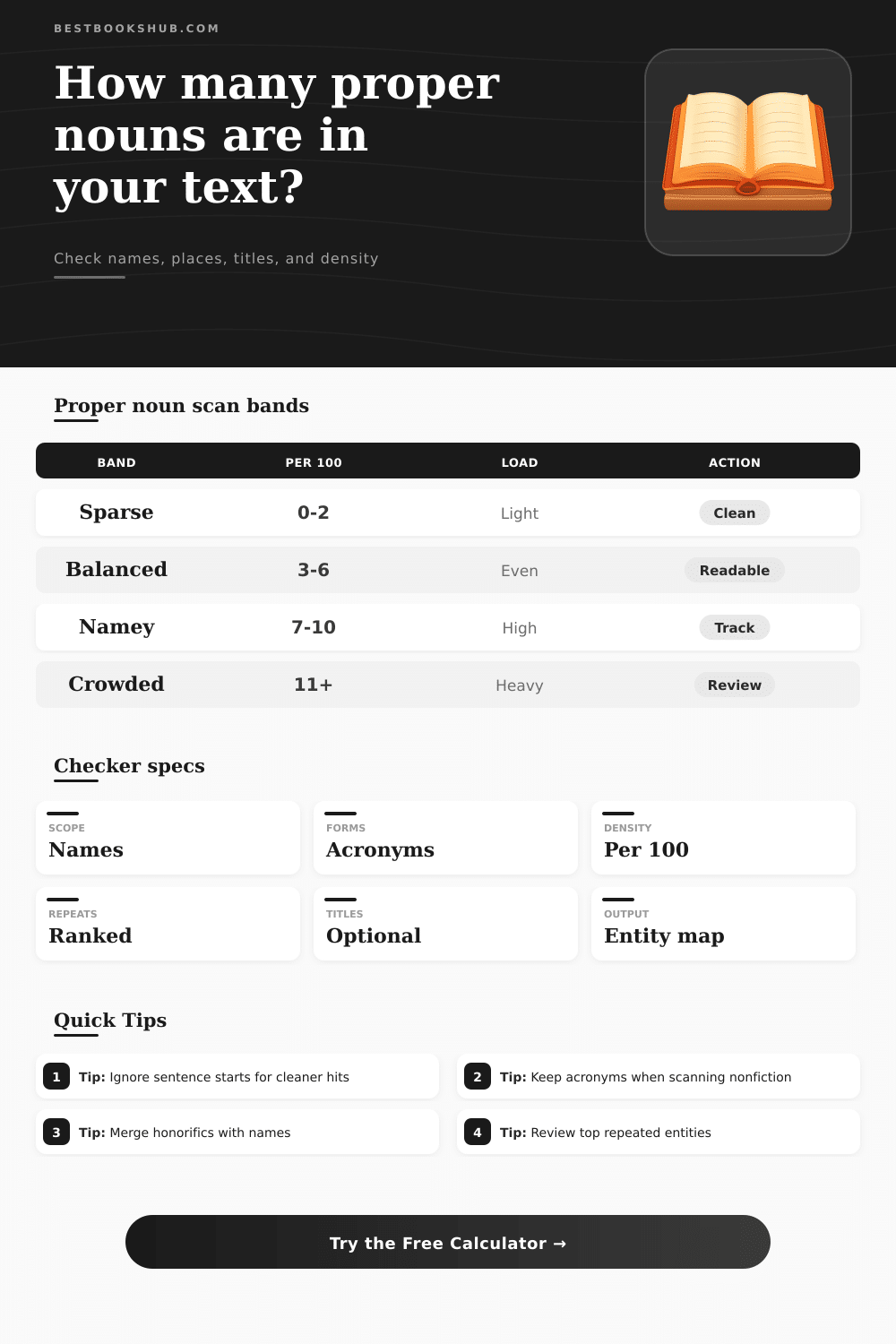
Pattern reference for surface-based proper noun detection
| Pattern | Example | Default treatment | Review note |
|---|---|---|---|
| Personal name | Marina Patel | Count as one span | Merge adjacent name words |
| Place or institution | New York Library | Count as one span | Watch generic final nouns |
| Acronym or initialism | UNESCO, J. R. R. | Count when enabled | Useful in nonfiction scans |
| Title-style line | The Glass Harbor | Depends on title mode | Best for headings or works |
| Honorific chain | Professor Alvarez | Merge with following name | Role words alone can be noisy |
Density bands by editorial context
| Document profile | Light range | Balanced range | Heavy range |
|---|---|---|---|
| General prose | 0-2 per 100 | 3-6 per 100 | 7+ per 100 |
| Fiction chapter | 0-3 per 100 | 4-8 per 100 | 9+ per 100 |
| News or article | 0-5 per 100 | 6-12 per 100 | 13+ per 100 |
| Academic or legal | 0-4 per 100 | 5-10 per 100 | 11+ per 100 |
| Bibliography or credits | 0-12 per 100 | 13-28 per 100 | 29+ per 100 |
Comparison grid for entity-heavy drafts
| Draft type | Likely proper nouns | Common false positives | Useful setting |
|---|---|---|---|
| Fantasy or sci-fi | Invented places, houses, titles | Capitalized magic terms | Count sentence starters |
| Memoir or biography | People, cities, schools | Chapter-opening words | Merge honorific chains |
| Research summary | Institutions, standards, acronyms | Section labels | Include acronyms |
| Book review | Authors, titles, publishers | Headline title case | Treat lines as title case |
| Legal note | Parties, courts, statutes | Defined common terms | Strict stoplist |
Review actions for repeated entity pressure
| Signal | Count cue | Meaning | Check next |
|---|---|---|---|
| Low repetition | 1-2 mentions | Entity appears lightly | Usually no action |
| Tracked name | 3-5 mentions | Reader will notice it | Check clarity and rhythm |
| Anchor entity | 6-10 mentions | Name is carrying the passage | Look for pronoun options |
| Heavy pressure | 11+ mentions | Repetition may feel loud | Review sentence openings |
If you’ve ever tried to read a long article or academic paper with lots of footnotes, you know what I’m talking about here: The writing becomes heavy. It comes to a halt. Your mind stop processing ideas and instead starts making lists of acronyms, place-names and people names. And then your eyes glaze over.
This is name density at work. Because yes, it’s not that the words are bad; it’s that the words takes up so much room in your brain! Too many proper nouns in one paragraph means the reader must come to a halt each time she sees a capitalized term to build a mental map. Too many halts too fast, and that reader give up.
How to Fix Too Many Names in Your Writing
Here, we’ll help track that load as well, letting you maintain the right amount of detail without sacrificing clarity or sharpness to your prose. You paste your draft into the box above, and it does the math for you, no more manually counting entities (many of which may not appear on first glance to be names). It identifies any honorifics, acronyms, and capitalized spans, giving you a true number of named entities.
As it turns out, not all capital letters are created equal. Some are punctuation, like sentence starters. Others like UNESCO or NASA is acronyms with institutional weight behind them. The tool will distinguish those signals from each other, allowing you to see how much they’re really doing in your text. It separates signal from noise. This lets you know whether you want to simplify or if the density serves the content.
The way the tool handles sentence starters is also one of its trickier inputs. A common practice in fiction is to emphasize a new paragraph with a character name. But in a technical piece, the first word is typically merely a noun by rule of grammar rather than an entity itself. Counting all those initial capitals as names inflates your density score. It’s an artificial spike that misrepresents the level of crowding in your text. Tweaking the setting to skip over isolated starters typically shows relative importance of the genuine names and locations in your work. That little change alone is sometimes what makes the difference between a stuffy-feeling report and a palatable one.
And then there’s one for acronyms. Acronyms generate another type of friction: readers read personal names different than acronyms, and a sequence of initials can read like code instead of prose. By separating acronym load from overall name density, the checker lets you distinguish between these two types of words. This is helpful if you’re editing a document that may be technically accurate but is also stylistically tiring (e.g., nonfiction or a legal summary).
If your acronym count is high, you might need to spell out terms more often or use pronouns instead of repeating the full name. You could use pronouns instead of re-using the entire name. The checker flags this tension so you can tackle it head-on, instead of guessing at what makes a paragraph sound awkward.
Everything depends on context. A scene of creative fiction would obviously tolerate far fewer names than a note in your bibliography. In fact, you can see from the reference table on the page how few proper nouns there is per hundred words. This amount is low for general prose, but it is normal for an abstract. Knowing what those baselines are helps you avoid over-editing text that should be dense or under-editing text that should breathe. It provides you with a standard of genre expectations instead of personal preferences.
Repetition is the silent killer of readability. If you mention something three times in two paragraph (a place, a character), then they’re going to be on your reader’s mind. But when you mention it ten times? Your text feel lazy and repetitive. By tracking repetition with a counter, you can catch that pattern early. Which names is given too much weight in a particular section? That’s what the repeat counter will show you.
It also lets you break the rhythm. You can do this by restructuring sentences, using different descriptions, or swapping in pronouns. Just by controlling how often you name something, you gain control over the pace of your argument/narrative.
The point of editing for proper noun density isn’t to cut down on information. It’s to manage attention. To make sure the names that matter appear in all their importance. But the ones that don’t gets out of the way. It is about clarity, not emptiness. You want readers following the thread of your argument, without tripping over every capital letter.
So use the tool to identify those tripwires; tune the settings to fit the type of document you’re working on; then trim (or balance) accordingly. The result is a lighter feeling to your prose, a speedier landing of your arguments, and readers who is with you from start to finish. That kind of focus is what makes a draft into a finished piece of work.