🔎 Manuscript style checker
All-caps word counter
Paste manuscript, nonfiction, copy, or metadata text to separate uppercase emphasis from acronyms, Roman numerals, shout lines, and heading artifacts.
| Draft lane | Clean range | Watch range | Heavy range | What it usually means |
|---|---|---|---|---|
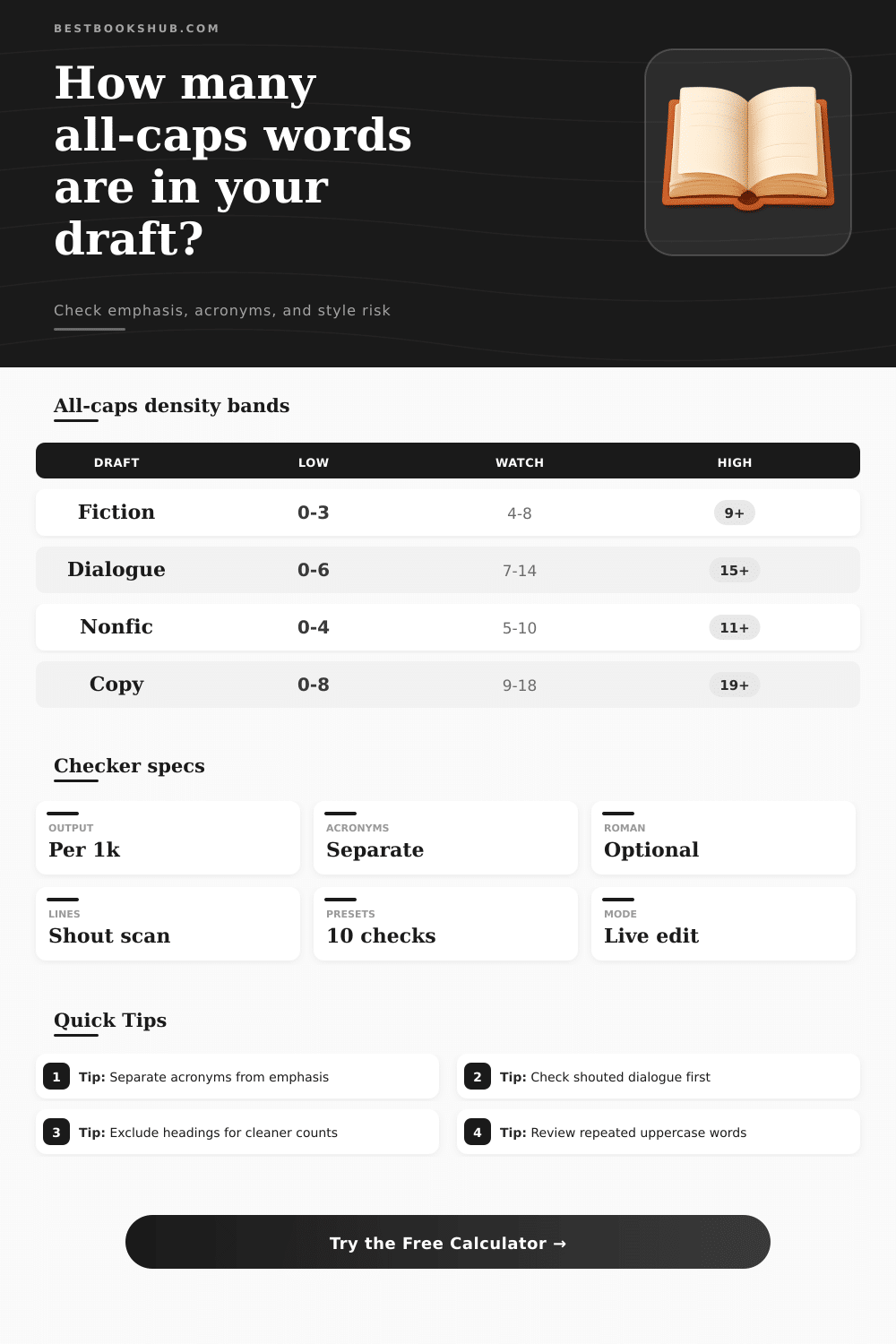
| Fiction narration | 0-3 per 1,000 | 4-8 per 1,000 | 9+ per 1,000 | Heavy emphasis may feel melodramatic outside dialogue. |
| Dialogue-heavy scene | 0-6 per 1,000 | 7-14 per 1,000 | 15+ per 1,000 | Raised voices are expected, but repeated shouting can flatten tone. |
| Nonfiction manuscript | 0-4 per 1,000 | 5-10 per 1,000 | 11+ per 1,000 | Most caps should be acronyms, labels, or deliberate stress. |
| Marketing or web copy | 0-8 per 1,000 | 9-18 per 1,000 | 19+ per 1,000 | CTA language tolerates caps, but overuse can reduce trust. |
| Metadata and catalog copy | 0-12 per 1,000 | 13-28 per 1,000 | 29+ per 1,000 | Series labels and BISAC-style codes can raise technical caps. |
| Token type | Example | Default treatment | Counts as emphasis? | Best edit action |
|---|---|---|---|---|
| Emphasis word | STOP | Included in primary result | Yes | Keep only when stress is essential. |
| Known acronym | NASA | Separated as technical | No | Add house acronyms to the known list. |
| Initialism | FBI | Separated by acronym handling | No | Review only if unfamiliar to readers. |
| Roman numeral | IV | Separated by Roman rule | No | Ignore in chapter numbers and citations. |
| Heading artifact | CHAPTER TWO | Included unless excluded | Depends | Exclude headings for prose-only checks. |
| Scenario | Typical caps source | Suggested setting | Review target | Preferred outcome |
|---|---|---|---|---|
| Fight scene | Shouted dialogue | Dialogue-heavy scene | Shout-style lines | Caps support peak emotion only. |
| Science fiction chapter | Agencies, ships, codes | Separate acronyms | Technical token load | Worldbuilding terms do not inflate style risk. |
| Query letter | Title and comp labels | Balanced line edit | Heading artifacts | Pitch reads polished and calm. |
| Academic excerpt | Citations and Roman numerals | Separate Roman numerals | Nontechnical emphasis | Citations stay out of emphasis counts. |
| Sales page | CTA and urgency words | Marketing or web copy | Repeated uppercase words | Urgency remains readable. |
| Setting | What it includes | What it separates | Best for | Caution |
|---|---|---|---|---|
| Strict full-word uppercase | Words with every letter uppercase | Numbers and mixed case | General manuscript checking | May skip codes with digits. |
| Uppercase letter tokens only | Alphabetic uppercase words | Hyphenated codes | Clean prose excerpts | Can undercount technical text. |
| Include mixed codes | Caps plus digits or hyphens | Lowercase words | Catalogs and science fiction | Technical codes may dominate. |
| Loose emphasis scan | Caps tokens and strong mixed tokens | Known acronyms if selected | Early copy review | Use flagged table before revising. |
DISCLOSURE: This post may contain affiliate links, meaning when you click the links and make a purchase, I receive a commission. As an Amazon Associate I earn from qualifying purchases.
Have you ever read something where it felt like someone was literal screaming on the roof? That’s probably been done in a draft before. Emphasis is such a strong impulse that we type in all caps to scream at readers when characters gets mad or to try to sound urgent in our marketing pitches. But that’s not what happens in high converting copy or published works.
Visual screaming typically backfire: it signals insecurity to the reader that author doesn’t trust their own words. By separating true emphasis from technical items like heading labels, acronyms, roman numerals, etc., this all-caps word counter allow you to more clearly judge its density. Now your “something feels too loud” gut-check becomes a concrete breakdown of edits to make. But the trick is knowing the difference between signal and noise.
Why You Should Not Use All Caps
Your sci-fi manuscript may have a dozen references to technology, ships, and agencies, all of them expressed as acronyms. Run your manuscript through this tool and it separate those acronyms from your emphasis count so your style risk score isn’t artificially inflated. This results in a higher style risk score, which makes no sense if you’re writing sci-fi. What matters here is the inputs: specifically, your draft lane and whether those technical words are capitalized (aka an acronym).
By doing the math based off those two inputs (and splitting off the number of acronyms vs. By using those two inputs and splitting off the number of acronyms versus the main emphasis count, the tool prevent you from having to filter out technical jargon that is not related to your stylistic choices. So a large quantity of uppercase word isn’t automatically “stylistic” if it’s a common feature of the genre.
For example: What’s the distinction between dialogue and narration? While an occasional all-caps word in prose (i.e. Narration may break your reader’s flow and sense of tension, as it depends on rhythm to signal that feeling. However, when characters shout at one another in a dialogue scene, readers expects some yelling. The table below show the tolerance levels for each kind of draft. An all-caps word in a piece of fiction will be flagged as risky. A handful in dialogue won’t sound so melodramatic. Knowing where those lines fall lets you determine if keeping a screamed line is worth the drama, or if you need to tone down the yell to make it credible.
Titles and Headings are also a pitfall. A lot of writers think nothing about cutting and pasting the whole chapter complete with chapter title when running it through a counter. Did you know that TECHNICALLY, chapter one is all caps? Unless you turn off the heading exclusion, you are going to get a bunch of garbage because your analyzer thinks these are indicators of emotional stress. Turning on the downweight or exclude headings cleans this noise right out. It causes the analyzer to concentrate on actual body of text where tone actually lives.
Why is this important for Blurbs and Query Letters? Because every word matters. You want to make a good first impression. But also consider placement of these words: A single all-caps word in every thousand might be a perfectly brilliant punchline or call for urgent attention. But ten all-caps words bunched up in three paragraphs is generally a sign that you’re using this as an anxious crutch, not as a proper emphasis. The repeat review window flag places where you’ve fallen back on the same all-capped crutch repeatedly. Nearby, seeing repeated uppercase word tends to mean the action surrounding them could use beefing up, not just amping up. If you have set the stakes clear in your context, you don’t need to shout.
All in all: Edit for caps carefully because it’s an expression of trust in your own voice, letting punctuation do the work that needs to be done. Let periods put things to rest. Let exclamation points express surprise while keeping writing from shouting visually at you. The next time you find yourself relying too heavily on caps to express something, use the tool to root out passages where you rely too much on caps to convey emotions. Then go back and build up the scene work there instead.
What’s left after stripping out all the heading and acronym clutter ought to be deliberate. You don’t want your reader to hear your font; you want them to hear your character.