📚 Word complexity lab
Monosyllabic vs polysyllabic ratio calculator
Paste a passage to estimate one-syllable, two-syllable, and three-plus-syllable word balance with adjustable counting rules for names, hyphens, contractions, and suffixes.
| Class | Syllables | Examples | Ratio role |
|---|---|---|---|
| Monosyllabic | 1 | stone, bright, through | Counts as M |
| Disyllabic | 2 | river, quiet, letter | Neutral middle |
| Polysyllabic | 3 or more | remember, delicate, interpretation | Counts as P |
| Excluded | 0 | Optional names or articles | Removed from W |
| Writing context | Mono share | Poly share | Typical signal |
|---|---|---|---|
| Early reader | 58-72% | 2-8% | Simple and quick |
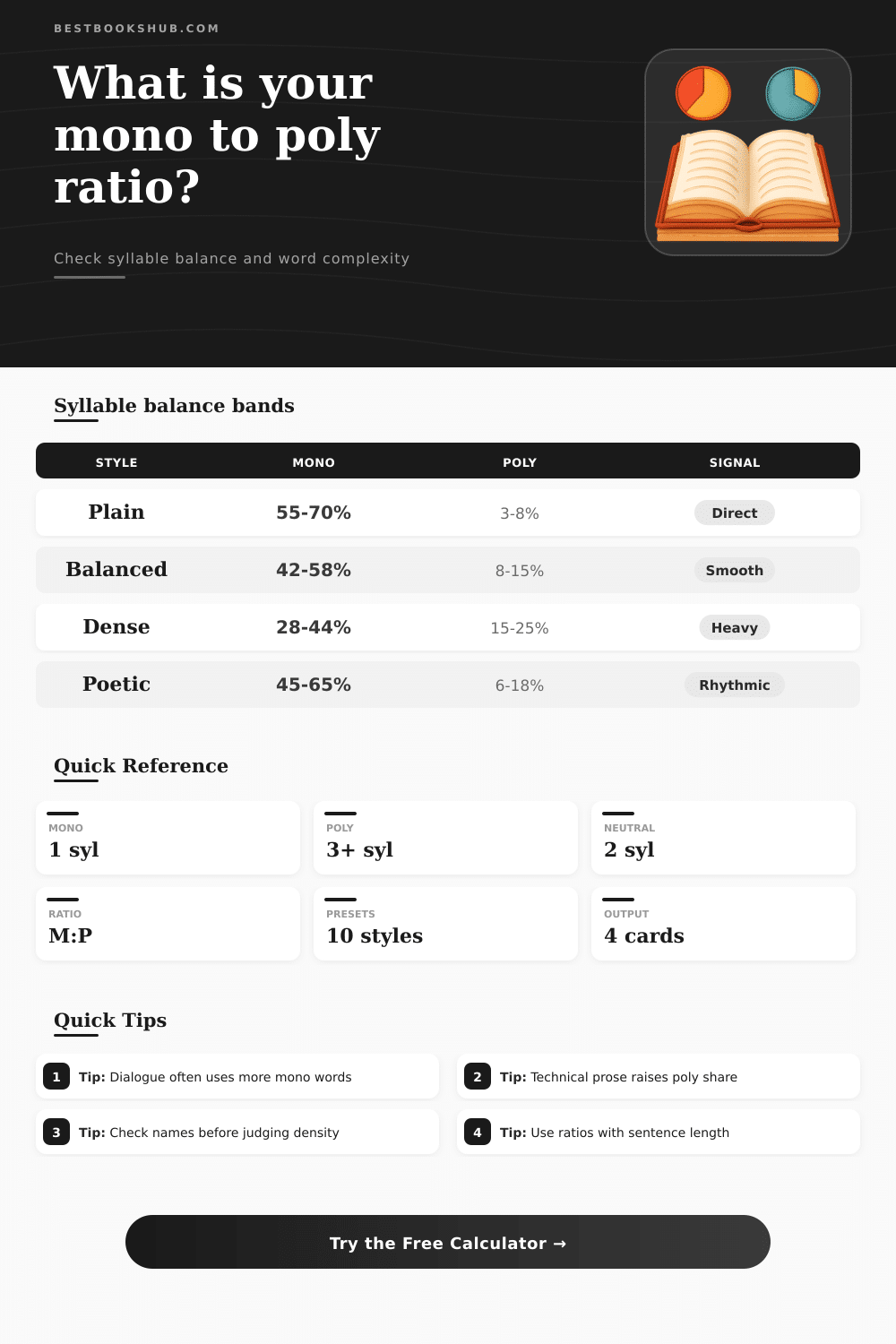
| General prose | 44-60% | 7-15% | Balanced flow |
| Academic prose | 28-45% | 16-28% | Dense and abstract |
| Speech draft | 52-68% | 4-12% | Clear when spoken |
| Rule feature | What it checks | Adjustment | Why it matters |
|---|---|---|---|
| Silent e | make, stone, line | Subtracts one vowel group | Avoids false two-syllable counts |
| Final le | table, little, simple | Adds a syllable after consonants | Protects common endings |
| Suffix scan | tion, sion, ious, ial | Raises count when needed | Better for formal words |
| Overrides | Any custom entry | Uses your number first | Handles names and invented terms |
| Comparison profile | Mono to poly ratio | Average syllables | Use this when |
|---|---|---|---|
| Spare plain style | 8:1 to 14:1 | 1.15-1.35 | You want speed and ease |
| Balanced narrative | 4:1 to 7:1 | 1.35-1.65 | You want natural variety |
| Formal explanation | 2:1 to 4:1 | 1.65-2.05 | You need precision |
| Highly technical | 1:1 to 2:1 | 2.05+ | The topic needs specialist terms |
DISCLOSURE: This post may contain affiliate links, meaning when you click the links and make a purchase, I receive a commission. As an Amazon Associate I earn from qualifying purchases.
A paragraph reads like this: the words are all long and cumbersome. The rhythm plods along, and you’re stumbling over every third sentence. Now another paragraph reads like this: the words fly by quickly, the beat hits you right in your ear.
That distinction is often a matter of syllable balance. This has nothing to do with knowing big words and everything to do with language moving across the reader’s brain. Most writers don’t fret over their vocabularies. They worry that people won’t understand them. They rarely consider how much their words weighs on the page.
Why Syllables Matter for Writing
After pasting in your text, the calculator (above) does all the math for you. No more guessing where on the scale of complexity you reside. Here’s how it breaks your passage down:
Fast ones, monosyllabic words like bright or stone. Force and speed. Heavy lifters, polysyllabic words like interpretation or delicate. Precision and abstraction. Stabilizers, two-syllable words that steady the flow, like letter or river. Without these your prose risks feeling too flat or jagged.
The point is this: you have to know how many syllables your audience prefers. Do they like a lot of short words that are easy to recognize (like the ones on this page)? Then your text needs to be mostly monosyllabic words. This provides clarity. This creates a low cognitive load and a high reading speed.
Are you writing a legal clause, or an academic abstract? Then your audience wants you to show off your expertise by being dense. More syllables, higher density. Look at the graph on the right; it illustrates how various types of writing group themselves around particular word ratios.
It’s hard to know which rules to count by. If you’re not careful, proper nouns and names throw things off. Christopher weighs polysyllabically, but he doesn’t have anything to do with how you write. The tool allows you to cap names at one syllable or remove likely ones entirely. Why? It removes accidental complexity so you can see what you actualy chose to write.
Hyphenated words present a similar challenge. Should we combine them into one unit or split them up (well known)? Splitting them up seems simpler on paper than it does out loud. Combining them shows us the real rhythmical drag.
But there’s another effect: the contraction changes things too. Do not has an extra syllable (and takes longer) than don’t. It may sound more formal, but it also has a loss of conversational ease. When writing a speech, for example, you’re likely to count those contractions as though they were written as such, because that’s how it will be spoken. On the other hand, in technical manuals, expanding them could help make the boundary between concepts clearer. No one answer is correct; it all depends on what you intend your text to sound like, spoken or printed.
These are syllable suffixes. Additional syllables are hidden in words’ suffixes (and those aren’t counted casually). Silent-e words drop a beat. Tion and ious-type endings add weight. A suffix adjustment catches the pattern. Without it, your complexity score will be lower than it should of been. Maybe you assume your writing’s easy; really, it’s loaded with academic-sounding language. That disconnect creates reader-frustration: they anticipate breezy copy, but find none.
If you’re talking about something that requires precision, don’t be afraid of long words. There are some things that require specialist terms for technical writing. Some things require exact definitions for legal documents. That’s fine! It would is sacrificing accuracy for speed. In those areas, that’s a bad tradeoff. Form follows function. Align your form with your function.
Do you want to convey urgency? Go with mono words. Do you want to explain complex systems or build atmosphere? Let the longer words breathe.
Rhythm: This one takes a bit of effort. To get it, you have to read it out loud, notice where your tongue stumbles? Too many monosyllables in a row (i.e., a high monosyllabic share) will make the text come across as blunt. It removes nuance. Too many long words in a row (i.e., a high polysyllabic share) will exhaust. It hides the main point behind a pile of heavy words.
The sweet spot is discovered through trial-and-error. Compare these metrics against the length of your sentences. A mix of long words in short sentences might still be ok. A mix of short words in long sentences works too. Now test it against a handful of important passages. How does that put them on the spectrum? Make one change at a time: Replace a fancy word with a less-fancy synonym. Link two brief sentences so they read better. Observe the ratio shift.
Often tiny adjustments will result in a large impact on readability. Don’t strive for perfection. Strive for consistent use within a single style band. Use the numbers as a map; use your ear as a compass. Rely on both, and you’ll write something that lands exactly as intended.