📈 Annual reading projection
Annual books read projection calculator
Estimate your year-end books read from finished books, page pace, book length, reading speed, remaining days, seasonal habits, and the gap to your annual goal.
| Format mix | Typical pages | Projection effect | Best use |
|---|---|---|---|
| Novellas and short novels | 120-240 pages | Raises book count quickly | Challenge years, backlog cleanup |
| General fiction | 280-360 pages | Stable yearly estimate | Mixed reading logs |
| Nonfiction | 300-420 pages | May need slower pace | Business, memoir, history |
| Fantasy and long series | 500-850 pages | Lowers count but raises pages | Series planning and long novels |
| Academic reading | 220-500 pages | Lower practical speed | Coursework, research, close reading |
| Speed band | Words per minute | Pages per hour at 275 words | 320-page book time |
|---|---|---|---|
| Careful notes | 125-175 wpm | 27-38 pages | 8.4-11.7 hours |
| Average reading | 200-275 wpm | 44-60 pages | 5.3-7.3 hours |
| Fast familiar genre | 300-400 wpm | 65-87 pages | 3.7-4.9 hours |
| Skim or review pass | 450-600 wpm | 98-131 pages | 2.4-3.3 hours |
| Season setting | Multiplier | When it fits | Projection warning |
|---|---|---|---|
| Busy season slowdown | 0.75x | Travel, deadlines, school terms | Goal gap grows quickly |
| Slightly slower months | 0.90x | Normal life drag | Small shortfall if goal is tight |
| Normal pace | 1.00x | Recent month is representative | Best neutral forecast |
| Reading season lift | 1.10x | Holidays, quieter evenings | Useful but not a sprint |
| Sprint finish | 1.50x | Short-term challenge push | Hard to sustain all year |
| Pressure rating | Daily page need | Daily time need | Interpretation |
|---|---|---|---|
| Easy | Under 15 pages | Under 20 minutes | Goal is comfortably within reach. |
| Steady | 15-35 pages | 20-45 minutes | Routine matters more than sprinting. |
| Demanding | 36-65 pages | 46-90 minutes | Choose shorter books or add sessions. |
| Aggressive | Over 65 pages | Over 90 minutes | The goal may need a reset or a challenge push. |
DISCLOSURE: This post may contain affiliate links, meaning when you click the links and make a purchase, I receive a commission. As an Amazon Associate I earn from qualifying purchases.
There’s something curious about the curse of reading resolutions: they’re like savings plans and gym memberships. In the abstract, they seem completely plausible. They’re an ideal in the cold winter air. You picture yourself annotating memoirs on Sunday afternoon or gorging on classics during your commute. And then reality hits: January is as messy as ever, and you begin to wonder how this large number of books (fifty-two!) went from something achievable to something more akin to a mountain climbed in ill-fitting boots.
That’s why we built the annual books read projection calculator: it’s here to ground your ambitions in real numbers instead of fuzzy goals so you don’t find yourself teetering on the brink of unrealistic optimism before falling off a cliff.
How to Set Realistic Reading Goals
There’s just no way around it: Books aren’t all alike. Breezing through 300 pages of light romance doesn’t require the same mental effort as plodding through 800 pages of dry academic history, but most of us tally these as equivalent victory. That skewed sense of achievement can give you a warped sense of how far along you’ve come. You might start out reading ten relatively short novels by this point in the year and convince yourself you’re kicking ass against your word-count goal, then you might discover in September that you’ve hardly made a dent in your monthly page-quota.
Once you input your average book size and number completed, the tool above will crunch those numbers for you (and spare you the volume-bias trap). Instead of weighing your different types of reading by their relative difficulty, it turns everything into an apples-to-apples comparison of pages per month. This subtle switch in perspective help distinguish between effort and output; that distinction goes a long way.
The parameters are based off honesty regarding what season means for you. Most readers read in fits and starts, until the wall hits them. There’s summer vacation, with increased availability, but also potentially travel disruption. There’s the winter holiday, full of family, not empty hours. You can plug in a pace multiplier that accounts for the time of year, recognizing that consistency is hardly linear. Dial it back to zero point seven five during hectic times so the prediction doesn’t get dangerously rosy. You’ll force yourself to reckon with how much momentum you must create today to offset future slowdowns.
And speed? Well, yes, speed is important, but not like some speed-reading guru will tell you. There’s no need to skim through text at six hundred words per minute as some sort of checkbox exercise. We’re talking about lasting comprehension here. Two-hundred-fifty words per minute is nothing to be ashamed of. That’s an average speed of about ten pages per quarter-hour, when you’re focusing on what you’re doing. The calculation assumes this base case and projects from there, telling you how many minutes you’ll have to literally carve out of your day to reach your goal.
That exposes the real cost of your goal. You will need thirty minutes in the mornings or evenings, maybe, if you haggle hard enough with yourself, to read more book. It is a lifestyle change, not a hobby tweak.
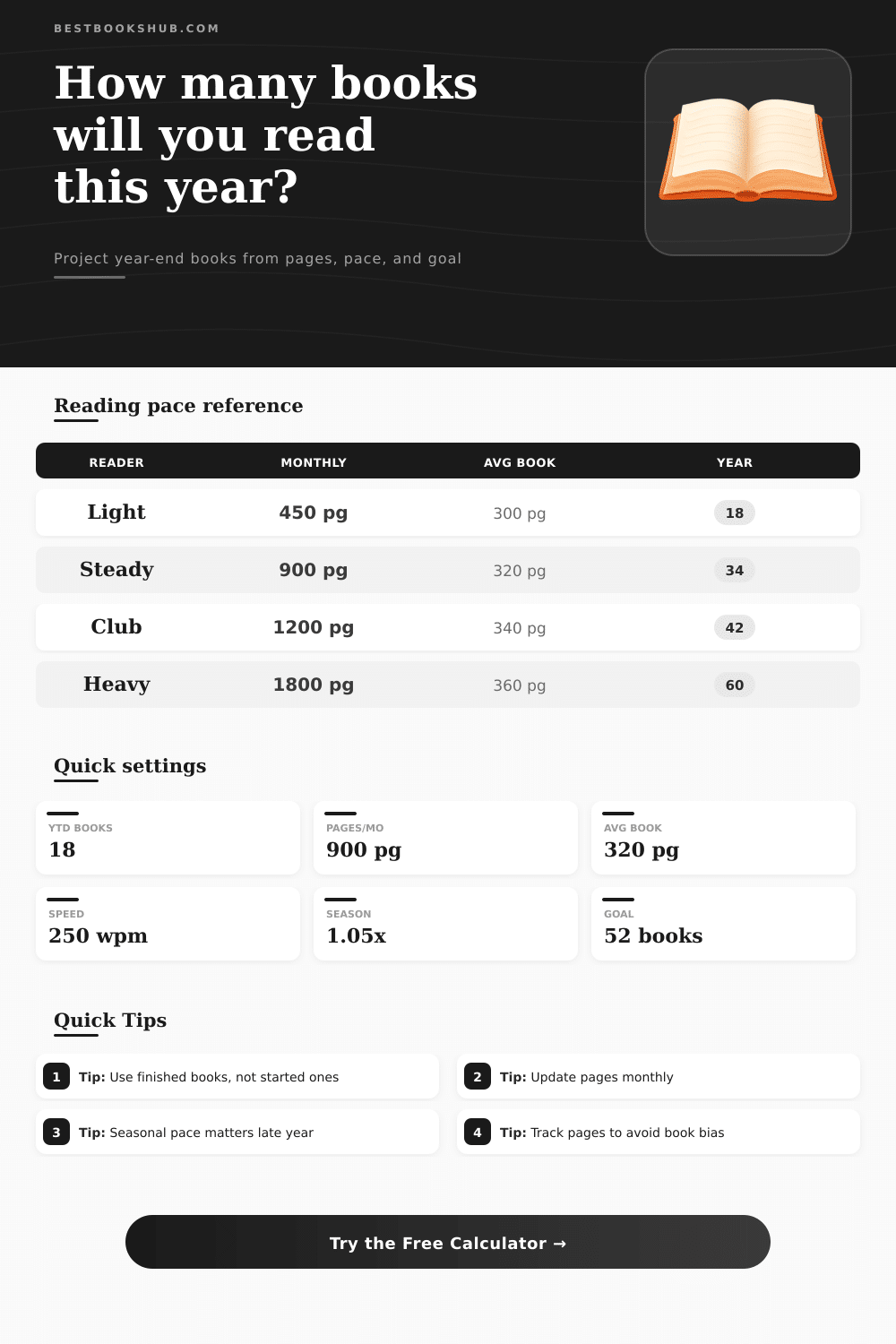
To see what I mean, scroll down to the reference table. It lays everything out and compares different reader types by book length. This shows just how much average book length affect the total number at the end. If you’re a fantasy fan who reads doorstopper epics, of course you’ll only finish fewer books than a person who tackles graphic novels with the same amount of time under their belt. It’s not a failing… It’s math! It’s geometry! It’s one of those things that can trip people up when they get into online reading communities and start trying to compare themselves.
But knowing this gets them out of the comparison trap. You’re not behind for having finished fewer books, maybe you’re deeper into your genre.
In short, projection isn’t really prediction; it’s calibration. Life is messy, and some amount of spontaneity is a good thing so you’ll probably end up off by several books either way. But do you have a shot at getting through sixty books? Or only forty? Knowing the answer lets you wisely adjust course long before December rolls around.
You should of not throw away your sanity if the goal is too far out of reach. Pick up that difficult pile that you’ve been putting off if it’s close enough. The numbers aren’t judging you, they’re simply telling you where you are, so you can choose how much you wish to run.