🤝 Shared reading planner
Buddy Read Pace Calculator
Plan a shared book deadline with daily pages, buddy count, target finish date, check-in cadence, buffers, catch-up pages, and spoiler-safe discussion sections.
Load a realistic shared-reading scenario, then adjust the book length, group size, cadence, buffer, and current lag for your own pair or group.
| Check-in | Target date | Read through page | Section pages | Discussion focus |
|---|
| Pace band | Daily pages | Best for | Group risk |
|---|---|---|---|
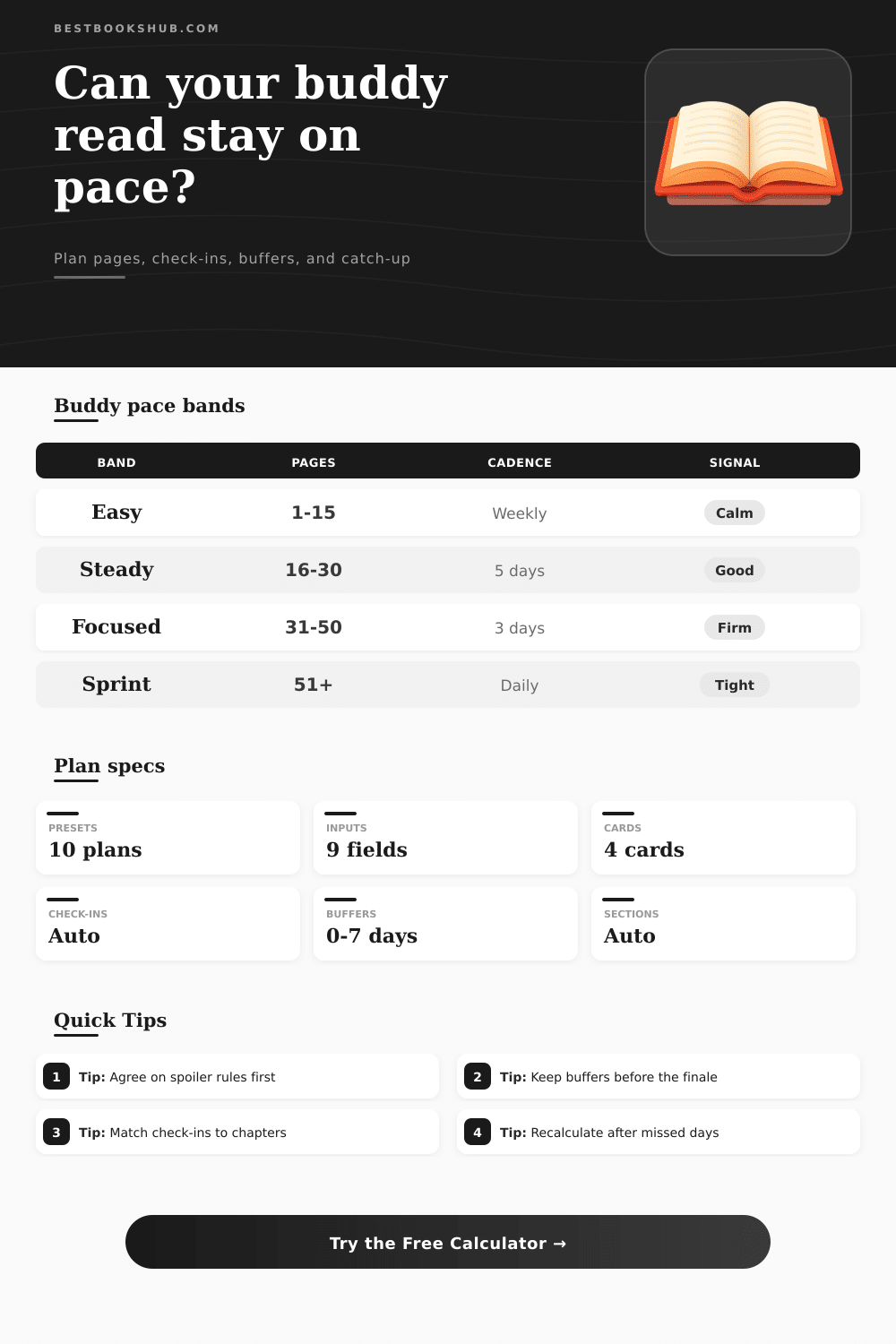
| Easy | 1-15 pages/day | Relaxed pairs, slow classics, annotated reads | Members may forget details between check-ins. |
| Steady | 16-30 pages/day | Most novels, memoirs, and light nonfiction | Works best with a weekly or twice-weekly nudge. |
| Focused | 31-50 pages/day | Late starts, long books, energetic groups | Discussion can become summary-heavy if stops are too far apart. |
| Sprint | 51+ pages/day | Final-week plans and short buddy challenges | One missed day can push the group into spoiler trouble. |
| Cadence | Typical section size | Use when | Discussion fit |
|---|---|---|---|
| Daily | 10-35 pages | Short challenge, buddy sprint, manga run | Quick reactions and spoiler-light notes. |
| Every 2-3 days | 35-90 pages | Balanced read with active messaging | Chapter clusters, predictions, and quotes. |
| Every 5-7 days | 80-180 pages | Busy readers or longer books | Theme questions and deeper summaries. |
| Every 2 weeks | 150+ pages | Classics, epics, or semester plans | Requires clear spoiler boundaries. |
| Book type | Typical pages/hour | Buddy-read adjustment | Planning note |
|---|---|---|---|
| Light contemporary novel | 35-55 pages/hour | Use normal pace | Works well with frequent short check-ins. |
| Literary fiction or classic | 18-35 pages/hour | Add buffer | Sentence density and references slow shared discussion. |
| Dense nonfiction or study text | 8-25 pages/hour | Add extra prep | Notes, arguments, and terms need smaller sections. |
| Graphic novel or manga | 60-120 pages/hour | Track volumes | Discussion may focus on scenes, panels, and reveals. |
| Setup | Ideal buddy count | Check-in style | Best buffer |
|---|---|---|---|
| Private buddy read | 2 readers | Every 2-3 days | 1-2 days for life interruptions. |
| Small group chat | 3-5 readers | Twice weekly | 2-4 days because one reader often lags. |
| Hosted club read | 6-12 readers | Weekly | 3-5 days for prompts and quote collection. |
| Class or study pair | 2-8 readers | By section | 5-7 days when notes or citations matter. |
DISCLOSURE: This post may contain affiliate links, meaning when you click the links and make a purchase, I receive a commission. As an Amazon Associate I earn from qualifying purchases.
I feel like it’s a contemporary social menace: That sense of panic when you realise that your buddy is on chapter twelve and you’re still struggling to get past the prologue. Buddy reads are exciting because of that mutual enthusiasm; they’re also accountable! But what happens if one person wants to slow down or go faster? What then?
Usually the issue isn’t the actual reading, per se. It’s more about coordinating two (or more!) people various schedules so that no one spoils anything for anyone who sleeps during the day. When planning out a buddy read, treat it like a little project management exercise. First, define the scope.
How to Make Buddy Reading Easier
Don’t look at how many days you have in an ideal world; instead look at how many actual days you’ll have (because most people forget life happens). There will be nights when you can’t concentrate on long sentences. There will be sick kids and late work deadlines. Add some days as a buffer. It’s not a sign of weakness. It’s insurance against lag time. Adding extra days into your plan creates room to catch up and/or reread tough parts without feeling like you’re letting down the group.
How often you check in is also important. Too many check-ins will interrupt your reading flow and create homework out of a book. Checking in only twice a month can make the conversation seem like an English class, no one remembers what happened on page 40. A happy medium is somewhere like checking in every three or five days, which lets you build up some worthwhile opinions while still having something to discuss that hasn’t been forgotten. It keeps it interesting, while giving your mind time to process twists and turns before diving back into it.
How fast you read also depends on what kind of mood you’re in and what type of book you’re reading. You read a light contemporary thriller at one pace. You read a dense historical epic packed with genealogical charts at another. Do not read at someone else’s pace just because you are being stubborn. If you read slowly, read at that pace. Lighten your expectations accordingly. Literary fiction and other types of dense nonfiction take longer for you to process, so you will require fewer pages a day to truly absorb the content. The next thing you’ll know, you’re trying to run through a big book, you get tired, and you end up forgetting half of what you’ve read. That completely messes up the next discussion.
The tricky bit with any reading plan is synchronization. Somebody is always ahead. It is human nature that if we are interested in something, we keeps going. So make it simple and make it firm: there are certain page markers for discussion stops and everybody agrees in advance what those pages will be. That way, the faster reader has a clear instruction on pausing, while the slower reader is protected from accidentally getting spoiled. It turns what might have been a potential conflict into a structured agreement. If the group knows exactly when the next message arrives, the pressure goes down a lot.
Enter your preferences and dates into the calculator above, and it does all the math for you. You won’t have to do mental math when you’re trying to figure out whether you can squeeze in some reading amidst this weekend’s busy schedule. The calculator will tell you how much you should of being able to get through each day, and it’ll let you know if it fits within your real-life evening routine. For example, if the calculator tells you you should be able to read 50 pages per day but you only have half an hour after dinner, then you’re probably going to fall behind. Take its results and use them to negotiate reasonable goals with your buddy before starting.
And at the end of the day, that’s the point of a buddy read: It’s about the bond, not how fast you get through it. It’s good to take it slow enough to have a real chat. You shouldn’t rush through it like you’re racing to the finish line, leaving everyone out of breath and unable to talk. Go into it expecting less; add some buffer time for the unknowns; then savor it while you’re going along. After all, you’re there to have a shared experience. You don’t have to rush to the last page just because you’re reading the same book.