📘 Reading log diagnostic
DNF rate calculator
Measure how often you stop reading books, how many pages are being abandoned, and whether your completion trend suggests healthy filtering or a mismatch in your current reading mix.
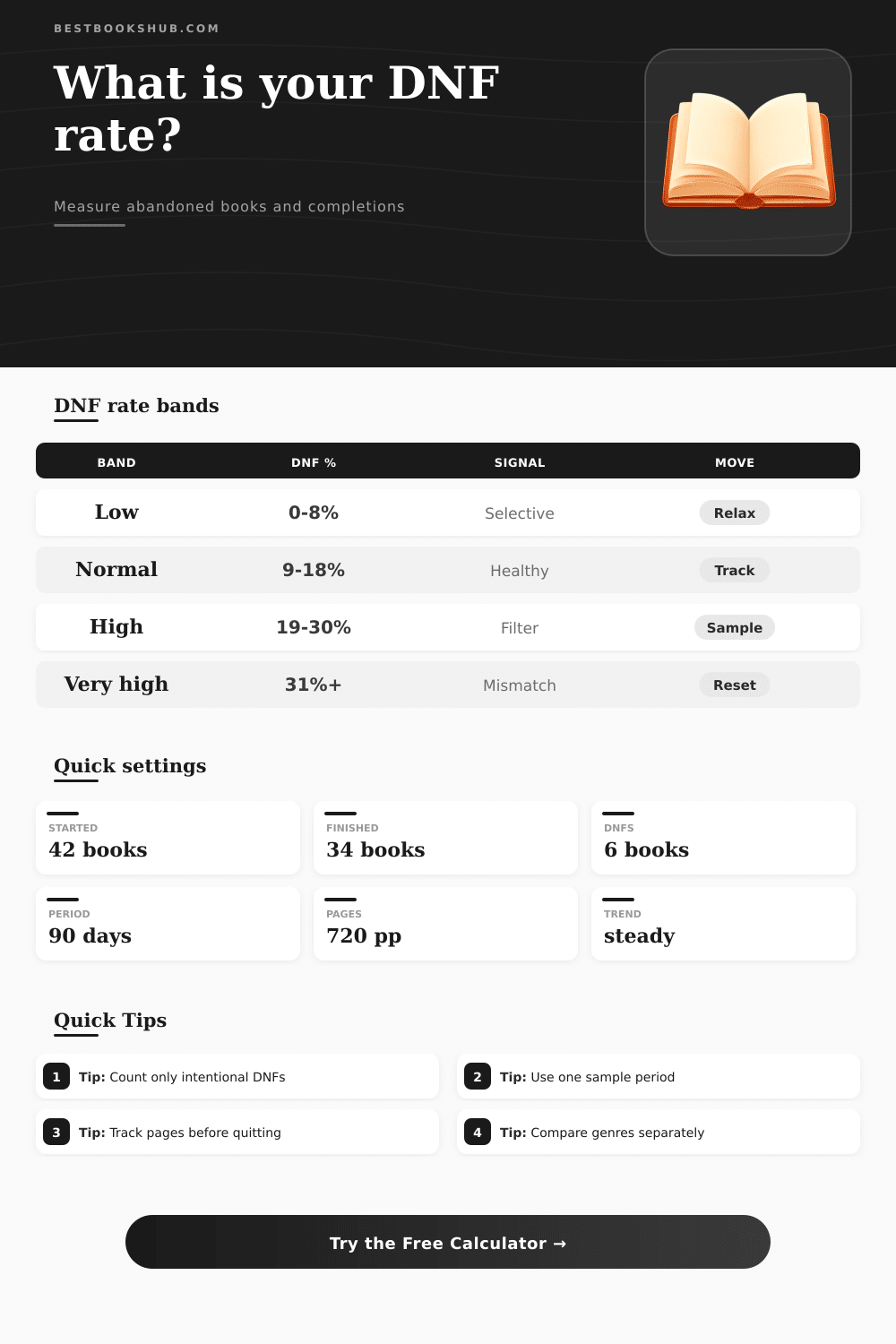
Use these profile specs to decide whether your DNF rate looks like normal filtering, genre mismatch, or an overloaded obligation stack.
| DNF rate band | Outcome DNF rate | Reading log signal | Useful response |
|---|---|---|---|
| Very low | 0% to 5% | You finish nearly everything you start | Check whether obligation reading is hiding preference data |
| Low | 6% to 10% | Light filtering with few abandoned books | Keep tracking pages before stopping |
| Balanced | 11% to 18% | Healthy sampling and selective completion | Compare genres before changing habits |
| High | 19% to 30% | Many starts are not matching current taste | Use shorter samples before committing |
| Very high | 31% and above | The selection process may need a reset | Narrow the next sample period by source or genre |
| Threshold pattern | Pages before DNF | What it usually means | How to read it |
|---|---|---|---|
| Immediate sample | 1 to 20 pages | Voice, format, or mood mismatch appears fast | Track separately from true abandonment |
| Early trial | 21 to 50 pages | Premise is interesting but not sticky | Useful for library hauls and mood reading |
| Meaningful attempt | 51 to 100 pages | You invested enough to evaluate structure | Count as a serious DNF in most logs |
| Late stop | 101+ pages | Pacing, trust, or payoff failed after investment | Review genre source and expectation fit |
| Genre mix | Typical DNF pressure | Main driver | Tracking note |
|---|---|---|---|
| Series comfort reads | Lower | Known voice and reliable tropes | A rising rate may mean fatigue |
| Literary and translated mix | Moderate to high | Style fit varies more by book | Threshold pages matter more than count alone |
| Research-heavy nonfiction | Moderate | Usefulness can fade after key chapters | Partial reading may still be a success |
| ARC or obligation reading | High | Outside-choice titles enter the log | Separate voluntary and assigned starts |
| Completion trend | Point change | Interpretation | Next sample move |
|---|---|---|---|
| Improving | Up 5+ points | Your selection filter is getting sharper | Keep the same sample rules one more period |
| Stable | Within 4 points | The rate is probably a normal personal baseline | Compare by genre before changing the threshold |
| Soft decline | Down 5 to 10 points | Recent picks may be less aligned | Review source, hype, and obligation starts |
| Sharp decline | Down 11+ points | The reading mix has likely shifted | Run a smaller, clearer next-period experiment |
DISCLOSURE: This post may contain affiliate links, meaning when you click the links and make a purchase, I receive a commission. As an Amazon Associate I earn from qualifying purchases.
If you’re like me, you’ve got a pile of incomplete books on your read-it-later list. These digital ghosts are lingering evidence of good ideas that went bad at chapter 40. We tend to view the impulse to quit a book as an act of impatience or a moral failing, which can make you feel anxious. But number of dropped books aren’t the whole picture. What matter are the places where you drop off, and what they tell us about where we pay attention and how we choose what to read next.
You plug in your start and finish counts into this calculator and it does the rest. No more wondering whether having a handful of DNFs is a sign of trouble or simply smart filtering. No longer do you have a sense that there’s too much clutter but no concrete way to judge.
Why Dropped Books Are Good
For most readers, allowing yourself to let go of the wrong book are a feature rather than a bug. If you find that your rate lies on the lower end of range… Or even on the more balanced side, odds are good you’re curating healthily by halting before sinking into misery mode. After all, you paid for insight and entertainment, and it makes sense to call off the transaction if a book doesn’t pay its way within a reasonable amount of sampling time.
However, this is also where the problem arise for those who neglect all the work they put into those failures. And here’s why tracking your abandoned books is so important. There’s a huge difference between abandoning a book at page 10 because the voice isn’t coming through (a small detour in the road that can be corrected with a few more pages) and abandoning one at page 200 because the writing is so thick you’re barely making headway (hours of your life that you’ll never see again, probably due to sunk cost fallacy or pride).
If voice is lacking, you tell yourself that if you stick with it everything you’ve been struggling with up until now will be worth it. But most of the time, it simply exhausts you. Not every kind of reading are treated equally, and that’s because different genres carry different weights and expectations. For example, abandoning a book halfway through a familiar series vs diving into something higher-risk like academic nonfiction or experimental fiction will generaly result in different abandonment rates.
Why? Because when you buy a series, you’ve bought into a brand promise: we know what we’re getting. On the other hand, if you dive into some untranslated experimental fiction, or an academic non-fiction book, there’s more risk involved: the writing may take some time to get used to, which means you has to set a higher bar before walking away. Your stats will start to look all over the place if you read a dense research book as impatiently as you would a thriller, it doesn’t mean you changed tastes at all. It means you’re comparing apples to oranges.
Obligation reading also adds another level of clutter. Books that we’ve been assigned for school bring down our completion rate. Books that came as review copies or were selected because they had won a prize also brings down our completion rate. They’re not pure choice, so intermixing them with things we genuinely choose to read skews the results. You end up looking like a flakey reader when really, you was just doing your duty. By separating those out you can get a better sense of what you actualy liked.
By specifying your sample’s time frame and intent, you let the calculator sort this out so you can see what you truly engaged with instead of just following rules. Any snapshot is less interesting than trends. A one-off spike in abandoned books could mean you’re getting overloaded with hyped-up titles, or maybe your life’s gotten too crazy to pay sustained attention to longer works. Adjust what you’re taking in and see if it levels out, or even gets better. That’s your sweet spot: a reading rhythm you can sustain.
Your aim isn’t zero abandonments (that’s an unrealistic and, frankly, kind of boring goal). Your aim is to tune yourself into a flow state where you quit fast if something doesn’t connect, saving the energy for the books that do. So in the end, your reading log is really a map of your curiosity. DNFs are where it turns out the path wasn’t the right one.
When you don’t hide them away in shame but acknowledge them, you can redirect yourself more quickly. Quitting early stops being something to apologize for. Starting off slowly stops being something to apologize for. You begin seeing the patterns that create satisfaction for you. Because when you do get to those books you do finish, they taste all the sweeter for making space.