📚 Three-book reading planner
Trilogy Reading Time Calculator
Estimate a full trilogy from three page counts, reading speed, daily minutes, reading days, gap days, recap time, notes overhead, start date, and deadline pressure.
Load a named reading scenario, then adjust the pages, pace, gaps, recap load, and finish date to match your own trilogy.
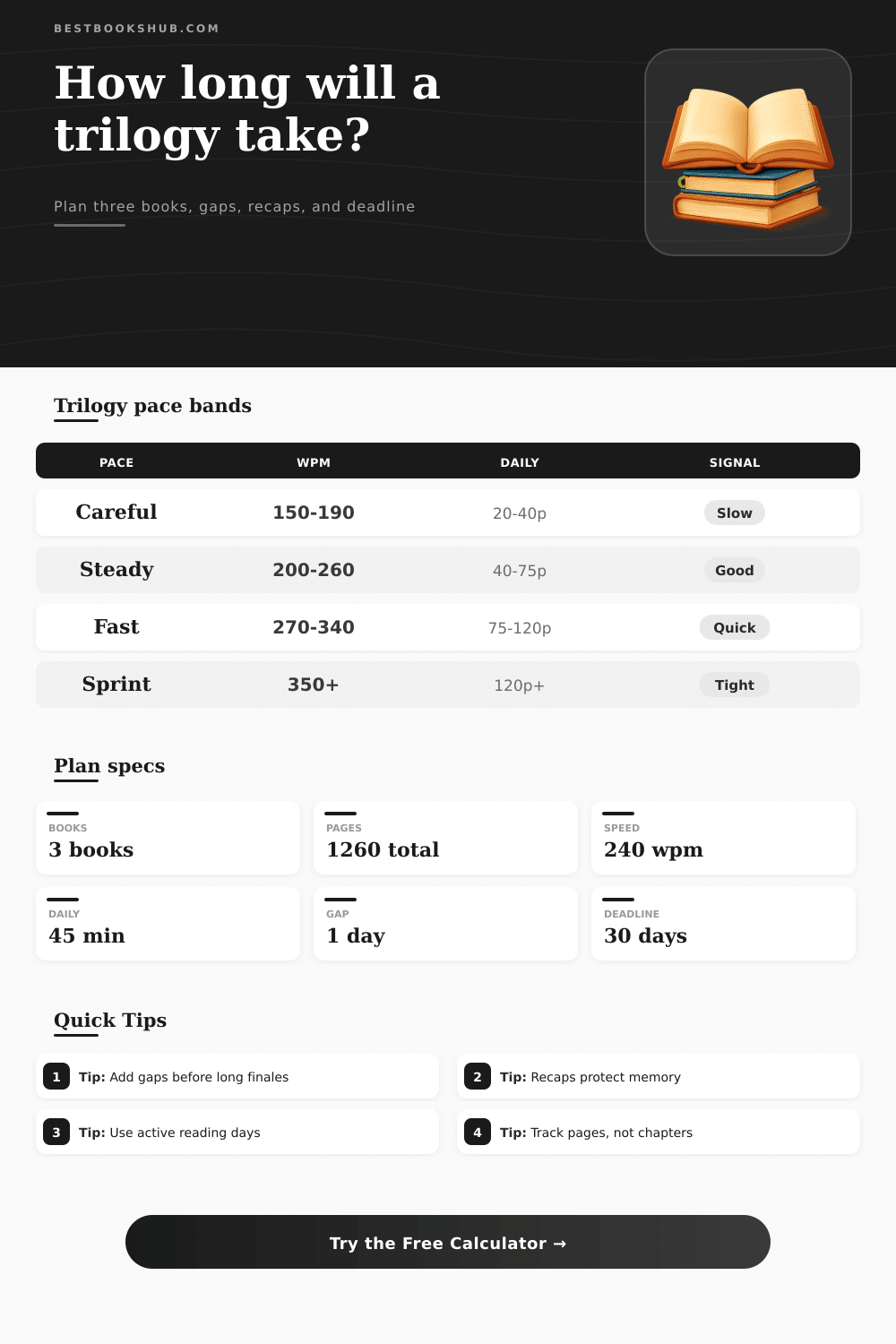
| Pace band | WPM range | Pages per 45 minutes | Best fit |
|---|---|---|---|
| Careful annotation pace | 150 to 190 WPM | 24 to 31 pages at 280 words/page | Classics, study reading, quoted passages, or dense worldbuilding. |
| Steady recreational pace | 200 to 260 WPM | 32 to 42 pages at 280 words/page | Most novels, memoirs, and narrative nonfiction trilogies. |
| Fast fluent pace | 270 to 340 WPM | 43 to 55 pages at 280 words/page | Familiar prose, rereads, short chapters, and high-momentum fiction. |
| Sprint or skim pace | 350+ WPM | 56+ pages at 280 words/page | Recap passes, light prose, and deadline recovery when recall is still acceptable. |
| Trilogy profile | Common page total | Planning caution | Good daily target |
|---|---|---|---|
| Cozy or romance set | 720 to 1,050 pages | Fast prose can still need recap time between repeating casts. | 35 to 60 pages per active day. |
| YA adventure trilogy | 900 to 1,300 pages | Momentum matters; long gaps can weaken plot memory. | 45 to 85 pages per active day. |
| Epic fantasy arc | 1,400 to 2,400 pages | World terms, maps, and viewpoint shifts add note drag. | 30 to 65 pages per active day. |
| Classic or study trilogy | 750 to 1,500 pages | Dense pages and annotations make WPM more important than page count. | 20 to 45 pages per active day. |
| Setting | Low impact | Moderate impact | High impact |
|---|---|---|---|
| Gap days between books | 0 to 1 day keeps momentum. | 2 to 4 days gives rest but needs a short recap. | 5+ days can require a stronger character and plot refresh. |
| Recap minutes per book | 5 to 10 minutes for plot-only reads. | 15 to 30 minutes for notes and major scenes. | 45+ minutes for theory, quotes, or study work. |
| Notes minutes per 100 pages | 0 to 4 minutes for light flags. | 5 to 12 minutes for summaries and tabs. | 13+ minutes for close reading, citations, or theme maps. |
| Planning buffer | 0 to 5% for stable schedules. | 10 to 15% for normal interruptions. | 20% when the deadline is real and missed days are likely. |
| Window | 1260-page trilogy | Active days assumed | Pressure signal |
|---|---|---|---|
| 14 calendar days | About 126 pages per active day | 5 days per week | Sprint: needs long sessions or fast prose. |
| 30 calendar days | About 59 pages per active day | 5 days per week | Focused: realistic for many steady readers. |
| 45 calendar days | About 39 pages per active day | 5 days per week | Comfortable: room for gaps and notes. |
| 90 calendar days | About 20 pages per active day | 5 days per week | Relaxed: good for classics or study reading. |
DISCLOSURE: This post may contain affiliate links, meaning when you click the links and make a purchase, I receive a commission. As an Amazon Associate I earn from qualifying purchases.
Panic: “I just picked up the third book in this series and I realize I have absoluteley no memory of what happened previously.
This can occur with all sorts of long narrativess, from mystery trilogies to fantasy epics. It’s typically a logistical problem, not an interest problem. Rather than thinking about reading as a project that has moving parts, you think of it more like a form of leisure that happens spontaneously. Thinking of it as a project will save your sanity… And protect the plot threads.
How to Plan Your Reading Time
Plug in the pace (words per minute) and the number of pages and the calculator do the math. No need for guesswork with conversions. So what are those things that go into it? Shouldn’t you know? Most people think about their reading speed (words per minute). It sounds like a measure of how powerful your brain is. It isn’t. It’s a rate of conversion.
The hidden killer in trilogy planning is not how fast you read, but how often you stop. What matter most is when you stop. Gap days between book are important. You could argue that taking a day break between the first and second book is no big deal. Maybe so, but as soon as the story slow down, memory starts fading at a faster rate. Without a refresher during a long pause, you’ll pick up the second book with some context missing. To account for this, tool allows you to add additional time for review of your notes.
Twenty minutes per book doesn’t sound like much. It’s really an investment in understanding. When you get lost and end up having to read back through chapters, it will feel like skipping this step were efficient.
Calendar dates aren’t daily targets. If you don’t read seven days per week, thirty days sounds like a lot of time. You take vacations; you get tired; there’s a commute; life gets in the way. That’s why the calculator makes you set apart the number of days on the calendar from the number of days you’re actively reading.
This is where most plans fall apart. You might think, “I can read fifty pages per day,” but if you have just five days per week when you’re actually awake and active, then your timeline extend beyond what seems obvious. This is why we has buffer settings for this kind of friction. An extra 10% helps account for a surprise sick day. Twenty percent allows for chaos and the fact that life will interrupt.
Pace is relative. It varies by genre. Speed reading through a dense, footnote-laced sci-fi stack will be different than moving quickly through a cozy mystery trilogy. The reference table show pace bands and their matching realistic daily targets. While you may be a fast reader in familiar writing, you’ll want to slow down for passages that require close attention. Inputting words per minute based off the density of what you’re reading is more honest than averaging over all books.
What this outputs for you are: A daily target and a finish date estimate. They are not commands. They’re guard rails. See, if your plan suggests you read one hundred pages per day, that’s your cue to lower your expectations. Increase your daily minutes. Extend your timeline. Or realize you’ll have to skim the last act. It’s up to you. But at least it’s an informed decision.
A trilogy is a three-part marathon. If you pace it out through the parts (if you don’t wear yourself out), then the story hold together, and you finish. By building in time to recap or take breaks just as much as you plan on reading, you won’t feel like the third installment is a chore, but rather part of an ongoing conversation that you never realy stopped having.
It is simple math, but a difficult discipline, which can transform an unfocused reading practice into a cohesive arc.