⏱ Daily reading pace planner
Reading Minutes Per Day Goal Calculator
Turn a book or page goal into a daily reading minutes target using your deadline, current progress, available reading days, words per page, WPM, and buffer.
Choose a named plan, then tune the target, progress, deadline, reading speed, and buffer to match your actual shelf and schedule.
| Reader profile | Typical WPM | Best use | Planning note |
|---|---|---|---|
| Slow close reader | 120-170 WPM | Classics, study reading, annotation | Use a depth multiplier if you pause for notes. |
| Average adult reader | 200-260 WPM | General nonfiction and most novels | A practical default when you do not know your speed. |
| Fast leisure reader | 280-380 WPM | Familiar genres and lighter prose | Keep words per page realistic for print size. |
| Skim or reread mode | 400+ WPM | Review passes and already-known material | Do not use this for a first close read. |
| Book format | Words per page | Pages per hour at 240 WPM | Use when |
|---|---|---|---|
| Mass market paperback | 300-380 | 38-48 pages | Small trim sizes with dense type. |
| Trade paperback novel | 250-320 | 45-58 pages | Common fiction and memoir formats. |
| Hardcover nonfiction | 300-420 | 34-48 pages | Dense layouts, citations, or fewer breaks. |
| Graphic novel or illustrated | 80-180 | 80-180 pages | Use lower WPM only if text-heavy. |
| Academic or technical | 350-550 | 26-41 pages | Pair with a higher depth multiplier. |
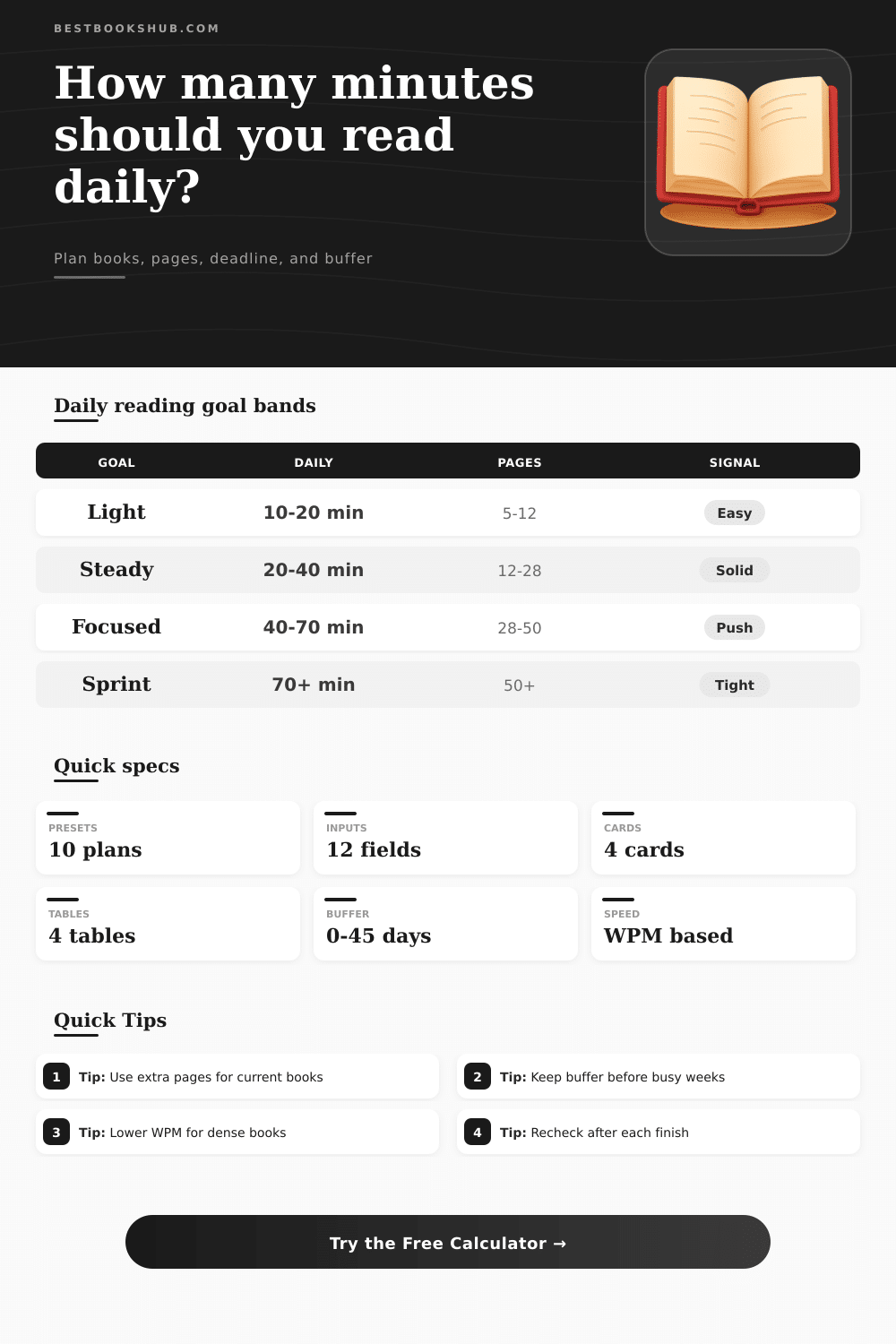
| Daily minutes | Pages per day at 275 WPP | Weekly pages at 6 days | Goal signal |
|---|---|---|---|
| 15 minutes | 13 pages | 79 pages | Habit builder for a calm long deadline. |
| 30 minutes | 26 pages | 157 pages | Steady pace for many annual goals. |
| 45 minutes | 39 pages | 236 pages | Focused but realistic for active readers. |
| 60 minutes | 52 pages | 314 pages | Strong pace for catch-up periods. |
| 90 minutes | 79 pages | 471 pages | Sprint level; protect rest days. |
| Target example | Pages left | Reading days | Needed pace |
|---|---|---|---|
| One book club pick | 320 pages | 24 days | 14 pages or 16 minutes daily. |
| Quarterly page goal | 2,400 pages | 72 days | 34 pages or 39 minutes daily. |
| Annual 52-book track | 8,960 pages | 150 days | 60 pages or 69 minutes daily. |
| Vacation catchup | 1,200 pages | 14 days | 86 pages or 99 minutes daily. |
DISCLOSURE: This post may contain affiliate links, meaning when you click the links and make a purchase, I receive a commission. As an Amazon Associate I earn from qualifying purchases.
Most reading goals don’t work because they don’t take into account physics of time. Fifty books this year sounds like a great goal, until you remember that one book is an eight-hundred page giant, while anothers just a slim pamphlet. Your brain doesn’t balance the math for you. It needs a ledger.
Here’s a calculator that translates vague ambitions into real minutes per day, so you can quit guessing and get reading.
A Simple Plan for Your Reading Goals
Second: Pages aren’t universal. A fantasy novel with wide margins isn’t going to have the same number of words on each page as an academic book with dense text. Treating them equal will break your schedule. With this tool, you get to account for both reading depth and words per page. That’s a minor adjustment that makes a huge difference in accuracy.
And you get to specify a close reading or note taking multiplier, so it adds extra time without adding extra pages. Your progress remains honest but you acknowledge that not all reading are created equal.
This is where the actual planning happens: setting a buffer. If you’re an optimist, you figure that between now and your deadline, you’ll get in some reading every day. The truth is, real life happen. You get sick. You take a week off for travel. You stay home one night and decide not to feel bad about watching television instead of reading because hey, it’s been a long day.
Set aside ten or twenty days for that in your plan, and you’ll slightly push the difficulty to the beginning but also guard against complete derailment further on down the line. Better to do a little extra reading today then freak out in November. The reference tables helps with that by showing you what various daily commitments look like and getting you a sense of scale before you click calculate.
But also speed, not as a fixed number, but rather how your words per minute fluctuates based off genre and energy levels. How many words per minute do you read when you’re raring to go versus reading for comprehension? You could be reading at three hundred wpm breezing through a thriller but grinding out at one hundred fifty wpm on philosophy. Plug in an estimate, but lean toward the low side.
And don’t get me started about reading dense material. Just make it a little easier then normal. It’s a safety net. When you underestimate your pace, you’ll think that reaching the daily minute target will be no problem. Then you read a paragraph with a bunch of complex ideas and realize the gap between where you thought you were and where you are is too wide to cross.
Another handy feature is that it lets you set hybrid goals (which may be necessary for people with mixed taste). You can read by pages or books. However, doing both might make you feel like you haven’t hit a goal if you read twenty thin pamphlet when you were actualy aiming for hefty novels. The system will use the stricter rule to maintain your pace. This prevents you from tricking yourself into thinking you’re making good progress by checking off easy wins while neglecting the tough ones on your bookshelf.
In short: A consistent routine beats an intense one every time. Having that clear number of minutes to dedicate daily eliminates any decision fatigue. There’s no wondering if you’ll have enough time to squeeze it in. You’ve got your days, now all you have to do is show up… with a book in hand.
This is why the final transition, from planning to execution, is where we turns a wish list into a completed stack: from estimation to execution.