📖 Summer reading tracker
Summer Reading Log Calculator
Track a full summer reading log by days read, books finished, pages, minutes, current streak, required pace, and catch-up minutes before the window closes.
Choose a realistic summer reading setup, then adjust the goals, logged progress, active reading rhythm, and day-by-day grid.
DISCLOSURE: This post may contain affiliate links, meaning when you click the links and make a purchase, I receive a commission. As an Amazon Associate I earn from qualifying purchases.
Turn on each elapsed day that had meaningful reading. The calculator counts days read, books logged, pages, minutes, streak, and catch-up pace from the grid and inputs.
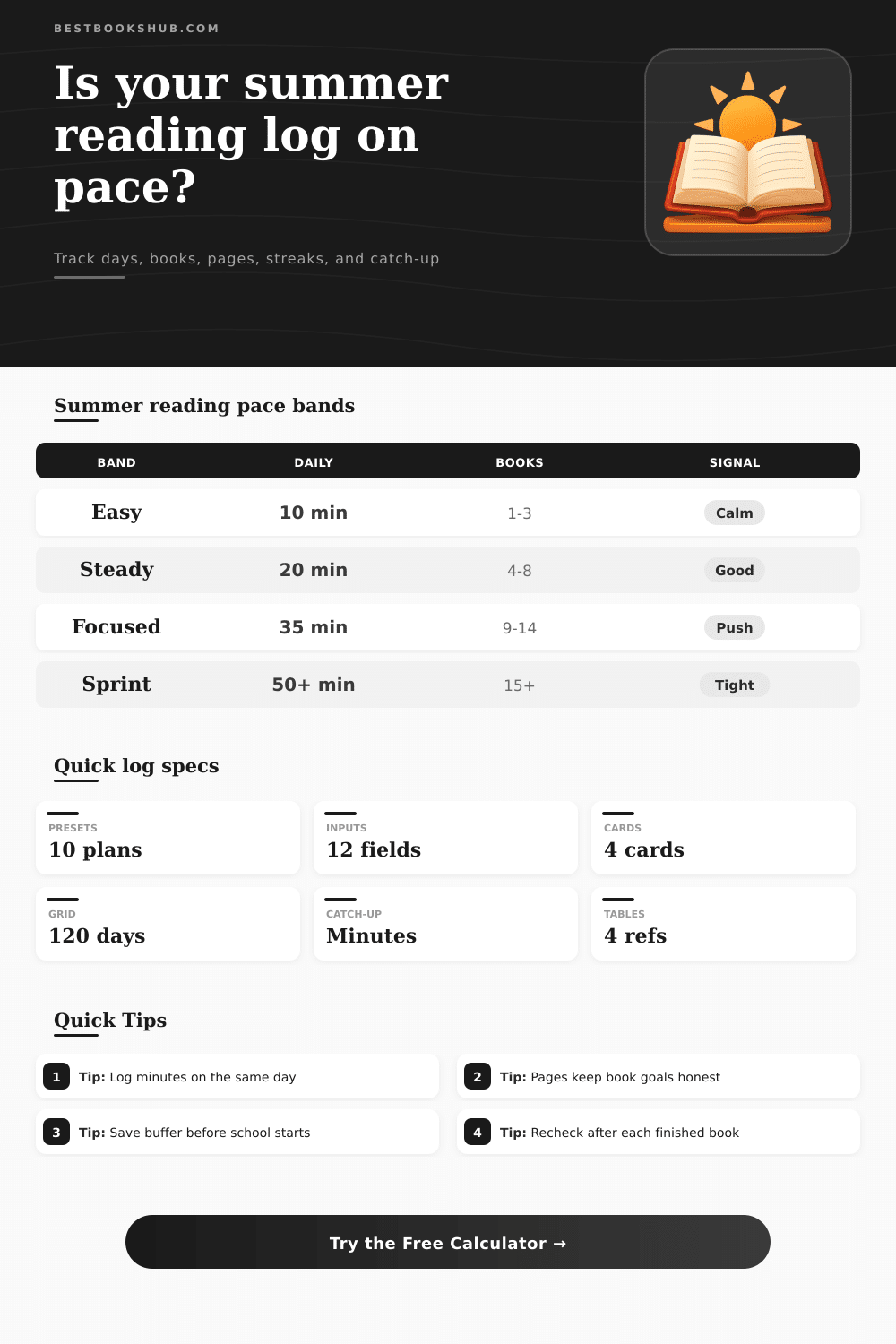
| Pace band | Minutes per reading day | Pages per reading day | Summer log signal |
|---|---|---|---|
| Easy habit | 10 to 15 minutes | 5 to 12 pages | Good for younger readers, rereads, or low-pressure library forms. |
| Steady log | 20 to 30 minutes | 12 to 25 pages | Often enough for a full certificate goal without weekend cramming. |
| Focused challenge | 35 to 50 minutes | 25 to 45 pages | Works for page goals, assigned books, or a larger book-count target. |
| Sprint finish | 50+ minutes | 45+ pages | Usually means the log is behind or the remaining window is short. |
| Program length | Daily 20-minute target | Helpful buffer | Best tracking focus |
|---|---|---|---|
| 4 weeks | 560 minutes | 2 to 3 days | Minutes and streak because each missed day changes the pace quickly. |
| 8 weeks | 1,120 minutes | 4 to 6 days | Minutes plus pages for a balanced library or classroom log. |
| 10 weeks | 1,400 minutes | 5 to 8 days | Books and pages because the longer window supports finished-book goals. |
| 12 weeks | 1,680 minutes | 6 to 10 days | All three targets: minutes, books, and pages. |
| Reading speed | Pages per hour | 20 minutes | Useful for |
|---|---|---|---|
| Slow or note-heavy | 10 to 20 pages | 3 to 7 pages | Assigned reading, nonfiction, or books with frequent pauses. |
| Relaxed chapter reading | 25 to 35 pages | 8 to 12 pages | Most chapter books, middle grade novels, and familiar series. |
| Brisk fiction pace | 40 to 55 pages | 13 to 18 pages | High-interest novels, rereads, and easier vacation reading. |
| Graphic or skim pace | 60+ pages | 20+ pages | Graphic novels, manga, or image-heavy books with low text density. |
| Preset | Summer length | Main target | Built-in reading rhythm |
|---|---|---|---|
| Library 20-Minute Club | 84 days | 1,680 minutes | Daily reading with several missed-day cushions. |
| School Packet Goal | 70 days | Assigned pages and books | Weekday-heavy log with a small final buffer. |
| Vacation Stack | 56 days | Short book stack | Longer sessions clustered around travel breaks. |
| Family Read-Aloud | 77 days | Shared minutes and streak | Frequent compact sessions with flexible page counts. |
| Final Week Rescue | 63 days | Catch-up minutes | Short remaining window with higher required pace. |
The summer begins well: a pile of unread books and great intentions. By late July, however, you’re scrambling through the last few days before school starts again. Where did all the time go? It’s not usually about time. It’s about measuring the pace against the days left on the calendar because most readers assume each day is the same length. They forget that missing hours matter. And they forget to build in a cushion for travel time.
You can’t just rely on willpower if you want to end strong. You need to understand the basics of what kind of pace turn into eight weeks of habits. A reading log’s math is straightforward. Most people ignore variables until the deadline looms. In other words, most people forget about them until it’s too late.
How to Plan Your Summer Reading
You have a set amount of time. Between 70 to 90 days. That varies based off your district’s calendar. Your school or library sets specific goals. Typically these come in the form of books finished, pages read, or minutes spent. Here’s where things get tricky: how do you convert that goal into a daily routine?
Twenty minutes a day for ten days = good job. A whole week gone at summer camp = not so much. Average speed decrease. Your logged progress and remaining days run through the calculator. Does it show that you’re crashing (or coasting)?
We underestimate importance of inputs. You tell the app how many pages per hour you can read. That’s your conversion rate. It links what you consume with time spent. And that’s important: page-based goals and minute-based goals tug in opposite directions. Fast readers will blast through pages. Slow readers will log lots of minutes. To reach your desired number of books, you need to read at a rate that matches your desired minutes, else you’ll fall short. It works the same way in reverse.
The tool strikes this balance. It factors in your current streak length compared to your available future time. It considers buffer days, weekends or evenings when you want to do something else besides reading. It avoids burnout before August even starts.
A sprint finish vs. A steadier log In isolation, a 20-minutes-a-day habit seems doable. On its own, it’s easy. But over an eight-week stretch, it adds up to more than fifteen hours. That could be a couple of middle-grade novels. And that could be a decent-sized young adult epic. It could also feel like a major slog because, oops! You missed half your days at the start. Suddenly, you’re behind by a lot. Now you might find yourself needing fifty minutes a day just to catch up. That’s no longer relaxing; it’s work.
That’s when a majority of summer logs go off-track. The reference table shows this tension: How the pace band shifts with growing deficit. It helps you realize which goals are realistic and which ones will require focus.
Even if the numbers is flat, there’s psychological momentum in seeing the streak. Visualizing a string of days is more powerful than pure totals. It doesn’t matter if you read 50 or ten pages; all that matters is that you open the book and keep the habit loop going. All that matters is that you open the book and keep the habit loop going.
That’s also why I think it helps to track total minutes spent separately from days elapsed: you can see at once whether your problem is with duration or frequency. Fixing a short streak is easier than fixing a big gap in minutes. Schedule around keeping your active reading day. Make them part of an existing routine, before bed? After dinner?
People think they have more time then they do. Starting is realy hard. They also forget the buffer. Have reasonable guardrails. Then panic won’t set in at the end of summer. Plan for seven days a week, even though you know two will be spent traveling. Don’t hope to make that up down the road. Typically, it’s only five-six days reserved as a cushion that makes all the difference between ending calmly vs. Frantically.
Before it occurs, play with situations using the tool. Log a fake setback. What effect does it have on your daily step rate?
Don’t let your books rule your vacation: Summer reading should enhance your time off, not dictate it. Knowing yourself, including how quickly you read, lets you retain control over what (and when) to read. Want to start with the hard stuff? Fine. How about ending with easy reads? Great. It’s up to you. Reading is a way to learn more about yourself, but the data isn’t judgmental. When you find out how much you realy can handle, you can change your expectations to fit your schedule. You don’t have to cram your life to meet arbitrary benchmarks.
This switch from reactionary scramble-mode to strategic plan-mode makes a reading log something that improves your summer… Not just documents it. You should of planned better!