📅 Weekly reading pace planner
Weekly Reading Goal Calculator
Turn a weekly book or page target into the pages, minutes, reading days, buffer day, and catch-up pace you need for the week ahead.
Choose a named weekly rhythm, then adjust books, pages, progress, WPM, book length, buffer day, and catch-up intensity.
DISCLOSURE: This post may contain affiliate links, meaning when you click the links and make a purchase, I receive a commission. As an Amazon Associate I earn from qualifying purchases.
The grid spreads remaining pages across your available reading days, keeps buffer space lighter, and highlights off days clearly.
| Weekly target | Pages | Minutes at 240 WPM | Book equivalent | Best fit |
|---|---|---|---|---|
| Light reset | 40 to 80 pages | 45 to 95 minutes | 0.1 to 0.3 books | Rebuilding consistency after a break. |
| Steady habit | 90 to 175 pages | 105 to 210 minutes | 0.3 to 0.6 books | Reliable weeknight reading without pressure. |
| One-book track | 250 to 360 pages | 285 to 415 minutes | 0.8 to 1.1 books | Finishing a standard novel most weeks. |
| Challenge sprint | 425 to 700 pages | 490 to 805 minutes | 1.3 to 2.2 books | Short-term catch-up or a high-volume week. |
| Available days | 240 pages/week | 320 pages/week | 480 pages/week | Planning note |
|---|---|---|---|---|
| 2 days | 120 pages/day | 160 pages/day | 240 pages/day | Works best as two long blocks. |
| 4 days | 60 pages/day | 80 pages/day | 120 pages/day | Good for alternating nights. |
| 5 days | 48 pages/day | 64 pages/day | 96 pages/day | Leaves two flexible days. |
| 6 days | 40 pages/day | 54 pages/day | 80 pages/day | Steady rhythm with one buffer day. |
| 7 days | 35 pages/day | 46 pages/day | 69 pages/day | Small daily sessions, less catch-up load. |
| Reading speed | Words/page | Minutes per 50 pages | Minutes per 100 pages | Use when |
|---|---|---|---|---|
| 180 WPM | 275 | 76 minutes | 153 minutes | Dense, annotated, or tired reading. |
| 220 WPM | 275 | 63 minutes | 125 minutes | Comfortable average pace. |
| 260 WPM | 275 | 53 minutes | 106 minutes | Light fiction or familiar style. |
| 320 WPM | 275 | 43 minutes | 86 minutes | Fast skimming-friendly pages. |
| Format or book type | Average pages | Words/page | Depth factor | Weekly planning note |
|---|---|---|---|---|
| Short novel | 220 to 280 | 250 to 285 | 0.95x to 1.05x | Often fits a one-book weekly goal. |
| General nonfiction | 280 to 380 | 275 to 340 | 1.10x to 1.25x | Use extra minutes for notes and review. |
| Long fantasy | 500 to 850 | 280 to 330 | 1.00x to 1.20x | Track pages more than finished books. |
| Study reading | 120 to 300 | 300 to 450 | 1.25x to 1.50x | Shorter page goals may still take longer. |
Why do most readers fail? They lump together the entire week into a single chunk of time rather then seven distinct opportunities. They begin strongly on Monday… then something happens in real life on Wednesday, so on Friday they’re running behind and need to play catchup. It’s not really an issue of self-control, mostly it’s just arithmetic.
When you input how many days you have and what type of buffer you prefer, the calculator above do all the math for you. That way, you don’t have to guess at conversions or coefficients which is the usual cause of burnout.
Why Reading Plans Fail and How to Fix Them
The primary input is your actual reading speed. We all know roughly how quickly we read, but few of us actualy measure our speed honestly. The tool prompts you for both words per page and words per minute, and takes into account depth. If you’re skimming through a thriller, you may be able to read three hundred words per minute. But if you’re studying a textbook with lots of notes in the margin, that number will be much lower. Your goal becomes unachievable. It is based on an average reading speed for all books. This increase the time estimate and makes the plan too hard for challenging materials. The depth adjustment slider increases the time needed while keeping same page count.
Avoid ignoring the buffer. You’ll have an off day or get tired all of a sudden, but that’s okay, everyone has imperfect week. That’s why you can use the planner to reserve a day (or even two) as lighter recovery time. Now when you miss a day, it doesn’t ruin the rest of the week. When you plan in some slack, you don’t feel guilty for taking a rest day; you feel like you’re carefully pacing yourself. When there’s no such buffer, every missed workout feels like a failure, not just something to be managed.
The other consideration is: do you want to track based off minutes read, pages read, or books? Each measure tracks something different. With minutes, it’s an accounting of effort, but it’s subject to wide variance based on the density of the text. With pages, it’s tangible and quantifiable, but blind to how long it will take to chew through that chapter. Tracking book gives you the sense of accomplishment, but unless the book concludes on a Sunday night, it’s not very detailed to plan week by week.
The new version of the calculator has this hybrid mode, which do all three calculations and then uses the most strict one as your floor. In other words, we’re making sure that whatever you choose, you won’t go below that threshold, lest you choose the lowest bar to clear. It makes us have to be more balanced between volume and time.
Perhaps more than anything else, though, I’ve found it helpful to have a schedule grid spit out of the calculator. Based on your active days, it will distribute your leftover pages so that there’s plenty of buffer room and it’s easy to see which are your off days. And so you can see that you have forty pages needed on Tuesday but only twelve needed on Friday. It’s not just a vague goal. It becomes something tangible.
Can you fit in a half-hour session over lunch? Or do you want to save up and set aside some time in the evening? The way things look spread out keeps you from falling prey to the front-loading mistake: putting in too many hours at the start and having nothing left by the end. Intensity is not as important as consistency. Hitting a modest weekly goal consistently creates more habit and knowledge than achieving an ambitious one that fall apart in three days.
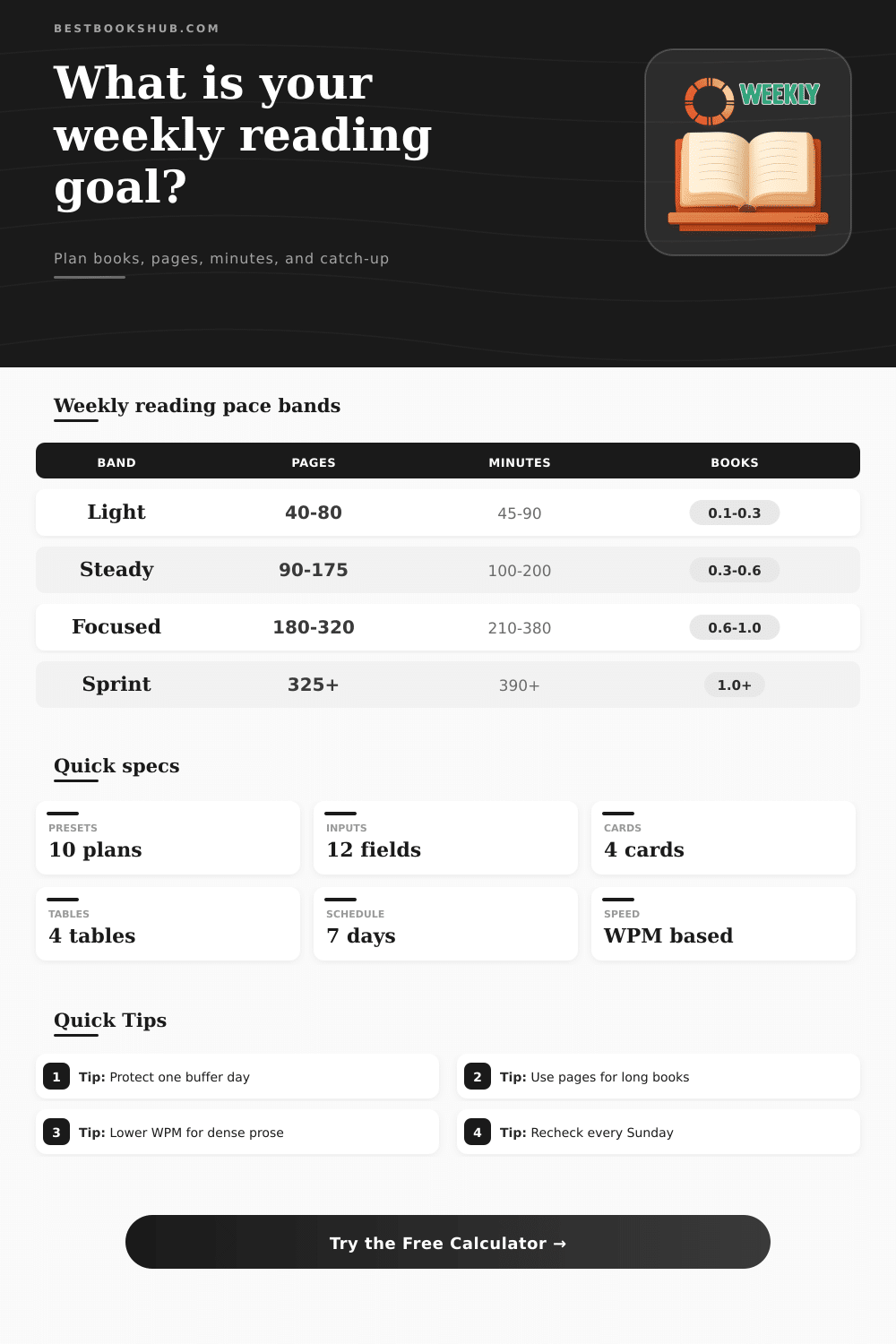
This is laid out in the reference tables on the page, showing the pace bands for various levels of commitment. Eighty or even just 40 pages might seem like a small reset, but it resets momentum if you’ve been away from it. Three-hundred-plus pages is great when doing a sprint burst, but not sustainable for the long run. It’s less about going for a big number and more about knowing what band you’re currently working at based on your life stage.
Each Sunday evening before the next week starts, reassess your level of energy and available hours. Adjust the inputs to match. If you missed some days, don’t punish yourself by going into an all-nighter. Instead, gently adjust the catch-up intensity. Go easy on yourself. Don’t fight the numbers; let them tell you how hard to work. Rest when you need to and don’t be afraid to go slow at first.
This isn’t about increasing the number of books you read. This is about finding a pace that will work through the madness of real life. Once you learn to work with a flexible plan instead of fighting an unrealistic schedule, reading stops feeling like a chore. It starts feeling like something solid you can rely on as part of your day. And that’s worth far more than any number of pages.