Library Deadline Planner
Overdue Book Pace Calculator
Turn pages left, reading speed, deadline pressure, and session length into a daily catch-up plan for an overdue or almost-overdue book.
📌Pick a Reading Scenario
📖Book Progress
⏱Deadline and Reading Time
📊Reading Pace Reference
📑Daily Catch-Up Table
| Pages Remaining | 2 Days Left | 5 Days Left | 10 Days Left | At 40 Pages/Hour |
|---|---|---|---|---|
| 120 pages | 60 pages/day | 24 pages/day | 12 pages/day | 3 hours total |
| 240 pages | 120 pages/day | 48 pages/day | 24 pages/day | 6 hours total |
| 360 pages | 180 pages/day | 72 pages/day | 36 pages/day | 9 hours total |
| 520 pages | 260 pages/day | 104 pages/day | 52 pages/day | 13 hours total |
| Book Type | Typical Pace | Adjustment | Best Session | Deadline Note |
|---|---|---|---|---|
| Light fiction | 45-70 pages/hour | Fast skim-safe prose | 25-45 minutes | Good for short catch-up windows |
| Standard novel | 30-45 pages/hour | Use your actual pace | 30-60 minutes | Works well with daily targets |
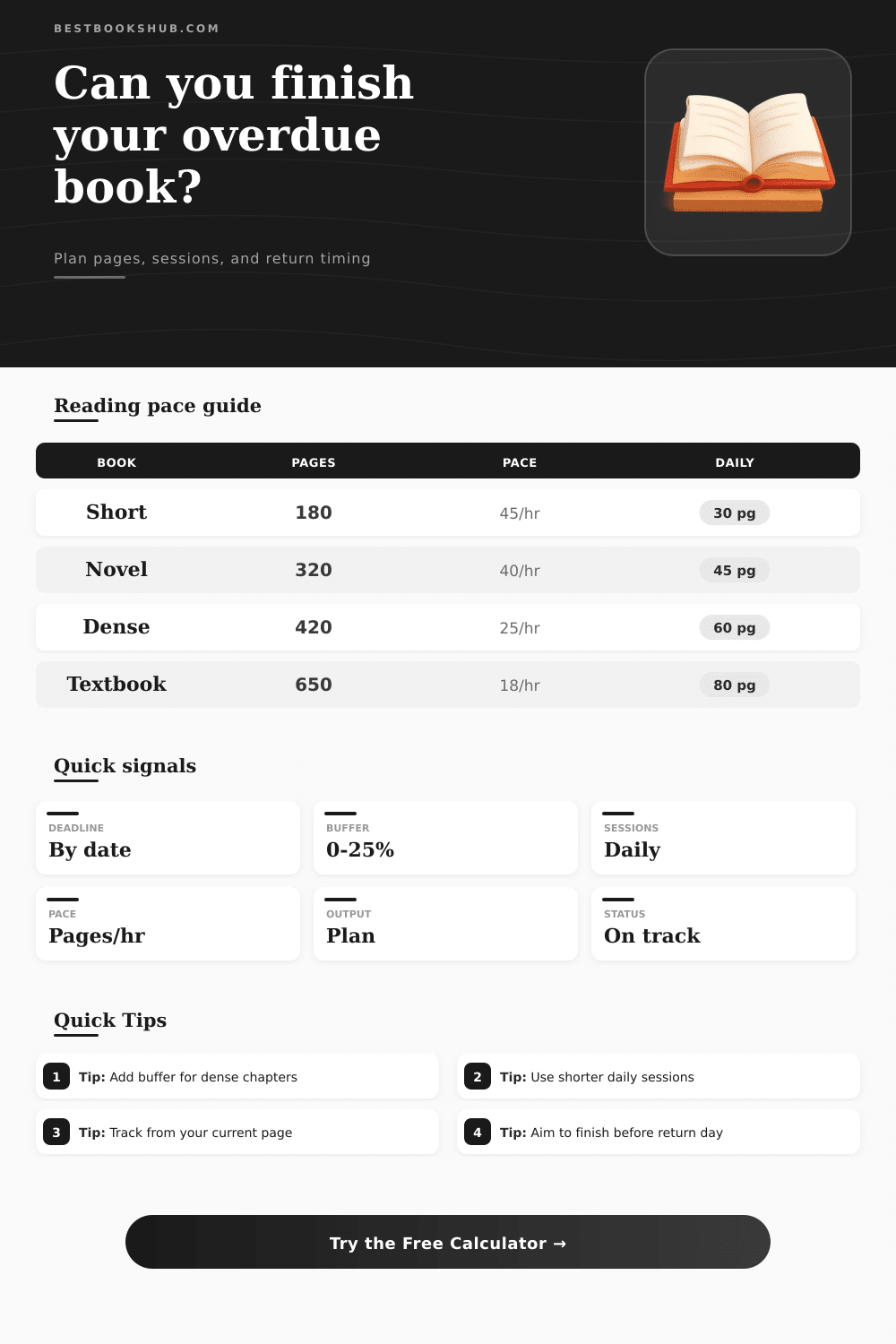
| Dense nonfiction | 18-30 pages/hour | Add 10-20% buffer | 20-40 minutes | Plan slower end chapters |
| Academic text | 12-24 pages/hour | Add 20-35% buffer | 20-30 minutes | Separate reading from notes |
| Graphic novel | 70-120 pages/hour | Reduce if text-heavy | 20-45 minutes | Often finishable in one sitting |
| Scenario | Pages Left | Days Left | Daily Pages | Daily Minutes |
|---|---|---|---|---|
| One overdue weekend | 180 | 2 | 90 | 120-180 |
| Class discussion week | 260 | 5 | 52 | 80-125 |
| Renewal grace period | 320 | 7 | 46 | 65-100 |
| Long classic push | 540 | 14 | 39 | 75-130 |
✍Planning Notes
DISCLOSURE: This post may contain affiliate links, meaning when you click the links and make a purchase, I receive a commission. As an Amazon Associate I earn from qualifying purchases.
One Thursday evening, you get a notice from library: It’s time to pick up your copy of the book you’ve had lying around on your nightstand for three weeks now. You flip through to see how many pages remain, and you feel a knot form in your gut. Whether you’re usually an organized person or not, this happen to all of us. Deadlines collide, life gets in the way, and what was meant to be a relaxing read turn into a logistical puzzle.
Sometimes, it’s not even about how much is left to read. It is more about wondering if you will finish before it is too late. If we can replace hope with arithmetic, then a systematic method will trump last-minute skimming. You don’t have to read faster. You simply want to know what speed is fast enough.
How to Finish Your Book Before the Deadline
People underestimate how fast they go based off their peak performance. If they remember the weekend they devoured a mystery novel (while drinking coffee), then that’s how fast they think they’ll go during a hectic workweek. Unfortunately, reality have other plans. There are distractions and tired eyes and long blocks of text that demand extra brain power.
A concrete plan accounts for all those details… Which is why you use a calculator. Plug in your deadline and number of remaining pages, and let the calculator do the math. Let it force you to face the fact that your day only contains so many minutes, not a hazy notion of someday reading if there’s time. For most people, it’s the initial change that gets them to finish line on schedule.
Take into account how thickly written it is. Fiction moves along more quickly than non-fiction, and a textbook isn’t going to be as breezy as a novel. With this tool, you can pick the format. That, in turn, will affect the right rate of reading. While you may be able to read thirty pages of fiction within an hour, you might need to devote that time to just fifteen densely-written pages of difficult-to-digest history.
Without considering this distinction, your plan might seem doable on paper but impossible in real life. You’ll end up spending twenty minutes staring at the same paragraph, because there’s no way that pace ever could of been sustainable. The 10% buffer is less about surrendering, and more about recognizing what you’re dealing with. This cushion transforms an incredibly tight squeeze into something you can handle, letting you breathe through the tougher parts without slipping behind.
The duration of each session matter too. You get less value if you’re trying to force-feed yourself two hours of reading all at once. Typically it’s better to break up your study sessions into smaller chunks, not only will you retain what you learn better this way, but you’ll be able to endure longer periods of time without losing concentration.
For example, look at the daily catch-up table above. When you spread out your page count over several days, the pressure decrease on each individual study session. A goal of forty pages a day looks different than an expectation of one-hundred pages in a single evening. The former encourages consistency; the latter encourages procrastination. You’re much more likely to follow through when the commitment is for twenty-five minutes of focused work instead of a marathon session.
Here’s one way I find helpful: Approach reading as if you were preparing for a race. Would you attempt to run a mile cold? No, you would warm up and check your readiness. In the same way, reading is an exercise of the mind; treat it accordingly. Mark out the tough spots in advance and dedicate extra time to them. Accept that some days are going to be better or worse and factor that change into the plan.
It doesn’t matter how well you read the thing, only that you do. Break the intimidating mountain of unfinished books into tangible goals you can complete each day. Shift the mental load from “here’s this huge thing I haven’t done” to “I’m doing this right now,” turning this chapter, and then this one, and so on, until I reaches the last page.