📚 Study workload planner
Textbook reading time calculator
Estimate textbook reading hours from pages, word density, pace, chapter difficulty, note-taking style, rereads, and your available study sessions.
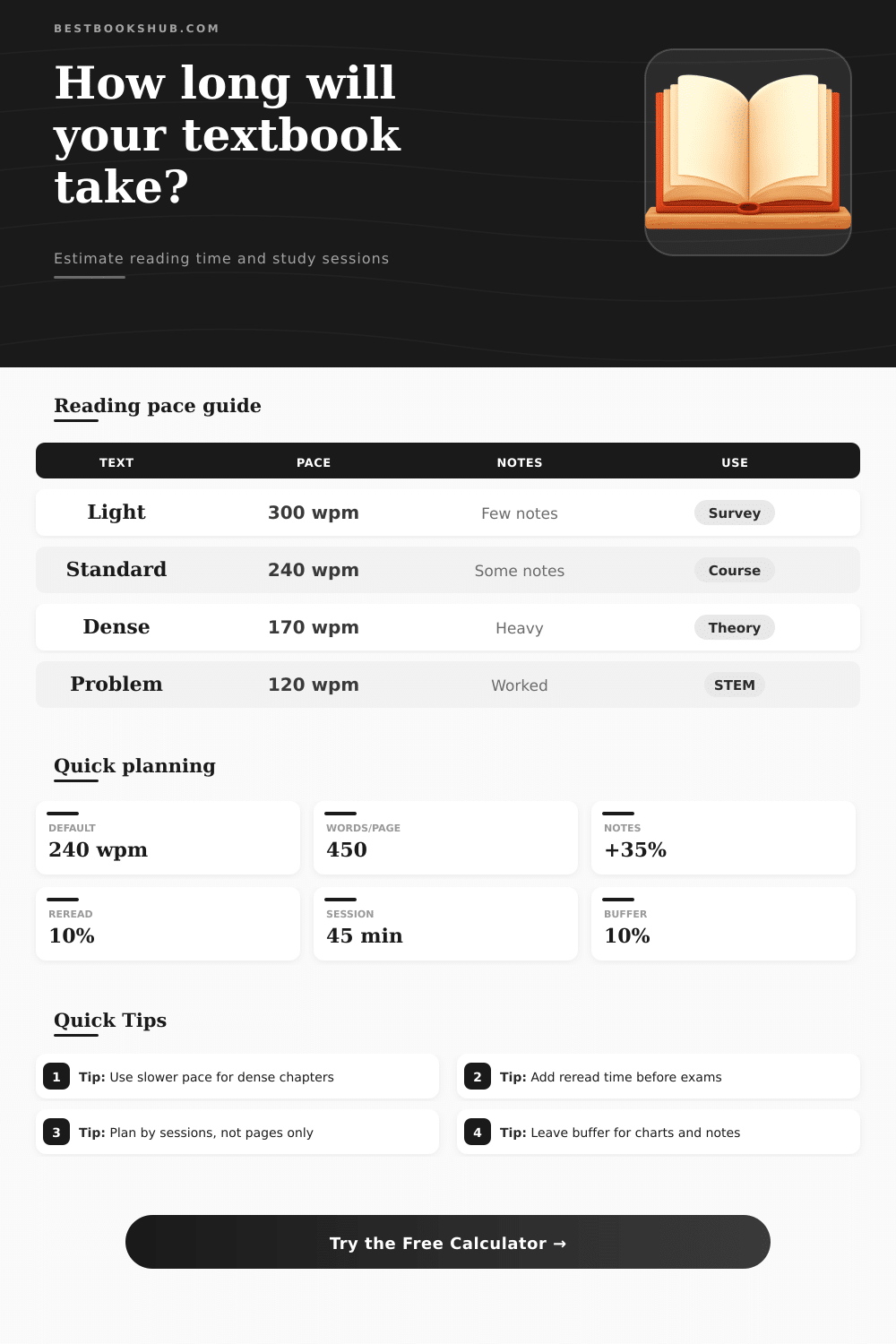
| Textbook page type | Typical words/page | Best calculator setting | Why it changes time |
|---|---|---|---|
| Visual-heavy intro chapter | 250 to 350 | 300 words/page | Images, sidebars, and review boxes lower the word count but may still need pauses. |
| Standard college textbook | 400 to 500 | 450 words/page | Most paragraph-heavy textbooks fall near this planning range. |
| Dense humanities or theory text | 550 to 650 | 600 words/page | Longer paragraphs and fewer visuals increase reading minutes per page. |
| Small-print professional reference | 700 to 850 | 750 words/page | Compact layouts make each printed page carry more reading load. |
| Study method | Multiplier | What it includes | When to use it |
|---|---|---|---|
| Read only | 1.00x | Continuous reading without written notes. | Light review, background reading, or first survey pass. |
| Highlight key points | 1.15x | Brief marking and occasional pauses. | Assignments where recall is useful but not tested deeply. |
| Margin notes or outline | 1.35x | Short summaries, terms, and chapter structure notes. | Most graded course readings and discussion prep. |
| Cornell notes or summaries | 1.55x | Organized notes, questions, and after-reading recap. | Exam-heavy courses or long retention goals. |
| Worked examples or problem checks | 1.85x | Solving examples, pausing at formulas, and checking answers. | Math, science, programming, accounting, and logic chapters. |
| Assignment size | Assumption | Estimated time | Session plan |
|---|---|---|---|
| 30 page weekly chapter | 450 wpp, 240 wpm, notes | About 1.4 hours | Two focused 45 minute sessions. |
| 80 page history unit | 550 wpp, 220 wpm, outline | About 4.5 hours | Six 45 minute sessions across the week. |
| 50 page technical chapter | 600 wpp, 140 wpm, worked examples | About 7.3 hours | Ten 45 minute sessions with breaks. |
| 250 page exam review | 450 wpp, 240 wpm, 35% reread | About 12.1 hours | Sixteen 45 minute sessions before exam week. |
DISCLOSURE: This post may contain affiliate links, meaning when you click the links and make a purchase, I receive a commission. As an Amazon Associate I earn from qualifying purchases.
Maybe this means starting out with an ordinary-looking assignment from the syllabus. Sure, reading 30 pages of history isn’t going to kill me. Or maybe 50 pages of intro psych? No problem, until you actualy try to read it.
That’s when the truth hits: There’s a big difference between browsing a news site or scrolling through social media and reading a textbook. What appears as easy reading become a mental burden, and suddenly you’re attempting to digest complicated ideas while your brain battles for focus.
How to Plan Your Study Time Well
By plugging in your preferences and page counts into the calculator above (which does all the math for you), there’s no need to guess what your week look like. Students is notoriously bad at underestimating their workloads. They figure they’ll read the same amount per minute every single time, ignoring the fact that their reading speed change a lot depending on study goals and how much information is in the text.
A page may have three hundred words on it. If there are many images, diagrams, and sidebars, that visual-heavy chapter slow you down just as much as a paragraph-filled one would. You will pause between each image, which slows your pace. This calculator lets you input both your reading speed and the average number of words per page. It accounts for these variations so you can get a clearer idea of just how long it will take to complete.
But speed itself isn’t a useful measure unless you factor in depth. If you’re skimming for a general overview, you might plow through three-hundred words-per-minute without skipping a beat. If you’re studying for an exam, though, you’ll pause, annotate, double-check your understanding (slowing down a lot). Doubling your time-investment may well make the difference between mastering something and merely previewing it. And this isn’t laziness; it’s price of retention.
There’s also another dimension which lots of planners don’t even think about: note-taking. While highlighting can be quick (but might not help you remember things for long), if you’re working through examples or writing out structured notes, then you has to really engage with the material and burn some brainpower. This cost is shown in an honest way by the planner’s multiplier settings. Writing out solutions or taking Cornell notes mean more than just reading, it means building knowledge.
And if you don’t adjust for that then your plan looks effortless on paper, but doesn’t go well when you actualy try to study, leaving you scrambling and running late.
There is a true hidden cost to rereading, especially before midterm exams. I could read a chapter in September and feel confident that I had it down cold. Fast-forward three weeks and the same chapter seem totally foreign when I see it on the test. By building in some extra time for review, you won’t need to nail it the first time around, which leaves time to shore up weaknesses before the big day, not by cramming, but at your own pace. You will feel panic-free rather than stressed like during exam week. Sounds like a waste of time while you’re planning, but it’s worth its weight in gold when it comes time for the test.
Because humans have limited attention span, session duration is also important alongside total study volume. It’s rare that pushing through several hours of concentrated material at once are effective, particularly when it comes to theory. A more balanced approach involve breaking up the effort into digestible chunks mixed with brief pauses to help sustain quality over quantity. The planner will distribute the overall time into sessions according to your availability, giving you a realistic daily target instead of an overwhelming weekly goal. This distributes the burden evenly around your calendar so you don’t burn out. This distributes the burden evenly around your calendar so you don’t burn out.
Reading should be approached as any other task that demands time and resource management. Adding in buffers for especially difficult material, note taking methods, review requirements, etc. This allows room for surprises and for difficult passages that might take more time than planned. With that knowledge, planning becomes easier and what was once an open-ended chore turns into a series of solvable problems.
Knowing how much effort will go into the assignment up front gives you control over your schedule because you know before it’s too late. It turns uncertainty into a manageable system so you don’t have to worry about completing it, you could of actually get down to learning.