📖 Study reading planner
Study Reading Pace Calculator
Plan academic reading by pages, words, deadline, note-taking load, session length, and realistic study pace for different material types.
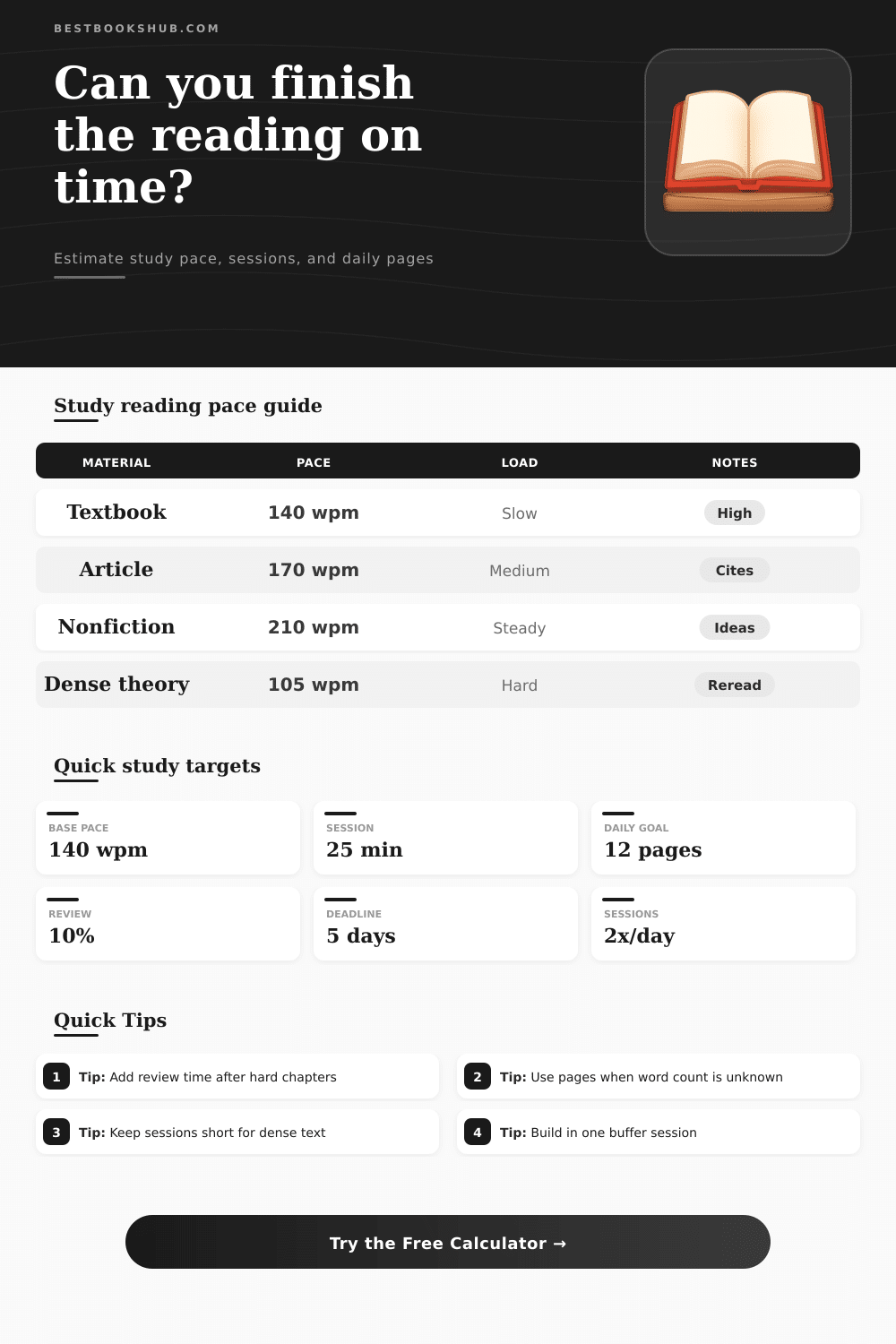
| Material type | Planning pace | Best used for | Study adjustment |
|---|---|---|---|
| General nonfiction | 210 words per minute | Clear explanatory books, popular research, essays | Use light notes or 5% review buffer |
| Textbook chapter | 140 words per minute | Assigned chapters with terms, examples, figures | Use 10% to 25% note time |
| Academic article | 170 words per minute | Journal articles, methods sections, literature reviews | Use 10% buffer for citation checks |
| Dense theory | 105 words per minute | Philosophy, critical theory, advanced primary sources | Use 25% to 40% note time |
| Technical manual | 120 words per minute | Code docs, procedures, math-heavy explanations | Use short sessions and 15% buffer |
| Casebook or law reading | 95 words per minute | Cases, holdings, issue spotting, legal notes | Use 40% annotation time |
| Language learning text | 80 words per minute | Second-language passages and vocabulary-heavy study | Use 30% review buffer |
| Review skim | 260 words per minute | Previously read chapters and exam refreshers | Use no extra notes unless extracting quotes |
| Study session | Textbook pages | Academic article words | Dense reading words |
|---|---|---|---|
| 20 minutes | 6 pages at 450 words/page | 3,400 words before notes | 2,100 words before notes |
| 30 minutes | 9 pages at 450 words/page | 5,100 words before notes | 3,150 words before notes |
| 45 minutes | 14 pages at 450 words/page | 7,650 words before notes | 4,725 words before notes |
| 60 minutes | 19 pages at 450 words/page | 10,200 words before notes | 6,300 words before notes |
| Reading task | Typical size | Planning assumption | Estimated focused time |
|---|---|---|---|
| Short journal article | 6,000 to 8,000 words | 170 wpm plus 10% review | 39 to 52 minutes |
| Textbook chapter | 30 to 45 pages | 450 words/page at 140 wpm | 1.8 to 2.7 hours |
| Seminar packet | 80 to 120 pages | Mixed article and theory pace | 6 to 10 hours |
| Casebook assignment | 25 to 40 pages | 95 wpm plus close notes | 3 to 5 hours |
| Exam reread block | 120 pages familiar text | Review skim at 260 wpm | 3 to 4 hours |
DISCLOSURE: This post may contain affiliate links, meaning when you click the links and make a purchase, I receive a commission. As an Amazon Associate I earn from qualifying purchases.
These are the reading assignments. Reading assignments is usually approached optimistically. Oh yeah, I have 40 pages here. Shouldn’t take me more than an hour, right? I will finish it before dinner.
And then you get to page three and realize the author is using thick layers of theoretical jargon. Damn. Now you have to go through this at half your usual pace. The gap between estimated work and real work are where academic anxiety lives. The reading isn’t what stresses you out. It’s the fact that you didn’t include the friction of understanding.
How to Plan Your Reading Time
Preparing for the future turn frantic cramming into bite-sized chunks. With that input (either word count or page count), the calculator do the math for you. No more guesswork about how many words is in x amount of pages; no need to remember coefficients and conversions. More importantly, it lets you understand what these inputs mean within a particular study session.
Your reading speed isn’t constant, like your height. Rather, it changes dramatically based off both your level of engagement with the material and its overall density. For example, a history book may go by in double digits (two hundred words per minute) as the narrative pulls you along. On the other hand, a legal casebook or philosophy text require active decoding, slowing you down below a hundred words per minute as you unpack complex arguments.
Take notes during your reading: Think of this as a part of your reading process; not something you do afterward. Highlighting/annotating burns clock time. Your tool can account for that with a percentage buffer. Twenty-five percent for in-depth notes isn’t excessive if you intend to recall something on the initial pass. That’s the missing piece for many people. Their math stops at pure reading time, without considering the necessary work of comprehension.
Ignoring reality will ruin your schedule. Plan for the mental effort required or your schedule will fall apart. How long is a session? How many minutes or hours do I need? Attention span are a limited resource for humans. Diminishing returns set in when trying to cram six intense hours of intense theory into one marathon go. After some point your brain shuts off; better to break it up with focused blocks and reset.
That’s where the calculator comes in: it will spread out the load over time and space (sessions & days). A goal of twelve pages-per-day sounds reasonable. A goal of one-hundred-twenty pages over five days sound unreasonable. It is the same amount of work, just in a different frame.
Your starting point for speed will come from the material. Nonfiction in general is easy. Primary source documents or technical manuals are slower. This chart is easily accessible on the page, laying out the material types. Take these as a jumping off point and change from there depending on your own experience.
If you’re having to go back and read sentences three times before you understand what they mean. Slow down some more. Mastery isn’t about getting through fifty pages at one time; accuracy is more important. It’s better to go over twenty pages thoroughly then to go through forty quickly only to have to learn it all again tomorrow.
You’ll need buffer time to protect yourself from the realities of life. Even the best-laid plans can be derailed by unexpected mental fatigue, assignment changes, and other factors. When this happens, add a review buffer of ten to fifteen percent, which will keep you from falling behind. I’m not being pessimistic, I’m just realistic. Slack makes your plan bend, but a rigid plan that has no slack break at the first hint of stress.
Enter your available study hours and deadline. Have the tool display whether your pace is sustainable. See? You’ll need to adjust your inputs. Maybe by reducing your session length or skimming less important sections. You have to cut corners on something important, or maybe you can increase your speed beyond what’s humanly possible. Adjust your inputs accordingly. Shorten your sessions to force more days, or accept that you’ll need to skim less important sections.
Clarity is the objective. Give yourself a clear understanding of where you stand and smartly make tradeoffs rather than guess in the dark. Planning is a strategy; reading is a skill. Respect both equally. Manage your reading time. Ditch the dread, because knowing roughly how long something will take to get through means you will not only read it, but you will also read it efficienty. Numbers makes anxiety go away. You map out the path, and now you face the work.