📝 Annotation planning desk
Annotation time calculator
Estimate how long it will take to read, highlight, margin-note, summarize, and review a book chapter, article, or research packet.
| Material type | Speed factor | Best use | Typical pace |
|---|---|---|---|
| Novel or memoir | 1.05x | Character notes and themes | 16-28 pages/hr |
| General nonfiction | 0.95x | Argument and evidence notes | 12-22 pages/hr |
| Textbook chapter | 0.78x | Definitions, examples, diagrams | 8-16 pages/hr |
| Journal article | 0.72x | Method, findings, citation notes | 6-14 pages/hr |
| Dense theory | 0.55x | Concept mapping and claims | 4-10 pages/hr |
| Primary source | 0.68x | Context, quote, and source notes | 6-12 pages/hr |
| Legal or policy text | 0.50x | Clause tracking and cross-reference | 3-8 pages/hr |
| Draft manuscript | 0.85x | Comment pass and revision flags | 10-18 pages/hr |
| Annotation depth | Reading adjustment | Note density | Review buffer |
|---|---|---|---|
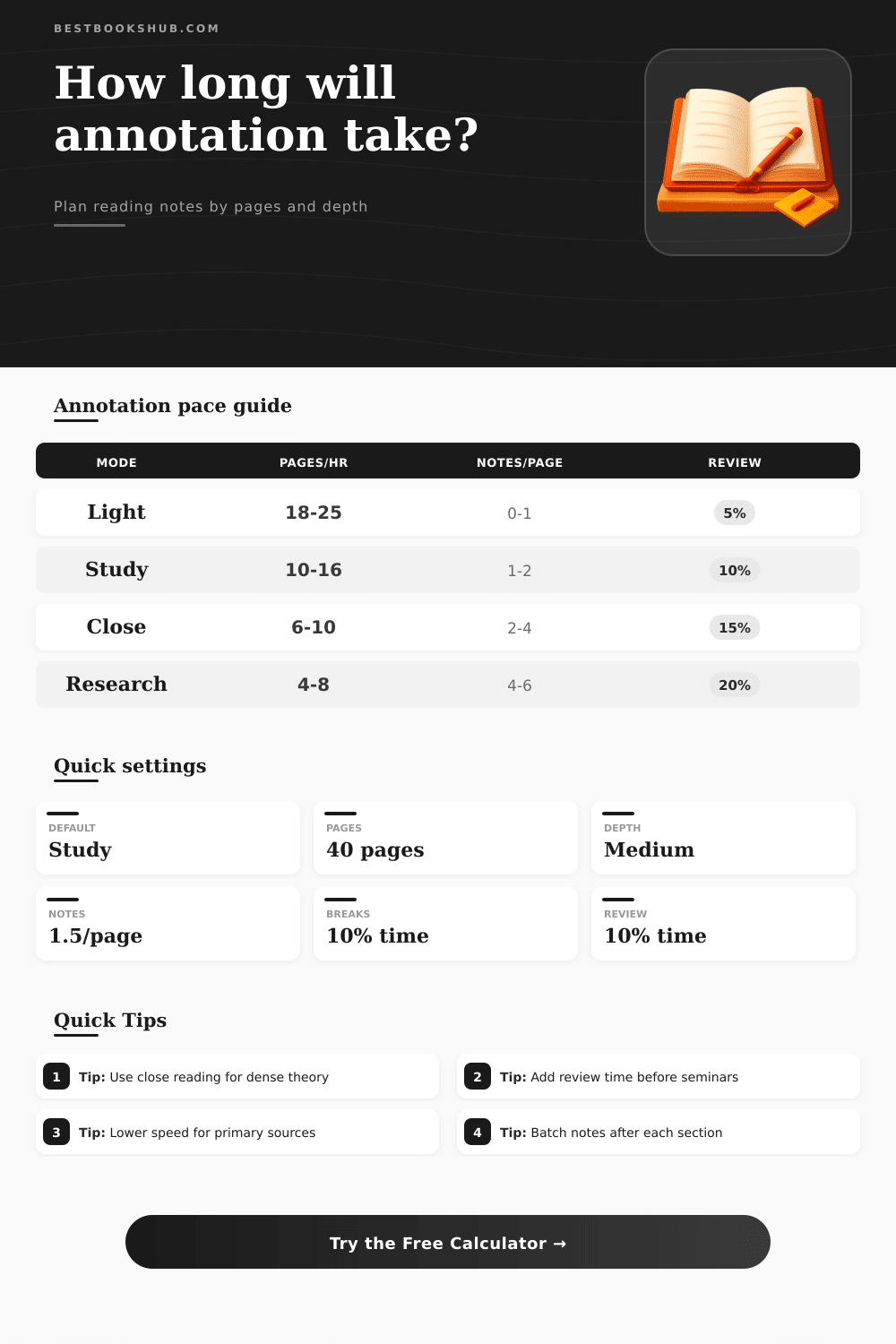
| Skim marks only | 1.20x faster | 0-0.5 notes/page | 0-5% |
| Light highlights | 1.05x baseline | 0.5-1 note/page | 5-8% |
| Study annotations | 0.88x baseline | 1-2 notes/page | 8-12% |
| Close reading | 0.68x baseline | 2-4 notes/page | 12-18% |
| Research extraction | 0.55x baseline | 4-6 notes/page | 18-25% |
| Reading task | Pages | Depth | Typical time |
|---|---|---|---|
| Discussion chapter | 25-35 | Study | 2-3.5 hours |
| Seminar packet | 60-90 | Close | 8-14 hours |
| Journal article | 18-30 | Research | 2.5-5 hours |
| Textbook unit | 35-55 | Study | 4-7 hours |
| Exam reread | 80-120 | Light | 5-9 hours |
DISCLOSURE: This post may contain affiliate links, meaning when you click the links and make a purchase, I receive a commission. As an Amazon Associate I earn from qualifying purchases.
When you open up your pile of readings before bed, you gets panicked. You glance at number of pages. Then you mentally subtract amount of time you’ll need to write notes in the margin. And then you remember that you’ve already missed your plan for the night.
I’m pretty sure most of us underestimate just how slow we’re going to go. Annotating takes a whole separate kind of mental effort and it isn’t simply eyeballs tracking along some text. Once you input pages you want to annotate and level of detail you want, this calculator will do all the work. No conversions, no guesses, no coefficients required.
How to Plan Your Reading Time
But here’s the main point: Students lumps everything together into one reading category. They believe a chapter from their textbook requires the same number of minutes-per-page as a novel. It doesn’t. In study-mode, you’re decoding an argument; in novel mode, you’re following a narrative. To account for this, the tool allow you to choose different kinds of materials (e.g., journal articles vs. Dense theory). You can then assign speed factors that slows you down based off how quickly you’ll read each item. Because every sentence has weight and you can’t skim past it, a dense theoretical passage will move at half-the-speed of a memoir. So yes, that distinction matters more than straight-up page counts.
Most plans breaks down at annotation density. Highlighting key phrases? That’s a few seconds a mark. You might question the author’s logic or write marginal notes summarizing the paragraph. That’s a few minutes. Be honest with yourself on seconds per note and notes per page. Four thoughtful comments per page isn’t reading any more; it’s drafting. See what happens when you crank up the note density in the tool. Total time will balloon and surprise you… And that’s good, because it’ll force you to pick between doing fewer pages well vs. More pages poorly.
Review passes and breaks is silent killers. It’s easy to forget our brains can only focus for so long before they need to rest. A ten percent break buffer is not laziness, it’s realism. Your brain will zone out. You’ll get thirsty. That’s where the calculator steps in with some automatic time to add to your final estimate. And a review pass allow you to really take advantage of what you’ve marked. If you’re going into an exam or seminar, having that additional percentage for review is key because otherwise highlighting is nothing more than coloring! It turns passive marking into active recall.
To make sense of those numbers, there are reference tables that come with the tool that give context to the estimates. It illustrate how many pages per hour you can typically expect at various levels of engagement. Close reading might drop it down to maybe six pages an hour, while light highlighting might allow you to fly through it and get 20 pages an hour. Both aren’t wrong. They’re simply different goals. The key is understanding exactly what you need to do your task. Are you trying to pass a test? Or are you writing a paper on this source? Your natural reading speed doesn’t matter as much than how deeply you choose to read.
Take a look at the suggested session split when you run your numbers. If you have a lot of days to play with, it breaks down the entire amount of time into chunks that are more manageable. This will help you resist cramming it all into one late night. The less stressed you are, the better you’ll do and the more you’ll retain from it. For instance, maybe a 40-page assignment calls for three 50-minute sessions total. That looks daunting until you realize it means you’re done for the day after exactly three 50-minute study sessions. It’s kind of liberating, if anything; you know the exact moment to shut up shop.
This is not rigidity. This is margin for error. This is planning your annotation time around the fact that there’s no such thing as a perfect schedule. If you try to have one, you should of not expected to succeed. Instead, recognize the cognitive cost of reading and taking notes, build in a buffer for yourself, and let that buffer save you when interruptions happen. By visualizing the cost at the start, the tool lets you turn your anxiety into an equation with a solution: lower the page count, trim the depth, whatever it takes for the estimated time to fit within your window.
All of this points to a simple truth: Better planning makes for better learning. You’re not rushing to fill out the last few pages and instead have time to really interact with the ideas. You stop skimming for keywords and instead understand the argument. The point of reading isn’t to get through it… It’s to make the reading stick. You protect your capacity to do deep work by accounting for actual time needed to review, mark up, and process the material. You’re giving yourself permission to slow down in order to make sure you remember what you learn.